topnav

Home Issues & Campaigns Agency Members Community News Contact Us

Community News

Open dialogue among community members is an important part of successful advocacy. Take Action California believes that the more information and discussion we have about what's important to us, the more empowered we all are to make change.

Monday, December 21, 2015

California adds just 5,500 jobs in November; unemployment rate declines to 5.7%

California employers added just 5,500 jobs in November, according to federal data — a significant slowdown from more robust monthly gains earlier in the year.
But the state unemployment rate continued its five-year-long decline, dropping to 5.7% in November, the lowest in eight years. The U.S. unemployment rate is 5%.
November's tepid job increases were the lowest one-month jump in more than four years, and far less than the 40,600 job gains the state posted in October.


But economists cautioned against reading too much into monthly swings in the employment data, which often are subject to revisions. September's numbers, for example, were revised upward from 8,200 positions to 21,100 jobs.
“We're reading the economy on the fly,” said Robert Kleinhenz, chief economist for the Los Angeles County Economic Development Corp. “That's just the nature of these economic statistics.”
Despite the lackluster November, California's payroll employment grew 2.6% over last year, faster than all but six other states and better than the national rate of 1.9%.
Construction continued to be the leading growth sector, as the industry continues to rebound from the housing crash. The high-paying professional and technical services industry — including lawyers, accountants, architects and engineers — also recorded some of the fastest job growth in the state.


The only industries to post losses were mining and logging, along with manufacturing and financial services.
The state unemployment rate is down significantly from a year ago, when it stood at 7.2%. The jobless rate is often criticized as an incomplete economic indicator because it doesn't count discouraged job seekers who have dropped out of the labor force.
Some of those who stopped seeking employment may be returning to the labor force, which has expanded over the last year even as unemployment fell. That suggests newly returned job seekers may be finding success.
Economists say job growth tends to taper off as an economic expansion progresses. The U.S. is technically in the seventh year of expansion.
Although California's economic growth has outperformed the nation, there are still reasons for many people to believe their fortunes have not improved.
The gap between high and low earners is more pronounced in California because wages for middle-income earners have fallen.
Since 2006, median wages have declined 6.2% in California, compared with 1.9% for the U.S. overall, according to the California Budget & Policy Center.


And while the share of part-time workers has declined since the depths of the Great Recession, that segment of the workforce is still larger than in the mid-2000s. About 5.9% of workers in California are considered part-time for economic reasons — meaning that they are unable to find full-time work.
That's down from 9.6% of the workforce in 2010, but still higher than when the economy last peaked in 2006.
“We don't want to miss the point that we are in one of the better times, employment-wise, in the last 40 years in California,” said Michael Bernick, a former director of the California Employment Development Department. “But at the same time, these numbers don't represent a lot of the instability: the part-time, contingent nature of the evolving labor market.”
Via Chris Kirkham, Los Angeles Times
http://www.latimes.com/business/la-fi-california-jobs-20151218-story.html

Friday, December 18, 2015

Poverty Hitting One in Six Californians


The economic recovery in California has not reached a sizable percentage of the population, with more than 16% of Californians living in poverty, according to an analysis released Tuesday by the California Budget and Policy Center.
In most California counties, the poverty rate increased from 2007 to 2014. Of the 40 California counties with available data, 32 had higher poverty rates last year than they did in 2007 before the state's recession began, the study said.
The California Budget and Policy Center is a not-for-profit that conducts independent, nonpartisan budget analysis.
"Millions of Californians continue to struggle to meet their basic needs, even after several years of steady job gains," the study said. "Poverty remained widespread even though the state's unemployment rate declined from a high of 12.2% in 2010 to 7.5% in 2014."
The federal poverty line is about $19,000 for a family of three. The overall rate fell slightly between 2012 and 2014 -- by 0.6% -- but the 2014 level of 16.4% is a full 4 percentage points higher than it was in 2007.
The study highlighted the differences between counties:
  • Not only was the poverty rate higher in 32 of the 40 counties with available data from 2007 to 2014, but there was no statistically significant difference in poverty rates in the other 8 counties;
  • In Lake County, the poverty rate rose to 25.9% of the population. In Kings County, 26.6% live in poverty;
  • In Lake, Kings and San Bernardino counties, the poverty rate jumped by more than 8 percentage points from 2007 to 2014; and
  • In 15 other counties, poverty rates in 2014 were 4 to 8 percentage points higher than in 2007. Most of those counties are in the Central Valley and in the Sacramento region.
"Many factors could contribute to the uneven recovery across California's counties," fact sheet author Alissa Anderson wrote. "These include differences in the availability of well-paying jobs and/or of sufficient work hours, as well as changes in county demographics, such as whether large numbers of people who struggle to get by move into a county."

By David Gorn
Via http://www.californiahealthline.org/capitol-desk/2015/12/poverty-hitting-one-in-six-californians

Wednesday, December 16, 2015

California Voters May Get to Choose Between Two Different Death Penalty Related Ballot Propositions

Faster Executions or None at All? Californians May Get to Choose

If there’s one thing supporters and opponents of the death penalty can agree on, it’s this: The system is broken. Since California reinstated capital punishment in 1977, 117 death row inmates have died. But only 15 of them have been executed. The vast majority have died of natural causes or suicide.

When he was chief justice of the California Supreme Court, Ronald George caused a stir when he said “the leading cause of death on death row in California is old age.” The system, he said, is dysfunctional  — and few would disagree.

Even before a federal judge blocked executions in 2006, the pace of implemented death sentences was slow. It wasn’t unusual for condemned inmates to spend two decades on death row, as their legal appeals slowly wound through the courts. But to death penalty opponents, the seemingly endless delays prove that capital punishment is unworkable and should be scrapped altogether.To death penalty supporters, that delay is a travesty of justice and disrespectful to crime victims and their families who, they say, deserve to see the ultimate sentence implemented.

Come November, California voters could have two completely different options for fixing the system. Two groups are preparing to collect signatures for ballot measures that would present stark choices.

One, the Death Penalty Reform and Savings Act of 2016, would limit inmate appeals, which can drag on for decades, and expedite executions. It would also give the California Department of Corrections and Rehabilitation more latitude in housing condemned inmates and require them to work, with 70 percent of their wages going to crime victims.

The other proposal, which ballot measure proponent Mike Farrell calls “The Justice That Works Act of 2016,” would ban executions altogether and convert all existing death sentences to life in prison without the possibility of parole.

The Death Penalty Reform and Savings Act of 2016 is current being reviewed by the Attorney General’s Office. A similar measure was proposed last year and endorsed by three former California governors. It never made it to the ballot.

An attorney advising proponents of the current death penalty reform measure told me that first effort was “controlled by crime victim families,” suggesting it didn’t have the kind of professional political consultants needed to make it to the ballot.

This time around, he said, Sacramento-based strategist Aaron McLear and his firm, Redwood Pacific, will guide the effort.

This week the nonpartisan Legislative Analyst’s Office released its fiscal review of that measure. While acknowledging the measure would affect various costs, “the magnitude of these effects would depend on how certain provisions in the measure are interpreted and implemented,” the LAO wrote.

In conclusion, it wrote:
  • Increased state costs that could be in the tens of millions of dollars annually for several years related to direct appeals and habeas corpus proceedings, with the fiscal impact on such costs being unknown in the longer run.
  • Potential state correctional savings that could be in the tens of millions of dollars annually.
  • Proponents of the measure to ban capital punishment must be more pleased with the LAO analysis of their measure. The LAO estimates a “net reduction in state and local government costs of potentially around $150 million annually within a few years due to the elimination of the death penalty.” You can be sure that will end up in a TV commercial for the measure.

  • Proponents of both measures have yet to collect a single signature. Assuming they get a green light from the attorney general and the secretary of state, they’ll have 180 days to collect the necessary signatures to put it before voters.

  • If both succeed, they’ll likely join a November 2016  ballot with measures related to legalizing pot, raising the minimum wage and strengthening gun control. All that, plus a presidential election and the race to replace retiring U.S. Sen. Barbara Boxer.
  • In other words, a political junkie’s dream come true.
By Scott Shafer
Via http://ww2.kqed.org/news/2015/12/14/faster-executions-or-none-at-all-california-voters-may-choose

Monday, December 14, 2015

California Expands Substance Abuse Treatment For Low-Income Residents

After years fighting a heroin addiction, Danny Montgomery, 33, is receiving inpatient treatment that is being paid for by Los Angeles County.


California is overhauling its substance abuse treatment system for low-income people, embarking on a massive experiment to create a smoother path for addicts from detox through recovery.
The state is the first to receive federal permission to revamp drug and alcohol treatment for beneficiaries of Medicaid, known as Medi-Cal in California. Through what's known as a drug waiver, state officials will have new spending flexibility as they try to help people get sober and reduce social and financial costs of people with substance abuse disorders.
Under the waiver, the state plans to expand treatment services, including inpatient care, case management, recovery services and added medication. Beginning next year, drug treatment centers will be able to get reimbursed for providing this much wider range of options to people on Medi-Cal.
Only a small fraction of low-income Californians with substance abuse disorders receive treatment, largely because of restrictions on what Medicaid will pay for.
"This was a long time coming," said Keith Lewis, executive director of Horizon Services, which provides treatment in San Mateo, Santa Clara and Alameda counties. "It's a win/win for people with substance use issues and their families ... and for the people providing those services."
The changes, which will be phased in starting next year, stem in part from the Affordable Care Act, which required that substance abuse treatment be covered for people newly insured through Medicaid or insurance exchanges. The health law allowed states to expand Medicaid to cover millions more people.
Drug rehabilitation providers say the changes will give addicts a better chance at getting — and staying — clean. But they fear the state won't raise the traditionally low Medi-Cal reimbursement rates for treatment, making it harder to provide services and produce the outcomes California is hoping for.
Lewis, of Horizon Services, said that under the waiver he expects drug treatment services to be higher quality and the workforce better trained. But he said that "Medi-Cal rates, which have always been too low, have to go up."
California's Medi-Cal drug treatment program currently costs about $180 million annually, paid through a combination of state and federal funds. There aren't any estimates for costs under the new approach. But the idea is that the changes will help health care expenses overall by enabling more people to get sober and healthier so they stop rotating through treatment centers, jails and hospitals.
Nearly 14 percent of Medicaid recipients are believed to have a substance abuse disorder, according to the National Survey on Drug Use and Health.
The five-year pilot project in California was approved by the federal Centers for Medicare & Medicaid Services in August. Under the waiver, counties will approve treatment for Medi-Cal patients based on medical necessity and criteria established by the American Society of Addiction Medicine.
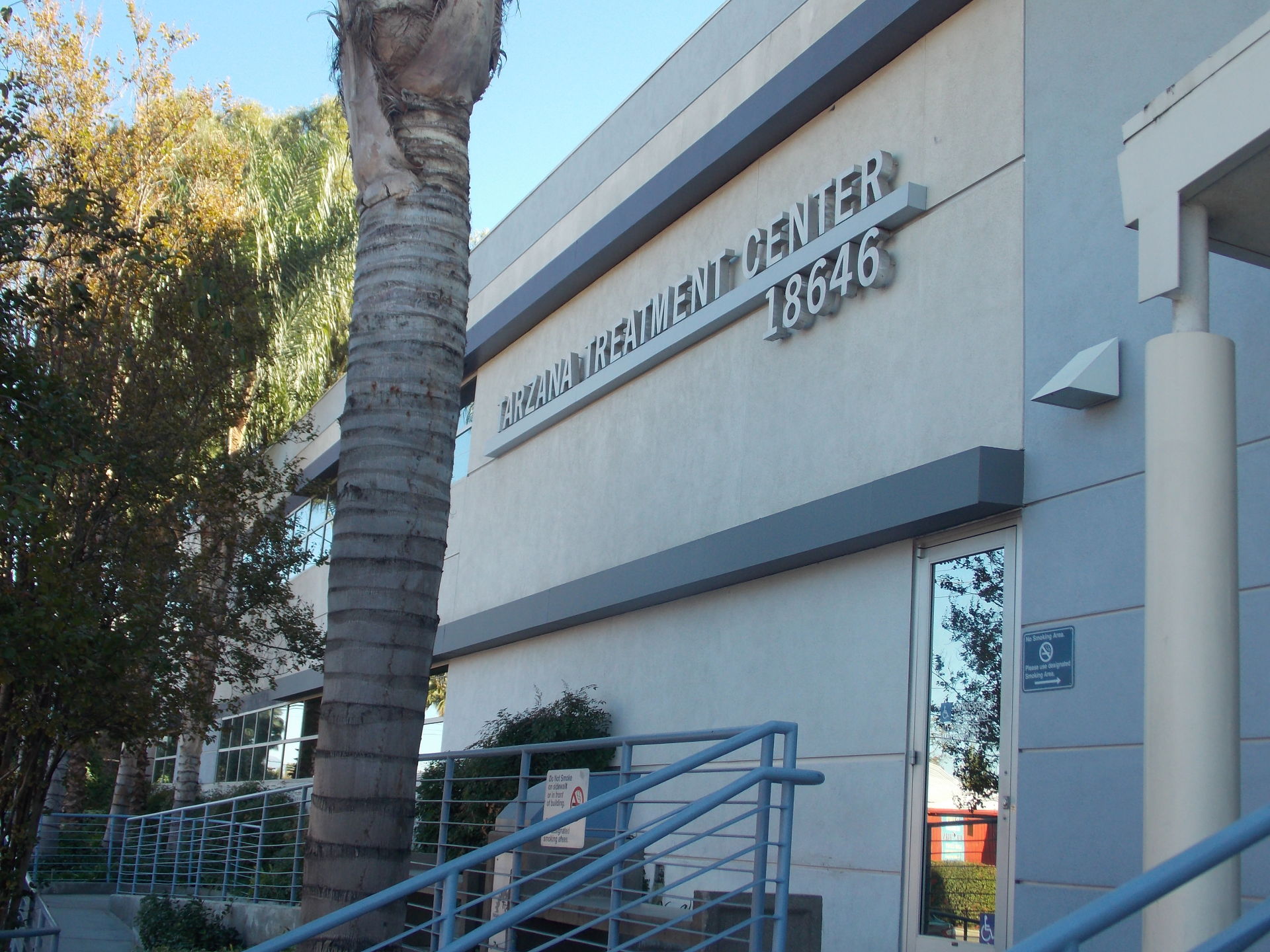
The Tarzana Treatment Centers in Los Angeles County provide outpatient and inpatient care for substance use disorders.i
The Tarzana Treatment Centers in Los Angeles County provide outpatient and inpatient care for substance use disorders.
Anna Gorman/KHN
Current federal rules limit drug treatment centers' ability to get reimbursed under Medicaid for residential care. Clinics with more than 16 beds essentially cannot get paid, except for treating pregnant and postpartum women. That restriction will be dropped for California under the waiver.
As a result, Medi-Cal beneficiaries will be able to access up to two 90-day residential stays each year, with the possibility of one 30-day extension if providers determine that it is medically necessary. Certain populations, including those in the criminal justice system, can get approval for longer stays.
The waiver is also designed to provide better coordination between physical, mental health and substance abuse services," according to John Connolly, deputy director of substance abuse prevention and control for the Los Angeles County Department of Public Health. That along with more access could result in fewer emergency room visits and hospitalizations, he said.
That's potentially good news for people like Caitlin Knoles, a resident of Orange County who says she gets turned down for treatment of her methamphetamine addiction every time she tells residential centers she's on Medi-Cal. She has ended up in the hospital more than once because of her addiction.
"It's hard," Knoles said. "I can't get help."
The only way she can reliably get clean now is in jail, she says.
"It'd be nice to have a job and have my family back and just be normal," said Knoles, 24, as she sat outside a liquor store in Laguna Hills.
For the first time, substance abuse disorders will be treated like a disease rather than a short-term illness, said Marlies Perez, chief of the substance use disorder compliance division for the state Department of Health Care Services. "Even though we know it's a chronic condition, we have treated it acutely," she said.
Much depends, however, on reimbursement rates, which are still being negotiated. Clinic officials say they need higher rates to expand services and handle the anticipated influx of clients, many of whom will be seeking rehab for the first time.
"There is a cost to raising the bar on treatment," said Albert Senella, president of the California Association of Alcohol and Drug Program Executives. "If the rates aren't adequate ... we are not going to be able to effectively meet the [new requirements] and the needs of the population."
Senella, who is also CEO of Tarzana Treatment Centers in Tarzana, Calif., said many clinics across the state don't have money to prepare for the overhaul, which will require improving technology and adding and training staff. For now, no plans are in place to provide counties or clinics with startup funds.
Eli Veitzer, interim CEO of Prototypes, which provides treatment services in Los Angeles, Orange and Ventura counties, said the waiver provides an "incredible opportunity" to transform care.
But in addition to fears about rates, Veitzer said he is also worried that 90 days of residential treatment won't be enough for many people. Someone may be able to stem their addiction in three months but will still need more time in a treatment facility to prepare for life outside.
"If their ability to function independently in the community is not addressed, they are likely to relapse," he said.
Danny Montgomery, a 33-year-old patient at Tarzana Treatment Centers, said he needed more than a few months to get clean after nearly a decade on heroin. The addiction, which he estimated cost him up to $100 a day, caused him to lose his job and nearly lose his family.
"The whole thing is a process," said Montgomery, who lives in the San Fernando Valley. "You get the substance removed from your body, but you have to retrain your mind." Montgomery said he tried to get a bed in a residential treatment center but couldn't find one that would take Medi-Cal.
He tried to get clean on his own but it never lasted. Months after beginning his search, Montgomery was finally able to get a spot at Tarzana. He said Los Angeles County is paying for his stay, which began in May.
As worried as they are about reimbursements, clinic operators said a big advantage of the new approach is that it could help stabilize their funding. Providers now depend largely on counties to pay for residential treatment for low-income residents.
"You always suffered the vagaries of the budget cycle," said Vitka Eisen, CEO of HealthRIGHT 360, which provides drug treatment in the Bay Area.
The waiver also means increased oversight of treatment centers.
Last year, a state audit found widespread fraud and questionable billing among Medi-Cal drug treatment providers. The audit followed reports by the Center for Investigative Reporting that clinics were billing for fake clients.
The new system will include more levels of accountability, Perez says, including more stringent requirements for clinics and more local control over contracting.
Knoles, who is addicted to methamphetamine, said she hopes that more people like her will be able to get treatment.
"I've had a lot of friends die from addiction," she said. "Imagine if they'd gotten the help they wanted and needed. Things would have been different."
Anna Gorman is a reporter with Kaiser Health News, a nonprofit news organization covering health care policy and politics. 
Via: http://www.npr.org/sections/health-shots/2015/12/11/459226074/california-expands-substance-abuse-treatment-for-low-income-residents

Friday, December 11, 2015

California Corrections Spending Still High Despite Reforms

In recent years, California has made significant progress in reducing the number of people involved with the state correctional system. These declines resulted from criminal justice reforms adopted by state policymakers and the voters following a 2009 federal court order requiring California to reduce overcrowding in state prisons.
This Issue Brief examines changes in corrections spending from the 2007-08 fiscal year — when the numbers of incarcerated adults and parolees peaked — to 2015-16, which began this past July. While total corrections spending as a share of the state budget is down slightly since 2007-08, spending for adults under state jurisdiction — which comprises more than 80 percent of total corrections expenditures and includes security and operations as well as health care — remains stubbornly high.
Significantly — and permanently — reducing corrections spending will require the state to take additional steps. These could include further reforming California’s sentencing laws, particularly with an eye toward cutting the length of prison sentences. This would reduce the number of incarcerated adults, which would allow the state to close one or more prisons and could help to lower prison health care spending.
Via the California Budget & Policy Center, November 2015 report
http://calbudgetcenter.org/resources/corrections-spending-through-the-state-budget-since-2007-08-still-high-despite-recent-reforms/ 

Wednesday, December 9, 2015

Education reform bill provides increased support for early childhood education

The revision of the No Child Left Behind law now before Congress has an increased level of support for early childhood education that advocates are calling “historic.”
The bill makes permanent a grant program for early education and has a number of new provisions aimed at ensuring the effective use of resources among federal, state and local governments.
The bill, which has passed the House and is expected to be passed by the Senate this week, has “historic support for early childhood education,” said Charles Joughin, communications director with the First Five Years Fund, a nonprofit organization based in Washington, D.C.
For the first time since the Elementary and Secondary Education Act  — currently referred to as NCLB — was implemented in 1965, the bill recognizes that early childhood education is important in federal and state efforts to close achievement gaps between low-income students and their peers, said Erin Gabel, deputy director of First 5 California. Gabel also applauds the bill for a new emphasis on coordination and collaboration between early education programs and K-12 schools.
There have been numerous attempts to revise NCLB since the law was enacted in 2002, but this is the first time it has found such strong bipartisan support. In a 359-64 vote last week, the House approved the bill, dubbed the Every Student Succeeds Act.
A number of early education advocates in California, including First 5, have signed a letter to California Congress members, urging them to vote for the bill and provide adequate funding.
“While California legislators have slowly begun to rebuild the state’s early learning system, which was so devastated in the Great Recession, it continues to have an enormous unmet need,” the letter said. “If passed, this new and increased federal funding can support California to fulfill its preschool promise – to ensure all 4-year-olds have access to pre-K.”
The bill makes permanent in law the existing competitive grant program, Preschool Development Grants. These grants can be used not only to support coordination and alignment of states’ early learning systems, as in the past, but also to expand access to preschool.
But, advocates say, the true test of the bill’s impact will come when Congress determines a budget for next year. An amendment to the bill to raise cigarette taxes to provide $30 million for early education programs was defeated.
“The big question mark behind the promise is how much funding will be allocated,” Gabel said, and whether California will be able to secure a grant.
California’s application for the current preschool grants was turned down. But the state’s prospects may be better because of California’s recent commitments to early education, she said.
“We’ve had two big years of state preschool investments back to back,” Gabel said.
In a compromise with Republicans who did not want to expand education spending, the grants will be considered part of the U.S. Department of Health and Human Services, which administers Head Start. But the grants will be jointly administered by the health department and the U.S. Department of Education.
The bill also:
  • Requires states to align their academic standards with relevant early learning guidelines.
  • Formally states in the law that districts can use Title I funds for low-income children in early education programs if those programs meet Head Start performance standards.
  • Encourages combining preschool and elementary school staff in professional development and planning activities that address kindergarten readiness.
  • Recommends that preschool teachers be included in trainings about how to develop instructional programs for English learners.
  • Requires that states use at least 15 percent of their funds under the Comprehensive Literacy State Development Grants for state and local programs aimed at children from birth through entry into kindergarten.
Via http://edsource.org/2015/education-reform-bill-provides-historic-support-for-early-childhood-education/91533 
Susan Frey, December 6th, 2015 

Monday, December 7, 2015

California will have one of the toughest equal pay laws in the country in 2016

California took a major step this year toward closing the lingering wage gap between men and women, as Gov. Jerry Brown signed one of the toughest pay equity laws in the nation.
Women in California who work full time are paid substantially less — a median 84 cents for every dollar — than men, according to a U.S Census Bureau report this year.
“The inequities that have plagued our state and have burdened women forever are slowly being resolved with this kind of bill,” Brown said at a ceremony at Rosie the Riveter National Historical Park in the Bay Area city of Richmond.
The governor called the measure, which will give employees more grounds for challenging perceived discrimination, “a very important milestone.”
It is supported by the California Chamber of Commerce and most state Republican lawmakers. National women’s rights leaders said the legislation was a model for other states and for Congress, where similar efforts have been stalled by Republican opposition.


Businesses said they expected more lawsuits once the new rules take effect Jan. 1.
Hannah-Beth Jackson
The sponsor of the bill was California State Senator Beth Jackson
Courts have interpreted current law to mean that male and female workers must hold exactly the same jobs to require equal pay, said state Sen. Hannah-Beth Jackson (D-Santa Barbara), author of the legislation.
“Now they're going to have to value the work equally,” she said.
California and the federal government already have laws banning employers from paying women less than men for the same jobs. The new California Fair Pay Act broadens that prohibition by saying bosses cannot pay employees less than those of the opposite sex for “substantially similar work,” even if their titles are different or they work at different sites.
A female housekeeper who cleans hotel rooms, for example, may challenge higher wages paid to a male janitor who cleans the lobby and banquet halls, said Jackson. Similarly, a female grocery clerk could challenge a male clerk's higher wages at a store owned by the same employer but located a few miles away.
The new law also prohibits retaliation against employees who ask about or discuss wages paid to co-workers, and it clarifies their ability to claim retaliation.
On the employer side, those sued by workers would have to show that wage differences are due to factors other than sex, such as merit or seniority; that they are job-related and reasonable; and that they are not due to discrimination.
Workers who believe they have been discriminated against said Tuesday that the new law would help bolster future cases. Employers will now be “accountable to pay women fairly,” said Aileen Rizo, a math consultant for the Fresno County Office of Education who is suing the agency.
Rizo alleges in her federal lawsuit that a male colleague was paid $12,000 more a year for the same work, even though he was hired four years after she was and had less experience, education and seniority.
The new law will mean more employees taking more bosses to court, said J. Al Latham Jr., a labor law attorney and lecturer at the USC Gould School of Law.
“It is going to lead to lots more litigation, which further weakens the business climate in California,” he said.
Geoff DeBoskey, another labor lawyer, agreed, saying it was significant to change from requiring equal pay for equal work to mandating equal pay for substantially similar work, and that would drive some businesses out of California.
Employers will “move operations and grow elsewhere,” said DeBoskey, whose clients include Fortune 500 companies. “If an employer is going to build a new call center, they are just not going to build that in California.”
The new law is the strongest in the country, according to the National Partnership for Women & Families, a Washington-based nonprofit advocacy group for workplace fairness.
Actress Patricia Arquette, whose call for equal pay in her acceptance speech at February’s Academy Awards helped spur Jackson's legislation, hailed the new law as “a critical step toward ensuring that women in California are seen and valued as equals.”
Jennifer Reisch, legal director of the San Francisco group Equal Rights Advocates, said women, especially those of color and mothers, “continue to lose precious income to a pervasive, gender-based wage gap.”
Brown's signature on Jackson's bill “will make California’s equal pay law clearer, stronger and more effective,” she said.
Via Los Angeles Times, Chris Megerian and Patrick McGreevy 
http://www.latimes.com/local/political/la-me-pc-gov-brown-equal-pay-bill-20151006-story.html