topnav

Home Issues & Campaigns Agency Members Community News Contact Us

Community News

Open dialogue among community members is an important part of successful advocacy. Take Action California believes that the more information and discussion we have about what's important to us, the more empowered we all are to make change.

Showing posts with label drug treatment. Show all posts

Monday, December 14, 2015

California Expands Substance Abuse Treatment For Low-Income Residents

After years fighting a heroin addiction, Danny Montgomery, 33, is receiving inpatient treatment that is being paid for by Los Angeles County.


California is overhauling its substance abuse treatment system for low-income people, embarking on a massive experiment to create a smoother path for addicts from detox through recovery.
The state is the first to receive federal permission to revamp drug and alcohol treatment for beneficiaries of Medicaid, known as Medi-Cal in California. Through what's known as a drug waiver, state officials will have new spending flexibility as they try to help people get sober and reduce social and financial costs of people with substance abuse disorders.
Under the waiver, the state plans to expand treatment services, including inpatient care, case management, recovery services and added medication. Beginning next year, drug treatment centers will be able to get reimbursed for providing this much wider range of options to people on Medi-Cal.
Only a small fraction of low-income Californians with substance abuse disorders receive treatment, largely because of restrictions on what Medicaid will pay for.
"This was a long time coming," said Keith Lewis, executive director of Horizon Services, which provides treatment in San Mateo, Santa Clara and Alameda counties. "It's a win/win for people with substance use issues and their families ... and for the people providing those services."
The changes, which will be phased in starting next year, stem in part from the Affordable Care Act, which required that substance abuse treatment be covered for people newly insured through Medicaid or insurance exchanges. The health law allowed states to expand Medicaid to cover millions more people.
Drug rehabilitation providers say the changes will give addicts a better chance at getting — and staying — clean. But they fear the state won't raise the traditionally low Medi-Cal reimbursement rates for treatment, making it harder to provide services and produce the outcomes California is hoping for.
Lewis, of Horizon Services, said that under the waiver he expects drug treatment services to be higher quality and the workforce better trained. But he said that "Medi-Cal rates, which have always been too low, have to go up."
California's Medi-Cal drug treatment program currently costs about $180 million annually, paid through a combination of state and federal funds. There aren't any estimates for costs under the new approach. But the idea is that the changes will help health care expenses overall by enabling more people to get sober and healthier so they stop rotating through treatment centers, jails and hospitals.
Nearly 14 percent of Medicaid recipients are believed to have a substance abuse disorder, according to the National Survey on Drug Use and Health.
The five-year pilot project in California was approved by the federal Centers for Medicare & Medicaid Services in August. Under the waiver, counties will approve treatment for Medi-Cal patients based on medical necessity and criteria established by the American Society of Addiction Medicine.
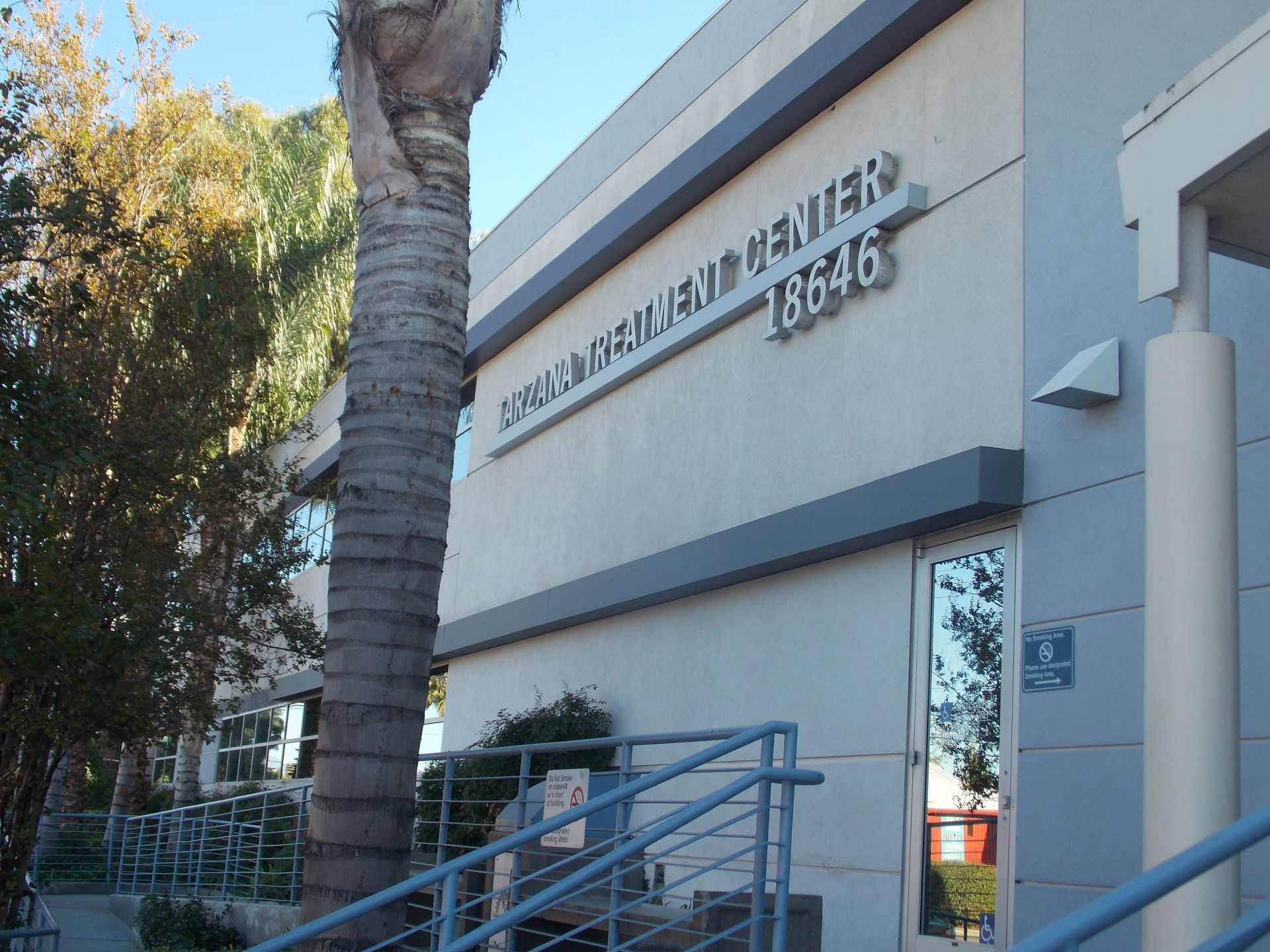
The Tarzana Treatment Centers in Los Angeles County provide outpatient and inpatient care for substance use disorders.i
The Tarzana Treatment Centers in Los Angeles County provide outpatient and inpatient care for substance use disorders.
Anna Gorman/KHN
Current federal rules limit drug treatment centers' ability to get reimbursed under Medicaid for residential care. Clinics with more than 16 beds essentially cannot get paid, except for treating pregnant and postpartum women. That restriction will be dropped for California under the waiver.
As a result, Medi-Cal beneficiaries will be able to access up to two 90-day residential stays each year, with the possibility of one 30-day extension if providers determine that it is medically necessary. Certain populations, including those in the criminal justice system, can get approval for longer stays.
The waiver is also designed to provide better coordination between physical, mental health and substance abuse services," according to John Connolly, deputy director of substance abuse prevention and control for the Los Angeles County Department of Public Health. That along with more access could result in fewer emergency room visits and hospitalizations, he said.
That's potentially good news for people like Caitlin Knoles, a resident of Orange County who says she gets turned down for treatment of her methamphetamine addiction every time she tells residential centers she's on Medi-Cal. She has ended up in the hospital more than once because of her addiction.
"It's hard," Knoles said. "I can't get help."
The only way she can reliably get clean now is in jail, she says.
"It'd be nice to have a job and have my family back and just be normal," said Knoles, 24, as she sat outside a liquor store in Laguna Hills.
For the first time, substance abuse disorders will be treated like a disease rather than a short-term illness, said Marlies Perez, chief of the substance use disorder compliance division for the state Department of Health Care Services. "Even though we know it's a chronic condition, we have treated it acutely," she said.
Much depends, however, on reimbursement rates, which are still being negotiated. Clinic officials say they need higher rates to expand services and handle the anticipated influx of clients, many of whom will be seeking rehab for the first time.
"There is a cost to raising the bar on treatment," said Albert Senella, president of the California Association of Alcohol and Drug Program Executives. "If the rates aren't adequate ... we are not going to be able to effectively meet the [new requirements] and the needs of the population."
Senella, who is also CEO of Tarzana Treatment Centers in Tarzana, Calif., said many clinics across the state don't have money to prepare for the overhaul, which will require improving technology and adding and training staff. For now, no plans are in place to provide counties or clinics with startup funds.
Eli Veitzer, interim CEO of Prototypes, which provides treatment services in Los Angeles, Orange and Ventura counties, said the waiver provides an "incredible opportunity" to transform care.
But in addition to fears about rates, Veitzer said he is also worried that 90 days of residential treatment won't be enough for many people. Someone may be able to stem their addiction in three months but will still need more time in a treatment facility to prepare for life outside.
"If their ability to function independently in the community is not addressed, they are likely to relapse," he said.
Danny Montgomery, a 33-year-old patient at Tarzana Treatment Centers, said he needed more than a few months to get clean after nearly a decade on heroin. The addiction, which he estimated cost him up to $100 a day, caused him to lose his job and nearly lose his family.
"The whole thing is a process," said Montgomery, who lives in the San Fernando Valley. "You get the substance removed from your body, but you have to retrain your mind." Montgomery said he tried to get a bed in a residential treatment center but couldn't find one that would take Medi-Cal.
He tried to get clean on his own but it never lasted. Months after beginning his search, Montgomery was finally able to get a spot at Tarzana. He said Los Angeles County is paying for his stay, which began in May.
As worried as they are about reimbursements, clinic operators said a big advantage of the new approach is that it could help stabilize their funding. Providers now depend largely on counties to pay for residential treatment for low-income residents.
"You always suffered the vagaries of the budget cycle," said Vitka Eisen, CEO of HealthRIGHT 360, which provides drug treatment in the Bay Area.
The waiver also means increased oversight of treatment centers.
Last year, a state audit found widespread fraud and questionable billing among Medi-Cal drug treatment providers. The audit followed reports by the Center for Investigative Reporting that clinics were billing for fake clients.
The new system will include more levels of accountability, Perez says, including more stringent requirements for clinics and more local control over contracting.
Knoles, who is addicted to methamphetamine, said she hopes that more people like her will be able to get treatment.
"I've had a lot of friends die from addiction," she said. "Imagine if they'd gotten the help they wanted and needed. Things would have been different."
Anna Gorman is a reporter with Kaiser Health News, a nonprofit news organization covering health care policy and politics. 
Via: http://www.npr.org/sections/health-shots/2015/12/11/459226074/california-expands-substance-abuse-treatment-for-low-income-residents

Monday, August 10, 2015

California prison population drops under Proposition 47, but public safety impact still unclear

Citrus Heights police Officer Wesley Herman recently arrested a parolee carrying stolen jewelry and a deceased man’s identification card.

If the property was valued at more than $950, the case was a felony that would let him take the man into custody. If not, it was a misdemeanor and he’d get a citation.

The first words out of his mouth, Herman said, were, “Am I going to jail?”

It’s been nine months since California voters approved a ballot measure reducing charges for some nonviolent drug and property crimes, and Herman says repeat offenders are getting savvy about the new limits of the law.

“These guys know that if they are running around with less than $950 of stolen property on them, they’re not going to jail,” he said. “They’re always trying to stay a step ahead of us.”

Continuing the recent trend away from decades of tough-on-crime policy, nearly 60 percent of voters last November supported Proposition 47, which reduced from felonies to misdemeanors offenses including drug possession for personal use. Savings on correctional spending, estimated to be hundreds of millions of dollars annually, is intended to go to mental health and drug treatment, anti-truancy efforts and victim services.

Only a spotty picture has emerged of the law’s early effects: Supporters celebrate that tens of thousands of current and former convicts have already had the felonies on their records changed to misdemeanors, opening up new opportunities for jobs, housing and public benefits. Police and prosecutors argue that it has made their jobs more difficult.

Communities across the state fret about the connection to spikes in crime, but those familiar with public safety statistics say it’s too soon to know whether anecdotes from the street are evidence that Proposition 47 is responsible.

“Law enforcement isn’t a place where change is readily embraced,” said Tom Hoffman, a longtime police officer and former director of California’s parole operations, who advised the Proposition 47 campaign. For this sentencing overhaul to succeed, it will take “a lot of time and a lot of patience and, quite candidly, a lot of courage.”

Proposition 47 has accomplished at least one of its objectives already.

As of this week, 4,347 inmates have been released from state prisons due to resentencing, according to the California Department of Corrections and Rehabilitation. The releases helped push the overcrowded prison system below court-mandated capacity levels by February, a full year ahead of its deadline.

Many more individuals have successfully petitioned at the county level to have their records changed, including approximately 1,400 so far in Sacramento County. As some inmates are released from jail and cramped facilities clear out, more serious offenders are serving longer portions of their sentences.

“We want to be very careful about who we’re putting in a cage,” said Santa Clara County District Attorney Jeff Rosen, because incarceration can sometimes “work at cross-purposes” with those people turning their lives around.

Nearly 3,600 defendants in Santa Clara County have had their felonies reduced to misdemeanors since November. Rosen, one of only three district attorneys in California to endorse Proposition 47, said they are sending fewer people to prison for these crimes than before.

“The benefits to our society from locking up fewer nonviolent offenders will in the long run translate into safer communities, a better economy, and stronger services,” he said.

Increases in crime during the first half of the year, however, have raised early doubts in many communities.

Preliminary statistics for the city of Sacramento show a 25 percent rise in violent crime, including homicide, rape, robbery and aggravated assault, through June, compared with the same period in 2014. Property crimes, such as burglary and motor vehicle theft, are up about 5 percent, though larcenies have dropped slightly.

The Sacramento County District Attorney’s Office has seen a 9 percent increase in filings so far this year for cases it is pursuing – an 11 percent drop in felonies offset by a 27 percent jump in misdemeanors.

Magnus Lofstrom, a researcher at the Public Policy Institute of California who has studied the impacts of realignment, cautioned against drawing conclusions from the data.

Upticks in violent and property crime rates during the first year of realignment caused similar concerns, Lofstrom said. With the exception of a boost in auto thefts, however, the spike was in line with increases in states that did not undergo realignment, and crime rates have since dropped again.

With a surge of releases under Proposition 47, “it’s fair to say it puts an upward pressure on crime rates” for the types of low-level offenses those inmates committed, he added. But he said it’s very difficult to attribute a particular change in law to a change in crime rates. Cities and counties vary in their staffing levels, law enforcement priorities and reentry services for released offenders.

Law enforcement officials feel more certain of the connection, pointing to “unintended consequences” of the law.

Herman of the Citrus Heights Police Department said Proposition 47 has limited the ability of police to respond to drug-related crimes.

Previously, he said, he was able to take someone to jail for simple possession, where at least “he’s going to be clean a few days.”

“Now you have to show that this is a crime heinous enough to take them out of the community,” he said.

Instead of being arrested, the suspect might instead receive a citation to appear in court in 30 days. Herman said that allows addicts to keep using – and potentially commit thefts to support their habit.

“It’s been difficult for us to prevent as many crimes as we could have before,” he said. “Our hands do sometimes get tied.”

The changes have also had a detrimental effect on California drug courts, according to prosecutors.

Those programs provide offenders with the option of seeking treatment for substance abuse rather than facing prison time. But without the “hammer” of a felony now hanging over them, Sacramento County District Attorney Anne Marie Schubert said, those arrested for drug-related crimes have little incentive to choose rehabilitation over the lesser charges.

“Logically, many of those people who have the addiction problems that we want to address are not going to avail themselves of that because it’s too much work,” she said, adding that it creates a “revolving door” for petty criminals to return to the streets and reoffend. “If you don’t have accountability for criminal behavior, there’s no reason not to commit that criminal behavior.”

The number of cases in Sacramento County’s two drug courts has fallen to 587 from 970 since the passage of Proposition 47. In Fresno County, one drug court has halved to 280 cases, while another lost all 80 of its participants.

San Bernardino County District Attorney Mike Ramos said proponents of the measure went about their aims in the wrong way. Established diversion programs in his county are collapsing – drug court participation is down 60 percent – and there are not yet resources to create new ones.

While 65 percent of any savings on correctional spending from Proposition 47 is earmarked for mental health and drug treatment programs to keep at-risk individuals out of custody, counties won’t see any of that money until August 2016, after the next budget cycle.

“What are they going to do in the meantime?” Ramos said. “They should have had a plan in place.”


Read more here: http://www.sacbee.com/news/politics-government/capitol-alert/article30455739.html#storylink=cpy

Monday, January 13, 2014

California governor proposes drug rehab program changes after CNN investigation

(CNN) -- California Gov. Jerry Brown has proposed millions of dollars in additional funding to crack down on abuses in the state's drug rehab program as a result of an investigation by CNN and The Center for Investigative Reporting.

The governor's budget summary specifies additional government oversight needed to run the Drug Medi-Cal program.

"The budget proposes 21 positions and $2.2 million ... to continue the state's intensive focus on program integrity and expansion of drug treatment services by recertifying all providers in the state," says the budget summary, which was released Thursday.

The yearlong investigation by CNN and The Center for Investigative Reporting -- which culminated in reports in July on CNN.com and onCNN's "AC360ยบ" television program -- revealed widespread fraud in the drug rehab program, which is part of the largest Medicaid system in the United States. The investigation revealed that convicted felons were operating clinics in violation of the law, clinics charged taxpayers for "ghost" patients and teens had been taken from their group homes for drug rehab even though they had no drug problems.

Regulators who could have stopped the fraud allowed it to continue, despite warnings that the system was being abused, the series found.

The investigation prompted a swift and strong reaction from the state. A total of 177 clinic sites have been suspended and 69 referred to the state's Department of Justice for potential criminal prosecution. The head of the program publicly apologized for the fraud before a legislative oversight hearing in September.

"Due to concerns about program integrity in the Drug Medi-Cal program, DHCS (the California Department of Health Care Services) took steps in July 2013 to eliminate fraud and abuse in the program. ... DHCS has conducted a review of internal operations to improve oversight and monitoring of drug treatment programs, and has improved coordination with counties to ensure appropriate monitoring and recertification of all drug treatment providers," according to the budget summary.

State Sen. Ted Lieu, D-Torrance, chairman of the Senate Business, Professions and Professional Development Committee, said, "I am pleased the governor is proposing additional positions and funding to fight fraud in the Drug Medi-Cal program. We will analyze his proposal during the budget process to see if it is sufficient, but it is a good start."

DHCS spokesman Norman Williams said the money will allow the department to add a wide variety of new positions to scrutinize individual clinics and the department's own procedures.
Some staffers will comb through applications from rehab clinics to be recertified by the state -- a new requirement prompted by the series. Others will analyze data to make sure clinic billing matches the services provided, examine the department's policies and make recommendations for improvement.

"These are positions that will make the (Drug Medi-Cal) program stronger," Williams said. 

"This amount gives us the support necessary to continue our efforts ... in a way that we will ultimately be able to improve the integrity of the program."

Of the $2.2 million, half will come from the state's general fund, and the rest will be matched with federal funds.

All of the clinics featured in the CNN/CIR investigation have either closed on their own or have shut down after being suspended by the state. George Ilouno, one of the clinic operators who continued to stay open despite being out on bail on charges of Medi-Cal fraud and grand theft, pleaded guilty to Drug Medi-Cal fraud in September. He received a one-year suspended jail sentence, three years' probation, paid $90,000 in restitution to the state and must perform 60 days of community service.