topnav

Home Issues & Campaigns Agency Members Community News Contact Us

Community News

Open dialogue among community members is an important part of successful advocacy. Take Action California believes that the more information and discussion we have about what's important to us, the more empowered we all are to make change.

Showing posts with label California. Show all posts

Monday, December 28, 2015

New California laws 2016: What to expect in the new year

Like bubbles ascending a champagne flute, a bevy of recently passed California policies will float to the surface and take effect this Jan. 1. Here’s a review of some of the major items.

Vaccines
One of 2015’s fiercest fights was over SB 277, which was introduced in the wake of a measles outbreak at Disneyland and requires full vaccination for most children to enroll in school. Schools will begin vetting students to ensure they have their shots in July, before the 2016-2017 school year begins.

Search warrants
Arguing our privacy laws lag behind our technology, lawmakers passed SB 178 to require search warrants before law enforcement can obtain your emails, text messages, Internet search history and other digital data.

Ballot fees
Thinking of filing a ballot initiative? You’ll need more cash. AB 1100 hikes the cost of submitting a proposal from $200 to $2,000, which supporters called a needed screen to discourage frivolous or potentially unconstitutional proposals.

Grocery jobs
When grocery stores get new owners, AB 359 requires the stores to retain employees for at least 90 days and consider keeping them on after that period ends. While workers can still be dismissed in that window for performance-related reasons, the labor-backed bill seeks to protect workers from losing their jobs to buyouts or mergers.

Reproductive services
AB 775 requires any licensed facility offering pregnancy-related services to post a sign advertising the availability of public family planning programs, including abortions. It is aimed at so-called “crisis pregnancy centers,” which pro-abortion rights critics assail for pressuring women into carrying their pregnancies to term.

Cheerleaders
Cheerleaders who root on professional athletes will be treated as employees under California law, with the accompanying wage and hour protections, under AB 202. Assemblywoman Lorena Gonzalez, D-San Diego, who carried the bill, was a Stanford cheerleader.

Testing
High school seniors will no longer need to take a long-standing exit exam to graduate, thanks to SB 172. The bill lifts the requirement through the 2017-2018 school year and also applies retroactively to 2004, meaning students who have completed all the other graduation requirements since then can apply for diplomas.

Guns on campus
Concealed firearms are barred from college campuses and K-12 school grounds under SB 707, which the California College and University Police Chiefs Association sponsored as a public safety corrective.

Equal pay
SB 358 seeks to close the stubborn gap between men and women’s wages by saying they must be paid the same for “substantially similar work,” an upgrade over the current standard, and allowing women to talk about their own pay and inquire about the pay of others without facing discipline. While California already requires equal pay for equal work, women still consistently make less.

Sex ed
Student participation in sexual education courses is currently voluntary. AB 329 would make the courses mandatory unless parents specifically seek an opt-out and would update curricula to include, for example, more information about HIV and the spectrum of gender identity.
Yes means yes

As long as their school districts require health classes to graduate, SB 695 will ensure high school students learn about the “yes means yes” standard of consent to sexual acts. In other words, students will learn they should be getting explicit approval from partners.

Toy guns
Realistic-looking airsoft guns will need to have more features that distinguish them as toys, like a fluorescent trigger guards, thanks to SB 199. Advocates said it would help law enforcement avoid tragic mistakes when making split-second decisions, pointing to the 2013 case of a Santa Rosa boy fatally shot by Sonoma County deputies who mistook his toy gun for the real thing.

Gun restraining orders
Passed last year in response to a troubled young man shooting and killing multiple people in Isla Vista, AB 1014 allows family members to obtain a restraining order temporarily barring gun ownership for a relative they believe to be at risk of committing an act of violence.

Rape kits
AB 1517 prods law enforcement to more quickly process so-called “rape kits,” the forensic evidence collected from sexual assault crime scenes. While the bill doesn’t mandate anything, it encourages law enforcement agencies to send evidence to crime labs sooner and urges crime labs to analyze the data and upload it into a DNA database in a shorter time frame.

Brew bikes
People rolling around midtown Sacramento on beer bikes could get a little tipsier under SB 530. The measure allows alcohol to be consumed on board the multi-person vehicles, which currently travel between different bars but don’t allow imbibing in between, as long as the city authorizes it. The city of Sacramento is working on updating its pedicab ordinance to reflect the new law.

Charity raffles
Professional sports fans could bring home big prizes thanks to SB 549, which authorizes in-game charity raffles allowing the winner to take home 50 percent of ticket sales. That’s a change from the current system, which permits charity raffles only if 90 percent of the proceeds go to the cause.

Pedestrian costs
AB 40 ensures pedestrians and cyclists won’t have to pay tolls on Bay Area bridges like the Golden Gate. While no such tolls yet exist, lawmakers were responding to a proposal to raise money with a Golden Gate Bridge fee.

Back wages
If an employee doesn’t get paid what they are owed, SB 588 allows the California Labor Commissioner to slap a lien on the boss’s property to try and recoup the value of the unpaid wages. This was a slimmed-down version of a prior, unsuccessful bill that was pushed by organized labor but repudiated by business interests – the key difference being that the commissioner, not workers, files the liens.

Franchises
Another bill whose earlier labor-backed, business-opposed version was softened in the name of compromise, AB 525 modifies the relationships between individual franchise business owners and the larger parent company by changing the rules for when the parent company can terminate or refuse to renew a franchise agreement and how the franchise owner can sell or transfer the store.

Transportation companies
The steady drip of new regulations on companies like Uber and Lyft continued with AB 1422, which requires such businesses to give the California Department of Motor Vehicles access to driver records by participating in the agency’s pull notice program.

Air regulations
After a sweeping climate bill spurred objections from lawmakers about the clout of the unelected California Air Resources Board, AB 1288 offered a concession by creating two new spots on the regulator’s board, to be appointed by the Legislature.

Via: http://www.sacbee.com/news/politics-government/capitol-alert/article51702105.html#storylink=cpy

Wednesday, December 23, 2015

California Jolt: State Upends How It Funds and Runs Education

It's hard to find stories of "upheaval" in the way states structure the machinery of public schooling. Wrangling interests tend to allow only a little tinkering under the hood. But California right now is rewriting that script. And the sweeping changes occurring in the state's education system are so politically stunning that those inured to paralysis in Sacramento stand slack-jawed.

Not only is the nation's biggest state calmly implementing the Common Core State Standards that have roiled the waters in a number of other states. But to bolster the success of those higher academic expectations, the Golden State is revamping its entire education architecture, from how dollars flow to schools to how teachers and principals are supported and held accountable.
The changes take dead aim at reversing a longstanding lag in student achievement and, especially, narrowing the socio-economic achievement gap in a state whose schools were once the envy of the nation. The animating force is the new Local Control Funding Formula, the linchpin of 2013's authorizing legislation. Phased in over eight years, the LCFF obliterates the state's old finance system long denigrated as ineffective, dizzyingly complex and, above all, inequitable. In its place is a weighted approach that provides a basic level of funding for every student then targets additional funding to districts with large numbers of students who are more expensive to educate--those from poor families, English learners, and foster children.
While many state funding formulas use a weighted approach to try to account for the higher costs of educating different groups of students, California is taking an extra step. In a profound turnaround, and in keeping with Governor Jerry Brown's principle of "subsidiarity," decision-making responsibility for how to spend the money has been handed to local school districts.
This flips the norm established more than 35 years ago with Proposition 13, the landmark property tax limit, when the state became the school funding distributor as well as decider, largely dictating how locals could use the dollars. Over time, highly regulated "categorical" or specific-purpose programs proliferated.
The one-size-fits-all approach became increasingly counterproductive as the state's diversity exploded in the 1980s. And now, decades later, local educators are being given back the reins. Instead of compliance, their new mandate is to go forth and be creative. Innovate. Make the money matter. Work with your communities to dig into evidence about which kids are struggling with what, and why. Agree on top improvement goals and map out a plan that ties your budget to the actions you're going to take--actions that will help teachers and administrators know and continually get better at using the most effective practices.
Reaction in the state's 1,000 school districts is a stew of excitement, energy, and concern. You'd be hard pressed to find educators who don't applaud the aspiration to level the playing field for the least advantaged kids; more than half the state's six million public school students are low income. Beyond that is the new law's philosophic underpinning:
It's an implicit vote of confidence in California's educators, the opposite of the test-and-punish mode that prevailed nationally under the federal No Child Left Behind act.
At the same time, there's a near-audible gulp. Local school leaders who have complained for years about being hamstrung by Sacramento's restrictions now face, for starters, mindset change. But even exuberant local visionaries know that navigating conflicting parental and community interests can be daunting without the lever of "the state requires it" to push things forward.
The state, of course, still must hold schools accountable. Doing so will now occur by way of each district's annually updated plan that spells out its needs, priorities, and goals within eight statewide priority areas. The priorities start with student achievement but also include less tangibly documentable factors as school climate, student engagement, and parent involvement.
The local planning process has begun, even though details such as progress measures and a promised new system of improvement assistance are not yet fully in place. Watching intently are vocal advocacy groups who worry that too much local flexibility or insufficient transparency, especially for reporting on spending, may translate to diminished services for the very students the LCFF aims to accelerate.
Despite much optimism, no one sees this as a panacea in post-Proposition 13 California where investment in education has, for decades, languished below the national average and sank even lower during the recession. The new law's passage was made possible in part by good government victories--i.e., voter approved changes in legislative and election rules that finally broke legislative gridlock. But a pivotal other factor was the ballot success of Governor Brown's big 2012 gamble: Proposition 30, a temporary tax increase that averted further draconian cuts in recession-decimated school districts.
Since then, California's budget has massively rebounded. But even if activists manage to extend Proposition 30, which fully expires in 2018, and if projections of a long stretch of black ink are correct, it will take years to restore many school districts to pre-recession levels, nevermind to raise base funding from a level that's widely seen as inadequate.
The position of Brown and the state board of education is that the kids can't wait. By clearing away resource-sucking regulations and accreted categorical programs, instead unfettering education dollars to be directed to actual school and student needs, they're betting the state can turn the page on achievement mire.
Are their ambitions quixotic? Not according to years of research findings, notably from an unprecedented set of California school finance and governance studies prompted by the student outcome urgency. Anchored at Stanford and undertaken by national experts--including current State Board of Education president Mike Kirst--the studies culled from experiments in the U.S. and abroad. Findings explicitly called for replacing the "fundamentally flawed" status quo with a system that would "improve the alignment between the accountability system and the decision-making responsibilities, increasing flexibility at the local level."
Guided by these studies, the state is buttressing the LCFF with a pre-emptive system of educator support to be orchestrated by a new state agency, the California Collaborative for Education Excellence. With 10,000 schools and nearly 300,000 teachers, there is intense focus on the problem of uneven local capacity--for aligning classroom practices with the Common Core; for ensuring skilled principal leadership; for revamping district management and budgeting strategies. One favored capacity building approach is to support cross-district partnerships to fast-forward the spread of best practices, using a model pioneered in the state by a group of mostly big districts.
As implementation unfolds, developmental glitches are inevitable. With criticisms simmering among advocates of tighter control, there may not be much leeway for missteps. But the governor is adamant that the state should remain hands off, giving local flexibility time to find its footing before making dramatic adjustments. So far, with momentum stoked by the political miracle of getting this far, the odds for success appear to be on his--and the kids'--side.
Via Joan McRobbie, Huffington Post 12/18/2015
http://www.huffingtonpost.com/joan-mcrobbie/california-jolt-state-upe_b_8833242.html

Wednesday, December 16, 2015

California Voters May Get to Choose Between Two Different Death Penalty Related Ballot Propositions

Faster Executions or None at All? Californians May Get to Choose

If there’s one thing supporters and opponents of the death penalty can agree on, it’s this: The system is broken. Since California reinstated capital punishment in 1977, 117 death row inmates have died. But only 15 of them have been executed. The vast majority have died of natural causes or suicide.

When he was chief justice of the California Supreme Court, Ronald George caused a stir when he said “the leading cause of death on death row in California is old age.” The system, he said, is dysfunctional  — and few would disagree.

Even before a federal judge blocked executions in 2006, the pace of implemented death sentences was slow. It wasn’t unusual for condemned inmates to spend two decades on death row, as their legal appeals slowly wound through the courts. But to death penalty opponents, the seemingly endless delays prove that capital punishment is unworkable and should be scrapped altogether.To death penalty supporters, that delay is a travesty of justice and disrespectful to crime victims and their families who, they say, deserve to see the ultimate sentence implemented.

Come November, California voters could have two completely different options for fixing the system. Two groups are preparing to collect signatures for ballot measures that would present stark choices.

One, the Death Penalty Reform and Savings Act of 2016, would limit inmate appeals, which can drag on for decades, and expedite executions. It would also give the California Department of Corrections and Rehabilitation more latitude in housing condemned inmates and require them to work, with 70 percent of their wages going to crime victims.

The other proposal, which ballot measure proponent Mike Farrell calls “The Justice That Works Act of 2016,” would ban executions altogether and convert all existing death sentences to life in prison without the possibility of parole.

The Death Penalty Reform and Savings Act of 2016 is current being reviewed by the Attorney General’s Office. A similar measure was proposed last year and endorsed by three former California governors. It never made it to the ballot.

An attorney advising proponents of the current death penalty reform measure told me that first effort was “controlled by crime victim families,” suggesting it didn’t have the kind of professional political consultants needed to make it to the ballot.

This time around, he said, Sacramento-based strategist Aaron McLear and his firm, Redwood Pacific, will guide the effort.

This week the nonpartisan Legislative Analyst’s Office released its fiscal review of that measure. While acknowledging the measure would affect various costs, “the magnitude of these effects would depend on how certain provisions in the measure are interpreted and implemented,” the LAO wrote.

In conclusion, it wrote:
  • Increased state costs that could be in the tens of millions of dollars annually for several years related to direct appeals and habeas corpus proceedings, with the fiscal impact on such costs being unknown in the longer run.
  • Potential state correctional savings that could be in the tens of millions of dollars annually.
  • Proponents of the measure to ban capital punishment must be more pleased with the LAO analysis of their measure. The LAO estimates a “net reduction in state and local government costs of potentially around $150 million annually within a few years due to the elimination of the death penalty.” You can be sure that will end up in a TV commercial for the measure.

  • Proponents of both measures have yet to collect a single signature. Assuming they get a green light from the attorney general and the secretary of state, they’ll have 180 days to collect the necessary signatures to put it before voters.

  • If both succeed, they’ll likely join a November 2016  ballot with measures related to legalizing pot, raising the minimum wage and strengthening gun control. All that, plus a presidential election and the race to replace retiring U.S. Sen. Barbara Boxer.
  • In other words, a political junkie’s dream come true.
By Scott Shafer
Via http://ww2.kqed.org/news/2015/12/14/faster-executions-or-none-at-all-california-voters-may-choose

Monday, December 14, 2015

California Expands Substance Abuse Treatment For Low-Income Residents

After years fighting a heroin addiction, Danny Montgomery, 33, is receiving inpatient treatment that is being paid for by Los Angeles County.


California is overhauling its substance abuse treatment system for low-income people, embarking on a massive experiment to create a smoother path for addicts from detox through recovery.
The state is the first to receive federal permission to revamp drug and alcohol treatment for beneficiaries of Medicaid, known as Medi-Cal in California. Through what's known as a drug waiver, state officials will have new spending flexibility as they try to help people get sober and reduce social and financial costs of people with substance abuse disorders.
Under the waiver, the state plans to expand treatment services, including inpatient care, case management, recovery services and added medication. Beginning next year, drug treatment centers will be able to get reimbursed for providing this much wider range of options to people on Medi-Cal.
Only a small fraction of low-income Californians with substance abuse disorders receive treatment, largely because of restrictions on what Medicaid will pay for.
"This was a long time coming," said Keith Lewis, executive director of Horizon Services, which provides treatment in San Mateo, Santa Clara and Alameda counties. "It's a win/win for people with substance use issues and their families ... and for the people providing those services."
The changes, which will be phased in starting next year, stem in part from the Affordable Care Act, which required that substance abuse treatment be covered for people newly insured through Medicaid or insurance exchanges. The health law allowed states to expand Medicaid to cover millions more people.
Drug rehabilitation providers say the changes will give addicts a better chance at getting — and staying — clean. But they fear the state won't raise the traditionally low Medi-Cal reimbursement rates for treatment, making it harder to provide services and produce the outcomes California is hoping for.
Lewis, of Horizon Services, said that under the waiver he expects drug treatment services to be higher quality and the workforce better trained. But he said that "Medi-Cal rates, which have always been too low, have to go up."
California's Medi-Cal drug treatment program currently costs about $180 million annually, paid through a combination of state and federal funds. There aren't any estimates for costs under the new approach. But the idea is that the changes will help health care expenses overall by enabling more people to get sober and healthier so they stop rotating through treatment centers, jails and hospitals.
Nearly 14 percent of Medicaid recipients are believed to have a substance abuse disorder, according to the National Survey on Drug Use and Health.
The five-year pilot project in California was approved by the federal Centers for Medicare & Medicaid Services in August. Under the waiver, counties will approve treatment for Medi-Cal patients based on medical necessity and criteria established by the American Society of Addiction Medicine.
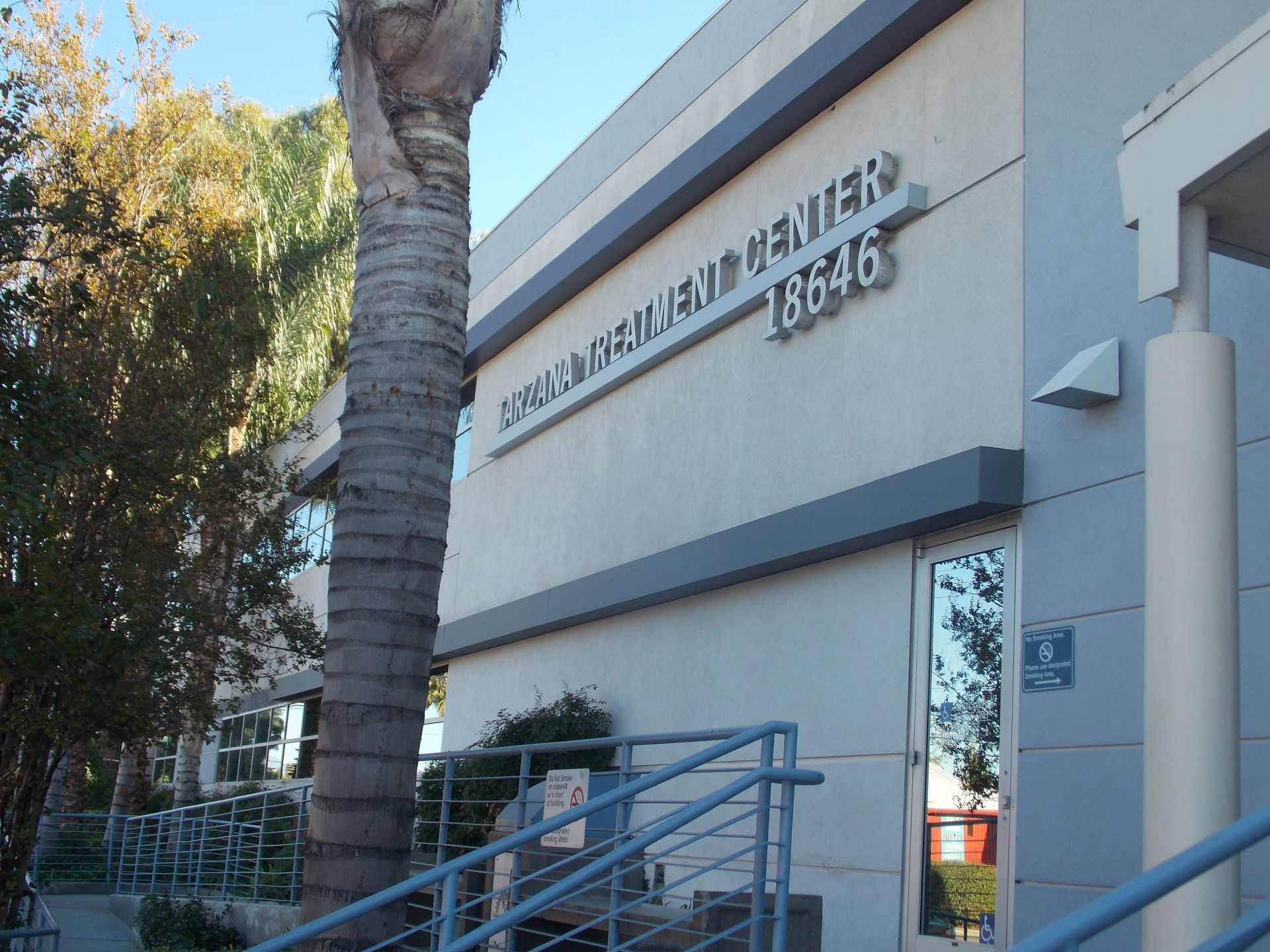
The Tarzana Treatment Centers in Los Angeles County provide outpatient and inpatient care for substance use disorders.i
The Tarzana Treatment Centers in Los Angeles County provide outpatient and inpatient care for substance use disorders.
Anna Gorman/KHN
Current federal rules limit drug treatment centers' ability to get reimbursed under Medicaid for residential care. Clinics with more than 16 beds essentially cannot get paid, except for treating pregnant and postpartum women. That restriction will be dropped for California under the waiver.
As a result, Medi-Cal beneficiaries will be able to access up to two 90-day residential stays each year, with the possibility of one 30-day extension if providers determine that it is medically necessary. Certain populations, including those in the criminal justice system, can get approval for longer stays.
The waiver is also designed to provide better coordination between physical, mental health and substance abuse services," according to John Connolly, deputy director of substance abuse prevention and control for the Los Angeles County Department of Public Health. That along with more access could result in fewer emergency room visits and hospitalizations, he said.
That's potentially good news for people like Caitlin Knoles, a resident of Orange County who says she gets turned down for treatment of her methamphetamine addiction every time she tells residential centers she's on Medi-Cal. She has ended up in the hospital more than once because of her addiction.
"It's hard," Knoles said. "I can't get help."
The only way she can reliably get clean now is in jail, she says.
"It'd be nice to have a job and have my family back and just be normal," said Knoles, 24, as she sat outside a liquor store in Laguna Hills.
For the first time, substance abuse disorders will be treated like a disease rather than a short-term illness, said Marlies Perez, chief of the substance use disorder compliance division for the state Department of Health Care Services. "Even though we know it's a chronic condition, we have treated it acutely," she said.
Much depends, however, on reimbursement rates, which are still being negotiated. Clinic officials say they need higher rates to expand services and handle the anticipated influx of clients, many of whom will be seeking rehab for the first time.
"There is a cost to raising the bar on treatment," said Albert Senella, president of the California Association of Alcohol and Drug Program Executives. "If the rates aren't adequate ... we are not going to be able to effectively meet the [new requirements] and the needs of the population."
Senella, who is also CEO of Tarzana Treatment Centers in Tarzana, Calif., said many clinics across the state don't have money to prepare for the overhaul, which will require improving technology and adding and training staff. For now, no plans are in place to provide counties or clinics with startup funds.
Eli Veitzer, interim CEO of Prototypes, which provides treatment services in Los Angeles, Orange and Ventura counties, said the waiver provides an "incredible opportunity" to transform care.
But in addition to fears about rates, Veitzer said he is also worried that 90 days of residential treatment won't be enough for many people. Someone may be able to stem their addiction in three months but will still need more time in a treatment facility to prepare for life outside.
"If their ability to function independently in the community is not addressed, they are likely to relapse," he said.
Danny Montgomery, a 33-year-old patient at Tarzana Treatment Centers, said he needed more than a few months to get clean after nearly a decade on heroin. The addiction, which he estimated cost him up to $100 a day, caused him to lose his job and nearly lose his family.
"The whole thing is a process," said Montgomery, who lives in the San Fernando Valley. "You get the substance removed from your body, but you have to retrain your mind." Montgomery said he tried to get a bed in a residential treatment center but couldn't find one that would take Medi-Cal.
He tried to get clean on his own but it never lasted. Months after beginning his search, Montgomery was finally able to get a spot at Tarzana. He said Los Angeles County is paying for his stay, which began in May.
As worried as they are about reimbursements, clinic operators said a big advantage of the new approach is that it could help stabilize their funding. Providers now depend largely on counties to pay for residential treatment for low-income residents.
"You always suffered the vagaries of the budget cycle," said Vitka Eisen, CEO of HealthRIGHT 360, which provides drug treatment in the Bay Area.
The waiver also means increased oversight of treatment centers.
Last year, a state audit found widespread fraud and questionable billing among Medi-Cal drug treatment providers. The audit followed reports by the Center for Investigative Reporting that clinics were billing for fake clients.
The new system will include more levels of accountability, Perez says, including more stringent requirements for clinics and more local control over contracting.
Knoles, who is addicted to methamphetamine, said she hopes that more people like her will be able to get treatment.
"I've had a lot of friends die from addiction," she said. "Imagine if they'd gotten the help they wanted and needed. Things would have been different."
Anna Gorman is a reporter with Kaiser Health News, a nonprofit news organization covering health care policy and politics. 
Via: http://www.npr.org/sections/health-shots/2015/12/11/459226074/california-expands-substance-abuse-treatment-for-low-income-residents

Friday, December 11, 2015

California Corrections Spending Still High Despite Reforms

In recent years, California has made significant progress in reducing the number of people involved with the state correctional system. These declines resulted from criminal justice reforms adopted by state policymakers and the voters following a 2009 federal court order requiring California to reduce overcrowding in state prisons.
This Issue Brief examines changes in corrections spending from the 2007-08 fiscal year — when the numbers of incarcerated adults and parolees peaked — to 2015-16, which began this past July. While total corrections spending as a share of the state budget is down slightly since 2007-08, spending for adults under state jurisdiction — which comprises more than 80 percent of total corrections expenditures and includes security and operations as well as health care — remains stubbornly high.
Significantly — and permanently — reducing corrections spending will require the state to take additional steps. These could include further reforming California’s sentencing laws, particularly with an eye toward cutting the length of prison sentences. This would reduce the number of incarcerated adults, which would allow the state to close one or more prisons and could help to lower prison health care spending.
Via the California Budget & Policy Center, November 2015 report
http://calbudgetcenter.org/resources/corrections-spending-through-the-state-budget-since-2007-08-still-high-despite-recent-reforms/ 

Monday, December 7, 2015

California will have one of the toughest equal pay laws in the country in 2016

California took a major step this year toward closing the lingering wage gap between men and women, as Gov. Jerry Brown signed one of the toughest pay equity laws in the nation.
Women in California who work full time are paid substantially less — a median 84 cents for every dollar — than men, according to a U.S Census Bureau report this year.
“The inequities that have plagued our state and have burdened women forever are slowly being resolved with this kind of bill,” Brown said at a ceremony at Rosie the Riveter National Historical Park in the Bay Area city of Richmond.
The governor called the measure, which will give employees more grounds for challenging perceived discrimination, “a very important milestone.”
It is supported by the California Chamber of Commerce and most state Republican lawmakers. National women’s rights leaders said the legislation was a model for other states and for Congress, where similar efforts have been stalled by Republican opposition.


Businesses said they expected more lawsuits once the new rules take effect Jan. 1.
Hannah-Beth Jackson
The sponsor of the bill was California State Senator Beth Jackson
Courts have interpreted current law to mean that male and female workers must hold exactly the same jobs to require equal pay, said state Sen. Hannah-Beth Jackson (D-Santa Barbara), author of the legislation.
“Now they're going to have to value the work equally,” she said.
California and the federal government already have laws banning employers from paying women less than men for the same jobs. The new California Fair Pay Act broadens that prohibition by saying bosses cannot pay employees less than those of the opposite sex for “substantially similar work,” even if their titles are different or they work at different sites.
A female housekeeper who cleans hotel rooms, for example, may challenge higher wages paid to a male janitor who cleans the lobby and banquet halls, said Jackson. Similarly, a female grocery clerk could challenge a male clerk's higher wages at a store owned by the same employer but located a few miles away.
The new law also prohibits retaliation against employees who ask about or discuss wages paid to co-workers, and it clarifies their ability to claim retaliation.
On the employer side, those sued by workers would have to show that wage differences are due to factors other than sex, such as merit or seniority; that they are job-related and reasonable; and that they are not due to discrimination.
Workers who believe they have been discriminated against said Tuesday that the new law would help bolster future cases. Employers will now be “accountable to pay women fairly,” said Aileen Rizo, a math consultant for the Fresno County Office of Education who is suing the agency.
Rizo alleges in her federal lawsuit that a male colleague was paid $12,000 more a year for the same work, even though he was hired four years after she was and had less experience, education and seniority.
The new law will mean more employees taking more bosses to court, said J. Al Latham Jr., a labor law attorney and lecturer at the USC Gould School of Law.
“It is going to lead to lots more litigation, which further weakens the business climate in California,” he said.
Geoff DeBoskey, another labor lawyer, agreed, saying it was significant to change from requiring equal pay for equal work to mandating equal pay for substantially similar work, and that would drive some businesses out of California.
Employers will “move operations and grow elsewhere,” said DeBoskey, whose clients include Fortune 500 companies. “If an employer is going to build a new call center, they are just not going to build that in California.”
The new law is the strongest in the country, according to the National Partnership for Women & Families, a Washington-based nonprofit advocacy group for workplace fairness.
Actress Patricia Arquette, whose call for equal pay in her acceptance speech at February’s Academy Awards helped spur Jackson's legislation, hailed the new law as “a critical step toward ensuring that women in California are seen and valued as equals.”
Jennifer Reisch, legal director of the San Francisco group Equal Rights Advocates, said women, especially those of color and mothers, “continue to lose precious income to a pervasive, gender-based wage gap.”
Brown's signature on Jackson's bill “will make California’s equal pay law clearer, stronger and more effective,” she said.
Via Los Angeles Times, Chris Megerian and Patrick McGreevy 
http://www.latimes.com/local/political/la-me-pc-gov-brown-equal-pay-bill-20151006-story.html

Thursday, November 19, 2015

California Funds New Prisons Despite Prop 47 Passage to Reduce Inmates

California officials voted on Thursday to divert US$500 million to open new jails, replacing jail beds with medical and mental health beds. Criminal justice and civil rights activists protested the decision, which counters the purpose of the popular Proposition 47, passed last year to re-classify low-level felonies to misdemeanors and redirect funds to reduce recidivism.

“Californians didn't vote for Prop 47 so that we could reduce prison populations just to begin building new jails,” said Kim Carter, executive director of Time for Change Foundation, in a press release from Californians United for a Responsible Budget. According to Carter, the Board of State and Community Corrections, responsible for the vote, “should take the money they want to spend on jails and build some affordable housing,” she said, adding that “Reducing recidivism and increasing public safety means people need access to housing and jobs, not jail beds."

Prop. 47 aims to reduce prison populations in a state with severe overcrowding, designating extra funds to programs like "school truancy and dropout prevention, victim services, mental health and drug abuse treatment." At the same meeting, the BSCC began forming a committee to decide the distribution of Prop. 47 funds. Activists against jail expansion submitted their 14 candidates, all formerly incarcerated experts on substance use treatments, reentry programming, housing and mental health treatment. Currently the BSCC is largely made up of opponents of Prop. 47.

Though the BSCC announced that it would fund the new jail projects with funds from another bill, its administrative powers were expanded last month by Governor Jerry Brown. Proponents of Prop. 47 worry that it would look to using their own funds, and community members of the cities in question, spread across 15 countries, fear less funds for local social services.

Other states that passed similar laws have seen crime rates decrease, but a year into passing Prop. 47, crime rates vary across the state, according to a report released by the American Civil Liberties Union on Tuesday. While some law enforcement authorities proposed innovative diversion programs, others escalated arrests to account for a perceived rise in petty crime. The report accounted for the differences in the priorities of officers and their departments.

The effects of Prop. 47 are too early to measure, but it is estimated to lower prison costs by US$150 million this fiscal year. The BSCC measure would eliminate 310 jail beds, but it would add 196 new ones, which some worry would not fulfill their definition of mental health treatment. This content was originally published by teleSUR at the following address:

Via TeleSur http://www.telesurtv.net/english/news/California-Funds-New-Prisons-Despite-Law-to-Reduce-Prison-Population-20151112-0039.html

Saturday, September 26, 2015

Another Prop. 30 income tax increase now aiming for 2016

A group of health and youth advocates on Monday introduced a ballot initiative to expand and make permanent the Proposition 30 income tax increases on the state’s highest earners.

The proposal, led by the California Hospital Association, the Service Employees International Union-United Healthcare Workers West and Common Sense Kids Action, is the second tax measure aiming for next year’s ballot that would extend the 2012 income tax increase.

Similar to Proposition 30, the latest measure would increase taxes on couples earning at least $580,000 annually. Those taxes were set to expire at the end of 2018. It also would impose even higher income tax rates for so-called “super-earner” couples that make more than $2 million a year.

Half of the estimated $10 billion a year in annual revenues would go to K-14 education; 40 percent to California’s Medi-Cal program for low-income people; and the remainder to prekindergarten and early childhood development programs. And it calls for a “rainy day” budget reserve modeled on last fall’s Proposition 2.

California has more kids living in poverty and greater income inequality than virtually any other state, Jim Steyer of Common Sense Kids Action said in a statement announcing the tax increase. Steyer said the measure asks the wealthiest to “pay a little more so we can make the investments every California kid needs to have a great start in life.”

Money from the Invest in California’s Children Act could go to any number of health care-related programs, including to reimburse physicians and other health care workers, who see Medi-Cal patients or to replace a tax on managed-care organizations that expires June 30.

The move creates the potential for another tax-hike clash between well-heeled and well-connected interest groups operating across the state. In 2012, Proposition 30 championed by Gov. Jerry Brown appeared on the same ballot as the unsuccessful Proposition 38 tax hike supported largely by Molly Munger.

It’s unclear whether Brown, who is termed out in 2018, will get involved this time. He said repeatedly that his 2012 tax measure was temporary and should remain so.

Last week, the coalition including the California Teachers Association, Service Employees International Union, and other public safety and public employees’ unions, introduced their version of a Proposition 30 income-tax extension that would run through 2030. The estimated $7 billion to $9 billion in annual proceeds would be deposited into an account for K-14 schools.

That campaign is being run by Gale Kaufman, who at the time stressed its temporary nature along with its promise to help maintain a balanced budget, and to prevent deep cuts to programs affecting students, seniors, working families and health care.

Both measures would allow the sales tax increase in Proposition 30 to expire in 2016.

The measure unveiled Monday is being guided by the SCN Strategies team led by Ace Smith, who ran the original Proposition 30 campaign and Brown’s gubernatorial campaigns. Its proponents stressed the need for sustained education and heath care funding given the state’s crowded classrooms and its near-bottom rankings on Medicaid spending.

If both measures qualify for the ballot and pass, the one with the most votes would prevail.


Read more here: http://www.sacbee.com/news/politics-government/capitol-alert/article35998542.html#storylink=cpy


Read more here: http://www.sacbee.com/news/politics-government/capitol-alert/article35998542.html#storylink=cpy


Read more here: http://www.sacbee.com/news/politics-government/capitol-alert/article35998542.html#storylink=cpy


Via: http://www.sacbee.com/news/politics-government/capitol-alert/article35998542.html

Friday, September 18, 2015

Los Angeles Record Change & Resource Fair


SUNDAY, SEPTEMBER 27, 2015
11:00 AM - 5:00 PM
Exposition Park
Los Angeles, CA 90037

Friday, August 28, 2015

Free Live Scans for Record Change Fair


Location:
Center for Living and Learning
14549 Archwood Street, #221
Van Nuys, CA 91405

Date:
August 29, 2015

Time:
1:00 pm - 4:00 pm

Tuesday, August 25, 2015

Free Live Scans for Record Change Fair


Location:
Fred Brown Recovery Services
270 W. 14th Street
San Pedro, CA 90731

Date:
August 27, 2015

Time:
3:00 pm - 6:00 pm