topnav

Home Issues & Campaigns Agency Members Community News Contact Us

Community News

Open dialogue among community members is an important part of successful advocacy. Take Action California believes that the more information and discussion we have about what's important to us, the more empowered we all are to make change.

Showing posts with label medicaid. Show all posts

Monday, December 14, 2015

California Expands Substance Abuse Treatment For Low-Income Residents

After years fighting a heroin addiction, Danny Montgomery, 33, is receiving inpatient treatment that is being paid for by Los Angeles County.


California is overhauling its substance abuse treatment system for low-income people, embarking on a massive experiment to create a smoother path for addicts from detox through recovery.
The state is the first to receive federal permission to revamp drug and alcohol treatment for beneficiaries of Medicaid, known as Medi-Cal in California. Through what's known as a drug waiver, state officials will have new spending flexibility as they try to help people get sober and reduce social and financial costs of people with substance abuse disorders.
Under the waiver, the state plans to expand treatment services, including inpatient care, case management, recovery services and added medication. Beginning next year, drug treatment centers will be able to get reimbursed for providing this much wider range of options to people on Medi-Cal.
Only a small fraction of low-income Californians with substance abuse disorders receive treatment, largely because of restrictions on what Medicaid will pay for.
"This was a long time coming," said Keith Lewis, executive director of Horizon Services, which provides treatment in San Mateo, Santa Clara and Alameda counties. "It's a win/win for people with substance use issues and their families ... and for the people providing those services."
The changes, which will be phased in starting next year, stem in part from the Affordable Care Act, which required that substance abuse treatment be covered for people newly insured through Medicaid or insurance exchanges. The health law allowed states to expand Medicaid to cover millions more people.
Drug rehabilitation providers say the changes will give addicts a better chance at getting — and staying — clean. But they fear the state won't raise the traditionally low Medi-Cal reimbursement rates for treatment, making it harder to provide services and produce the outcomes California is hoping for.
Lewis, of Horizon Services, said that under the waiver he expects drug treatment services to be higher quality and the workforce better trained. But he said that "Medi-Cal rates, which have always been too low, have to go up."
California's Medi-Cal drug treatment program currently costs about $180 million annually, paid through a combination of state and federal funds. There aren't any estimates for costs under the new approach. But the idea is that the changes will help health care expenses overall by enabling more people to get sober and healthier so they stop rotating through treatment centers, jails and hospitals.
Nearly 14 percent of Medicaid recipients are believed to have a substance abuse disorder, according to the National Survey on Drug Use and Health.
The five-year pilot project in California was approved by the federal Centers for Medicare & Medicaid Services in August. Under the waiver, counties will approve treatment for Medi-Cal patients based on medical necessity and criteria established by the American Society of Addiction Medicine.
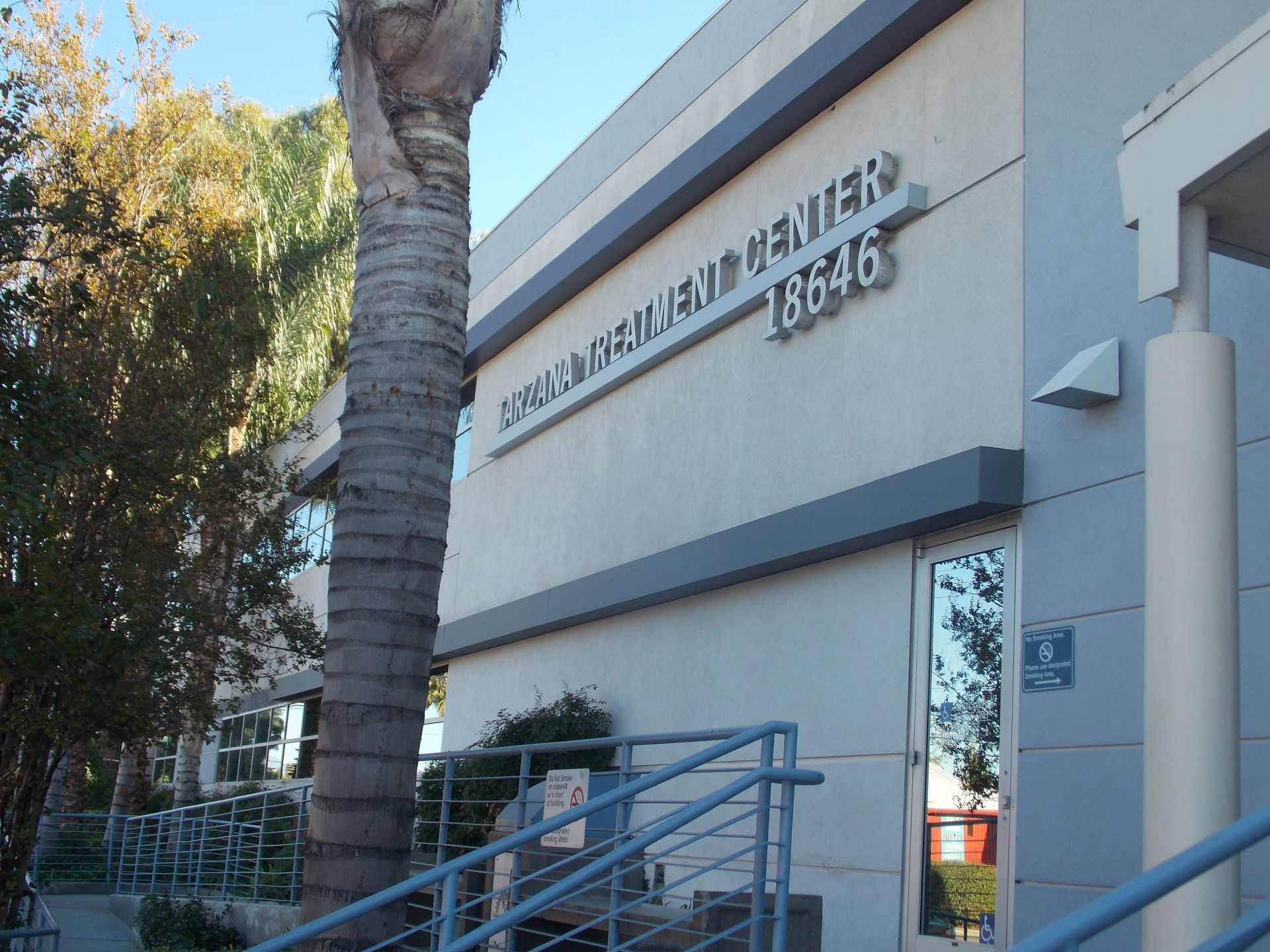
The Tarzana Treatment Centers in Los Angeles County provide outpatient and inpatient care for substance use disorders.i
The Tarzana Treatment Centers in Los Angeles County provide outpatient and inpatient care for substance use disorders.
Anna Gorman/KHN
Current federal rules limit drug treatment centers' ability to get reimbursed under Medicaid for residential care. Clinics with more than 16 beds essentially cannot get paid, except for treating pregnant and postpartum women. That restriction will be dropped for California under the waiver.
As a result, Medi-Cal beneficiaries will be able to access up to two 90-day residential stays each year, with the possibility of one 30-day extension if providers determine that it is medically necessary. Certain populations, including those in the criminal justice system, can get approval for longer stays.
The waiver is also designed to provide better coordination between physical, mental health and substance abuse services," according to John Connolly, deputy director of substance abuse prevention and control for the Los Angeles County Department of Public Health. That along with more access could result in fewer emergency room visits and hospitalizations, he said.
That's potentially good news for people like Caitlin Knoles, a resident of Orange County who says she gets turned down for treatment of her methamphetamine addiction every time she tells residential centers she's on Medi-Cal. She has ended up in the hospital more than once because of her addiction.
"It's hard," Knoles said. "I can't get help."
The only way she can reliably get clean now is in jail, she says.
"It'd be nice to have a job and have my family back and just be normal," said Knoles, 24, as she sat outside a liquor store in Laguna Hills.
For the first time, substance abuse disorders will be treated like a disease rather than a short-term illness, said Marlies Perez, chief of the substance use disorder compliance division for the state Department of Health Care Services. "Even though we know it's a chronic condition, we have treated it acutely," she said.
Much depends, however, on reimbursement rates, which are still being negotiated. Clinic officials say they need higher rates to expand services and handle the anticipated influx of clients, many of whom will be seeking rehab for the first time.
"There is a cost to raising the bar on treatment," said Albert Senella, president of the California Association of Alcohol and Drug Program Executives. "If the rates aren't adequate ... we are not going to be able to effectively meet the [new requirements] and the needs of the population."
Senella, who is also CEO of Tarzana Treatment Centers in Tarzana, Calif., said many clinics across the state don't have money to prepare for the overhaul, which will require improving technology and adding and training staff. For now, no plans are in place to provide counties or clinics with startup funds.
Eli Veitzer, interim CEO of Prototypes, which provides treatment services in Los Angeles, Orange and Ventura counties, said the waiver provides an "incredible opportunity" to transform care.
But in addition to fears about rates, Veitzer said he is also worried that 90 days of residential treatment won't be enough for many people. Someone may be able to stem their addiction in three months but will still need more time in a treatment facility to prepare for life outside.
"If their ability to function independently in the community is not addressed, they are likely to relapse," he said.
Danny Montgomery, a 33-year-old patient at Tarzana Treatment Centers, said he needed more than a few months to get clean after nearly a decade on heroin. The addiction, which he estimated cost him up to $100 a day, caused him to lose his job and nearly lose his family.
"The whole thing is a process," said Montgomery, who lives in the San Fernando Valley. "You get the substance removed from your body, but you have to retrain your mind." Montgomery said he tried to get a bed in a residential treatment center but couldn't find one that would take Medi-Cal.
He tried to get clean on his own but it never lasted. Months after beginning his search, Montgomery was finally able to get a spot at Tarzana. He said Los Angeles County is paying for his stay, which began in May.
As worried as they are about reimbursements, clinic operators said a big advantage of the new approach is that it could help stabilize their funding. Providers now depend largely on counties to pay for residential treatment for low-income residents.
"You always suffered the vagaries of the budget cycle," said Vitka Eisen, CEO of HealthRIGHT 360, which provides drug treatment in the Bay Area.
The waiver also means increased oversight of treatment centers.
Last year, a state audit found widespread fraud and questionable billing among Medi-Cal drug treatment providers. The audit followed reports by the Center for Investigative Reporting that clinics were billing for fake clients.
The new system will include more levels of accountability, Perez says, including more stringent requirements for clinics and more local control over contracting.
Knoles, who is addicted to methamphetamine, said she hopes that more people like her will be able to get treatment.
"I've had a lot of friends die from addiction," she said. "Imagine if they'd gotten the help they wanted and needed. Things would have been different."
Anna Gorman is a reporter with Kaiser Health News, a nonprofit news organization covering health care policy and politics. 
Via: http://www.npr.org/sections/health-shots/2015/12/11/459226074/california-expands-substance-abuse-treatment-for-low-income-residents

Thursday, January 2, 2014

Obamacare Met With Confusion, Relief At Start Of New Year

SACRAMENTO, Calif. (AP) — The new year brought relief for Americans who previously had no health insurance or were stuck in poor plans, but it also led to confusion after the troubled rollout of the federal health care reforms sent a crush of late applications to overloaded government agencies.
That created stacks of yet-to-be-processed paperwork and thousands — if not millions — of people unsure about whether they have insurance.
Mike Estes of Beaverton, Ore., finally received his insurance card on Dec. 27 after applying in early November. Still, the family was thrilled to have insurance through the Oregon Health Plan, Oregon's version of Medicaid, because their previous $380-a-month premium "literally crushed our family's finances," Estes said.
Obama administration officials estimate that 2.1 million consumers have enrolled so far through the federal and state-run health insurance exchanges that are a central feature of the federal law. But even before coverage began, health insurance companies complained they were receiving thousands of faulty applications from the government, and some people who thought they had enrolled for coverage have not received confirmation.
Tens of thousands of potential Medicaid recipients in the 36 states relying on the federal exchange also are in limbo after the federal website that was supposed to send their applications to the states failed to do so.
Reports of complications were scattered around the country.
In Burlington, Vt., the state's largest hospital had almost two dozen patients seek treatment with new health insurance policies, but more than half of those did not have insurance cards. Minnesota's health care exchange said 53,000 people had enrolled for coverage through its marketplace, but it was unable to confirm the insurance status of an additional 19,000 people who created accounts but did not appear to have purchased the plans.
In Connecticut, officials were pleading for patience as call centers fielded calls from people who are concerned because they had yet to receive a bill for premiums or an insurance identification card.
"This is an unprecedented time, because there are a record number of people who have applied for coverage with an effective date of Jan. 1," said Donna Tommelleo, a spokeswoman for the Connecticut Department of Insurance.

Wednesday, December 18, 2013

This Chart Blows Up the Myth of the Welfare Queen

The Bureau of Labor Statistics shows us the frugal reality of life on the social safety net. 

Here's a useful graph to keep handy for the next time Fox News airs a report about food stamp users buying lobster with their benefits.

This month, the Bureau of Labor Statistics compared yearly spending between families that use public assistance programs, such as food stamps and Medicaid, and families that don't. And surprise, surprise, households that rely on the safety net lead some pretty frugal lifestyles. On average, they spend $30,582 in a year, compared to $66,525 for families not on public assistance. Meanwhile, they spend a third less on food, half as much on housing, and 60 percent less on entertainment.


These figures, drawn from the 2011 Consumer Expenditure Survey, don't capture all non-cash perks some low-income families get from the government, such as healthcare coverage through Medicaid. But they give you a sense of the kind of tight finances these families deal with.

Take the food budget: There were, on average, 3.7 people in each family on public assistance (I know, that sounds weird, but bear with me). So that $6,460 spent on food comes out to about $34 per person, per week. Not exactly a shellfish budget. 

Monday, June 17, 2013

CALIF. OKS EXPANDED MEDI-CAL TO 1.4 MILLION UNINSURE


Sacramento — The Legislature passed a major piece of the federal Affordable Care Act on Saturday, opting to expand Medicaid to 1.4 million low-income Californians, as it rushed to meet its deadline to complete a state budget.
The action came a day after lawmakers passed the main budget bill outlining a $96.3 billion spending plan for the fiscal year that starts in July.

Saturday’s votes were on a handful of targeted bills. They included ones that would provide college scholarships for middle class families, increase grants for those in the welfare-to-work program, restore dental care for low-income adults, distribute money for school energy projects, and strengthen oversight of the California Public Utilities Commission.

The centerpiece legislation was the expansion of Medicaid, which is called Medi-Cal in California. Broadening the entitlement program to reduce the number of uninsured people in the country is one of the cornerstones of President Barack Obama’s national health care reforms.

Several Democratic lawmakers called Saturday’s vote historic. “We don’t know for certain that this will contain the costs; that’s certainly the goal. But … we also make sure health care is not considered a privilege of the fortunate few but as a basic human right,” said Sen. Mark Leno, D-San Francisco. “That’s what we’re implementing today. This is a big deal.”

Republicans raised concerns about whether California can afford the expansion over the long run, especially once the federal government drops its commitment from 100 percent to 90 percent.
Democrats included a provision in the bill that allows for future lawmakers to reconsider the expansion if the federal government’s share drops below 70 percent.

The federal government will pay the full cost of expanding the low-income health program for the first three years. It’ll reduce payments to 90 percent starting in 2020, putting the rest of the cost on the states that adopt the expansion.

Legislative Analyst Mac Taylor has estimated that by taking on new enrollees, the state could be responsible for between $300 million and $1.3 billion a year starting in 2020. “I worry about expectations that we set out for individuals with ACA in California and having the rug pulled out from underneath us without a funding mechanism,” said Sen. Ted Gaines, R-Rocklin.

Democrats said the expansion would help save lives, keep workers healthy and attract billions of dollars from the federal government into the state. Senate President Pro Tem Darrell Steinberg, D-Sacramento, noted taxpayers and those who have health insurance are paying for the medical care of those who go without insurance. The Medicaid expansion will cover many of those who now receive uncompensated care, he said.

By LAURA OLSON Associated Press 12:01 A.M.JUNE 16, 2013Updated8:04 P.M.JUNE 15, 2013

Thursday, May 16, 2013

California Budget Surplus: Golden State Debates What To Do With Extra Money


SAN FRANCISCO -- The late rapper Notorious B.I.G. may have been have hailed from New York, but his immortal maxim, "mo' money, mo' problems" has surfaced in the Golden State.
Earlier this week, California Gov. Jerry Brown unveiled his revised budget plan for the fiscal year that begins in July. It reaffirmed something that many in government have been predicting for some months: the state may be headed for a multi-billion dollar budget surplus resulting from the rebounding economy and a tax hike approved by voters last November.
The notoriously cash-strapped state spending less than it takes in hasn't occurred in more than a decade. Unsurprisingly, a lot of people have a lot of different ideas about how that money should be used -- from restoring government programs slashed from years of budget cuts to paying down the massive collection of debt obligations that the Los Angeles Times called a $28 billion cloud hanging over the state's future.
Though much of the surplus could be automatically diverted into the state's public education system, that hasn't stopped some in Sacramento from drawing up their own wish lists for what to do with the additional revenue.
Assembly Speaker John Perez (D-Los Angeles) said last week that his spending priorities include putting more money toward child care for poor families and providing increased financial assistance to college-bound Californians. "It's about responsibility," Perez told the Associated Press. "It's not about walking away from our obligations."
Other suggestions proffered by Democrats have included increased spending for the state's low-income Medicaid welfare program MediCal, reversing some of the deep cuts that have devastated the state's court system and increasing funding to job training programs. Some of these ideas were incorporated into the spending portion of the budget Brown made public on Tuesday.
Because Democrats hold supermajorities in both houses of the state legislature, not to mention a recent legal shift allowing the passage of a budget with a simple majority, the California GOP has been almost entirely shut out of the process.
Staying true to his public image as a voice of fiscal restraint Brown urged, well, fiscal restraint.
"Everybody wants to see more spending -- that's what this place is, it's a big spending machine," said the governor at a press conference in Sacramento earlier this week. "But I'm the backstop."
"It's not time to break out the champagne," he added.
That doesn't mean the administration is content to just stick the surplus in the bank and be done with it.
"Brown wants to use lot of this money for his new school funding program, where more money would be targeted toward schools in impoverished areas and with large percentages of non-English speakers, but a lot of members of the legislature don't seem to keen on this," San Jose State political science professor Larry Gerston said. What may ultimately happen is a compromise, with the governor agreeing to kick in some money for legislators' favored programs in exchange for getting more funding for schools, he said.
However, Gerson told HuffPost he's unsure this surplus will materialize. "California has a long history of promising surpluses that never actually come to be because predicting government income in our state is notoriously difficult," he explained. "When 75 percent of our revenues come from from a single [income] tax that primarily falls on high earners, one bump in the economy and your projection could be off by billions of dollars."
Gerston said he doesn't see as politically likely using the money to pay down any of the state's long-term debt obligations with anything more than a token contribution, even though the release of the original surplus projection in January is what triggered Standard & Poor's to boost California's credit rating.
The California legislature has until June 15 to approve Brown's budget.

Via Huffington Post