topnav

Home Issues & Campaigns Agency Members Community News Contact Us

Community News

Open dialogue among community members is an important part of successful advocacy. Take Action California believes that the more information and discussion we have about what's important to us, the more empowered we all are to make change.

Showing posts with label Food. Show all posts

Sunday, October 18, 2015

AB 1321 Passes: California Will Set Up Nutrition Incentive Program!

Governor Jerry Brown signed AB 1321 (Ting), which will set up the infrastructure for the Market Match program already running using mostly private funding throughout California. This is a tremendous victory that will be essential in scaling up the Market Match program, benefitting low income California residents struggling to afford healthy food, as well as the state’s small farm sector.

Tremendous thanks are owed to Roots of Change, the organization which sponsored the legislation and organized the advocacy efforts, from Northern California to the Central Valley to LA to San Diego, at every step of the way through the legislative process.

Hunger Action LA operates Market Match at 20 markets now in LA County, with the newest programs just beginning in the past month in Pasadena, Downtown LA, Santa Fe Springs and Eagle Rock. Our colleagues at SEE LA operate the program at 5 additional markets. AB 1321’s passage should pave the way for a bright future for the program.

Thank you, very much, to all of you who made phone calls and wrote letters of support---multiple times!---for the program. It’s another testament to the power of people’s voices if we but use them, in policy issues that affect us all.

Via: Hunger Action Los Angeles
http://www.hungeractionla.org/news_update_oct_13th_2015#ab1p

Sunday, March 16, 2014

California drought to drive up food prices in the long term

With 2013 the driest year on record and 2014 possibly worse, the devastation of California’s drought is trickling down to crops, fields, farmers markets, grocery stores — and the kitchen table.
While it’s too early to tell precisely how much the drought will push up household grocery bills, economists say consumers can expect to pay more for food later this year because fewer acres of land are being planted and crop yields are shrinking.
Large grocery chains have distribution networks and can import produce from around the world to keep customers in everything from cantaloupe to cauliflower, but experts say California’s smaller yields will inevitably lead to higher consumer prices here and elsewhere. Some consumers already are plotting ways to keep their food budgets under control if there is a big spike in prices.
“The first thing I would cut back on is eating meat,” retired schoolteacher Sharon Jay, 66, said as she shopped for pears and asparagus at a Safeway in Oakland’s lower Rockridge neighborhood. “And I wouldn’t go out to eat very often. If food costs go up, restaurant meals will cost more, too.”
Kathy Jackson, CEO of the Second Harvest Food Bank of Santa Clara and San Mateo Counties, which distributes 52 million pounds of food each year to low-income residents from Daly City to Gilroy, says the drought could prove devastating to the people her organization serves. That’s because 27 million pounds of the food her organization hands out annually is fruits and vegetables donated by California farms and growers.
Many of the families Second Harvest serves live in “food deserts” with no major retailers nearby, just corner stores. “Fresh produce is the most difficult food for our clients to both find and afford,” she said.
Jim Cochran of Swanton Berry Farm in Davenport, Calif., offers a hint of what may come. He stopped watering his artichokes a month ago and expects the cost of a pint of organic strawberries, which usually sell for $3.50 at Bay Area farmers markets, to go up roughly 20 percent to at least $4.20 a pint.
“We are going to have to sell our products for higher prices because we are not going to have the yield,” Cochran said. “We’re not trying to make more money; we’re trying to lose less.”
California is the nation’s largest producer of many fruits, vegetables and nuts. But with the traditional rainy season more than half over, farmers are making hard decisions about what crops to plant and how many acres to leave fallow. At least 500,000 prime acres, representing an area the size of Los Angeles and San Diego combined, are expected to go unplanted this spring because of insufficient water.
“We’re really concerned about the extent to which acreage is being taken out of action,” said Richard Volpe, an economist in the Foods Markets Branch of the U.S. Department of Agriculture. “The real economic impact is long term and will be felt down the road, when there will be a structural shift in prices.”
Dave Heylen, spokesman for the California Grocers Association — which represents 80 percent of the grocery stores in California, including large chains like Safeway and Trader Joe’s — said the reduced planting may result in a limited supply of particular produce at certain times of the year. But he declined to speculate on the exact impact the drought will have on food prices, noting that large retailers have global distribution systems that give them access to foods from other parts of the country and throughout the world.
“When I was growing up, when peach season was over it was over; there were no more peaches,” Heylen said. “Now you can get peaches from South America.”
While California’s drought may be good for growers elsewhere, the state’s farmers are feeling increasing stress. Last week, the federal government announced that it will not allocate any water to the Central Valley via the federally controlled Central Valley Project, California’s largest water delivery system. The Westlands Water District provides water to nearly 600 farms in western Fresno and Kings counties and now has to contend with an allocation of zero. Roughly 200,000 acres of the 500,000 acres of land expected to be taken out of production this year fall within Westland’s boundaries.
“Typically there would be huge amounts of lettuces in the ground right now, and you are going to see lost production of lettuce,” said Gayle Holman of the Westlands Water District. “As we move further into the prime harvest season, consumers are not going to see as many California-grown honeydew, cantaloupes and watermelon at their Fourth of July celebrations. We imagine higher prices, higher demand and less availability. We need buckets of daily rainfall to even get us to the point of catching up to the worst-case scenario.”
Besides being the nation’s leading wine and dairy state, California produces 80 percent of the world’s almonds and is a major producer of strawberries, walnuts, celery, leaf lettuce, spinach and cattle. The $45 billion agriculture sector includes 2.6 million acres of permanent crops like almonds and grapes, which allow farmers less flexibility in tough times.
“There will be thousands of acres of fruit and nut trees that will die this year because of lack of water,” said David Sunding, a professor in the College of Natural Resources at UC Berkeley. “The reduction in yield will drive up prices.”
But Mike Wade, executive director of the California Farm Water Coalition, said the precise impact on consumers is difficult to gauge because other states and countries might increase production of the crops that California farmers cut back on.
“We’re not expecting to see much in terms of spring planting of peppers and melons,” said Wade. “But planting may be ramped up somewhere else. It could be grown in Arizona or Mexico.”
Full Belly Farm, a 350-acre organic farm in Yolo County’s Capay Valley, is cutting back on water-intensive crops like corn and melons, which means that there will be less variety at Bay Area farmers markets. And the lack of rain has forced growers to spend money fighting another intrusion: wildlife. Deer and wild pigs are increasingly coming onto the farm in search of food, and Full Belly expects to spend $20,000 this year just on fencing.

PHOTO: President Barack Obama, walks and chats with Joe De Bosque, second from right, and his wife Maria Gloria De Bosque, far right, while California governor Jerry Brown walks at the far left, addressing drought issues on the couple's farmland south of Los Banos, Calif. on Friday. (The Fresno Bee, Eric Paul Zamora, AP Photo) 

via: http://www.sbsun.com/business/20140312/california-drought-to-drive-up-food-prices-in-the-long-term

Wednesday, March 12, 2014

Californians' food assistance use doubled during recession

As recession gripped the state a half-decade ago, Californians receiving what used to be called food stamps more than doubled to more than four million, a legislative hearing was told Tuesday, but the state still has, relatively, a very low rate of utilization.

Californians' use of what is now called CalFresh may be the lowest in the nation, a report from the Legislature's budget analyst says.

The state's utilization rate of 57 percent of eligible low-income Californians was calculated by the federal government for 2011 and was tied with Wyoming for the lowest. The national average was 79 percent that year, indicating that were California to reach that level, another 1.4 million Californians would be receiving the electronic benefit cards that replaced food stamps and are used in grocery stores to purchase approved foods.

The report said that the food assistance program increased from two million persons in 2006-07 to more than four million in 2013-13 and showed an especially large jump — nearly 25 percent — in 2009-10, during the depths of the recession. While enrollment is still growing, the rate of increase has dropped to scarcely 5 percent a year as the economy has improved.

However, the report from Legislative Analyst Mac Taylor's office warned legislators that the federal data on utilization may be outdated and otherwise not a true picture of what's happening with the federally financed program in California, although it did not question that the state's use is below average.

The joint hearing by the Assembly and Senate human services committees was called to delve into ways to increase utilization. It heard from a variety of advocates for the poor, as well as state and local officials who administer the program.

PHOTO: Volunteers sort boxes of food at the Elk Grove Food Bank Services in Elk Grove on Feb. 20, 2014. The Sacramento Bee/Randall Benton

Wednesday, December 25, 2013

The Republican War on Hungry Women: The Newly Invisibile and Undeserving Poor

While the rest of the world debates America's role in the Middle East or its use of drones in Pakistan and Afghanistan, the U.S. Congress is debating just how drastically it should cut food assistance to the 47 million Americans -- one out of seven people -- who suffer from "food insecurity," the popular euphemism for those who go hungry.
The U.S. Government began giving food stamps to the poor during the Great Depression. Even when I was a student in the 1960s, I received food stamps while unemployed during the summers. That concern for the hungry, however, has evaporated. The Republicans -- dominated by Tea Party policies -- are transforming the United States into a far less compassionate and more mean-spirited society.
The need is great. Since the Great Recession of 2008, the food stamp program, now called Supplemental Nutrition Assistance Program (SNAP), has doubled from $38 billion in 2008 to $78 billion in the last year. During 2012, 65 million Americans used SNAP for at least one a month, which means that one out of every five Americans became part of the swelling rolls of "needy families," most of whom are women and children.
Democrats defend the new debit card program, which can only be used to purchase food, as feeding needy Americans at a time of high unemployment and great poverty. Republicans, for their part, argue that the program is rife with fraud, that its recipients (who are mostly single mothers) are lazy and shiftless, and that we must make drastic cuts to reduce government spending. Their most Dickensian argument is that if you feed the poor, they won't want to work.
But as the New York Times economic columnist Paul Krugman has repeatedly pointed out, welfare entitlements, including the food debit card, are not only good for families; they are also good for the economy. People who receive such help spend the money immediately. Single mothers hold down multiple jobs at minimum wages to keep their family together. The debit card allows them to go shopping and to buy needed groceries. Such entitlements boost spending and the economy, rather than depleting it.
Despite these arguments, the cuts have already begun. On November 1, 2013, Congress cutnearly $5 billion from SNAP and Republicans now want to cut another $40 billion dollars. The stalemate has resulted in the failure of Congress to pass the farm bill, which provides SNAP subsidies to farms, mostly of which are large agricultural corporations.
Meanwhile, poverty grows, the stock market zooms to new heights, the wealth of the one percent increases, and corporate executives continue to get tax exemptions for business entertainment expenses, which allow corporations to deduct 50 percent of these costs from their annual taxes.
In all this discussion, the real face of poverty -- single mothers -- has strangely disappeared. Welfare policy in America has always favored mothers and children. In a country that values self-sufficiency and glorifies individualism, Americans have viewed men -- except war veterans -- as capable of caring for themselves, or part of the undeserving poor. Women, by contrast, were always viewed as mothers with dependents, people to be cared for and protected precisely because they are vulnerable and raise the next generation.
As I read dozens of think tank and government reports, and newspaper stories, however, I am surprised to notice that even strong opponents of the cuts describe SNAP's recipients as children, teenagers, seniors or the disabled. Why have single mothers disappear from such accounts about the poor? There are plenty of "needy families," "households," and "poor Americans," but the real face of poverty and the actual recipients of food assistance are single mothers, whose faces have been absorbed by the more abstract language of "poor Americans" and "needy households."
Even the strongest opponents of these cuts don't focus on women or mothers. Instead they publicize pinched-faced children -- a better poster image -- staring hungrily at food they cannot eat. Or, they discuss the public health impact these cuts may have on children. According to most reports, even from the Agriculture Department, "children and teenagers" make up almost half of the recipients of food assistance. But they don't mention the mothers who receive this assistance in order to feed those children and teenagers. From the stories about food stamps, you'd think that only children, teenagers, the elderly and the disabled have gone hungry.
The words "women" or even "mothers" rarely appear. In a powerful column against the cuts, the liberal and compassionate New York Times columnist Nicholas Kristof, for example, argued that "two-thirds of recipients are children, elderly or disabled" and warnedhis readers about the long-range impact of malnourished children. He, too, never mentioned women, who are the main adult recipients of the SNAP program and who feed those children, elderly or disabled. Nor did he point out that those who apply for such assistance are the mothers and women who seek to nourish these children. It's as though women are simply vehicles, not persons, in the reproduction process of the human race.
Yet the reality tells a different story. In 2010, for example, 42 percent of single mothersrelied on SNAP and in rural areas, the rate often rose as high as one-half of all single mothers. What's missing from this picture -- on both sides -- are the real faces of hunger, which are not "needy" families, or "poor Americans", but single mothers with "food insecurity" for themselves and their families. According to the Center for Budget Priorities, women are twice as likely to use food stamps as anyone else in the population. They are the ones who apply for the SNAP debit card, go shopping, takes buses for hours to find discounted food supplies, and try to stretch their food to last throughout the month for their children, teenagers and, less often, husbands. They are the pregnant women with older children whose infants are born malnourished, and the Americans who, at the end of the month, make hasty runs to relatives, food banks and even join other dumpster divers.
When journalists do focus on the women who are recipients of food assistance, they discover a nightmare hiding in plain sight. These women are either unemployed, under-employed or service workers who don't earn enough to feed themselves and their families. By the end of the month, they and their children frequently often skip meals or eat one meal a day until the next month's SNAP assistant arrives.
So why have women disappeared from a fierce national debate over who deserves food assistance? I'm not actually sure. Perhaps it is because so many adult women, like men, now work in the labour force and are viewed as individuals who should take care of themselves. Perhaps it is because Republicans find women's appetite, as opposed to that of children, an embarrassment, hinting at sexual desire. Perhaps it is because this is part of the Republican war on women's reproductive freedom -- a single mother with children is somehow guilty of bringing on her own poverty.
Whatever the reason, the rhetoric does not match the reality. Once in while, the media publishes or broadcasts a "human interest" story that gives poor women a face.
"It is late October," one reporter began, "so Adrianne Flowers is out of money to buy food for her family. Feeding five kids is expensive, and the roughly $600 in food stamps she gets from the federal government never lasts the whole month. 'I'm barely making it, said the 31-year-old Washington, D.C., resident and single mother."
End of story. On to weather and the sports.
For the most part, however, poor women remain invisible, even as the mothers who feed the children, teenagers, elderly and disable who live with them. They do not elicit compassion. If anything, they are ignored or regarded with contempt.
Whatever the reason, Americans are having a national debate about poor and needy Americans without addressing the very group whose poverty is the greatest. The result is that we are turning poor, single mothers, who are 85 percent of all single parents, into a newly invisible and undeserving group of recipients.
Republicans may view single mothers as sinful parasites who don't deserve food assistance. But behind every hungry child, teenager and elderly person is a hungry mother who is exhausted from trying to keep her family together. Women who receive food assistance are neither invisible nor undeserving. They are working-class heroes who work hard -- often at several minimal wage jobs -- to keep their families nourished and together.
This story originally appeared on openDemocray.net.
 

Wednesday, December 18, 2013

This Chart Blows Up the Myth of the Welfare Queen

The Bureau of Labor Statistics shows us the frugal reality of life on the social safety net. 

Here's a useful graph to keep handy for the next time Fox News airs a report about food stamp users buying lobster with their benefits.

This month, the Bureau of Labor Statistics compared yearly spending between families that use public assistance programs, such as food stamps and Medicaid, and families that don't. And surprise, surprise, households that rely on the safety net lead some pretty frugal lifestyles. On average, they spend $30,582 in a year, compared to $66,525 for families not on public assistance. Meanwhile, they spend a third less on food, half as much on housing, and 60 percent less on entertainment.


These figures, drawn from the 2011 Consumer Expenditure Survey, don't capture all non-cash perks some low-income families get from the government, such as healthcare coverage through Medicaid. But they give you a sense of the kind of tight finances these families deal with.

Take the food budget: There were, on average, 3.7 people in each family on public assistance (I know, that sounds weird, but bear with me). So that $6,460 spent on food comes out to about $34 per person, per week. Not exactly a shellfish budget. 

Monday, May 28, 2012

Are Healthy Foods Really More Expensive? It Depends on How You Measure the Price


Healthy food, we’ve often heard, is pricey food. Fruits and vegetables -- they’re expensive! We can’t afford to eat that way! That’s why we don’t do it!

The U.S. Department of Agriculture wants us to understand that this isn’t the case, and held a news conference Wednesday to report the results of a study that examined the matter.

Study lead author Andrea Carlson from the USDA’s Economic Research Service presented the 50-page report, entitled “Are Healthy Foods More Expensive? It Depends On How You Measure the Price."

Carlson explained that most studies measure the prices of groceries based on price-per-calorie. And when prices are computed that way, sure enough, items like broccoli do end up being more expensive than the likes of maple-glazed donuts. What about that?

(It may just be me, but isn't it a little astounding that analyses are generally done this way? Calories are not what most Americans lack.)

Carlson and her colleague, Elizabeth Frazao, calculated food costs the price-per-calorie way and two
additional ways.

One method -- price per edible weight -- calculated price based on the weight of food once it was all
prepared (that is scaled, seeded, hulled, bones removed, cooked, etc.).

A third way was price per average amount -- meaning how much people actually eat of a food. (You could
see how broccoli would end up being a heck of a lot cheaper than maple-glazed donuts if prices were
calculated this third way.)

They used a database of more than 4,000 food items and sorted them into several groups: the five USDA
food groups -- grains, dairy, fruit, vegetables or protein foods -- as well as mixed dishes and “less healthy”
items. Less-healthy foods had too much saturated fat, sodium or added sugars or were just generally
lacking, five-food-group-wise. (Interestingly, a lot of canned soups as well as fruit-flavored yogurt fell into
that group.)

“If we use price per calorie, fruits and vegetables tend to be more expensive than less healthy food,” Carlson
wrote on the USDA blog. “If we use price per edible weight or per average amount eaten, then grains,
vegetables, fruits and dairy foods are less expensive than most protein foods and less healthy foods.”

The research “challenges the widely held belief that ‘Gee, I just can’t eat healthily affordably,’ ” commented
Kevin Concannon, USDA undersecretary for food, nutrition and consumer services.

It is still true that the USDA’s vegetable recommendation is the most expensive to meet because we’re
meant to eat a whole bunch of vegetables, Carlson notes. (The recommendation depends on your age and
level of physical activity: I just calculated mine and I should eat 1.5 cups of fruit and 2.5 cups of vegetables a
day. Try computing your own.) 

But there are always ways to eat cheaply and healthily just by choosing the right foods, Carlson said.
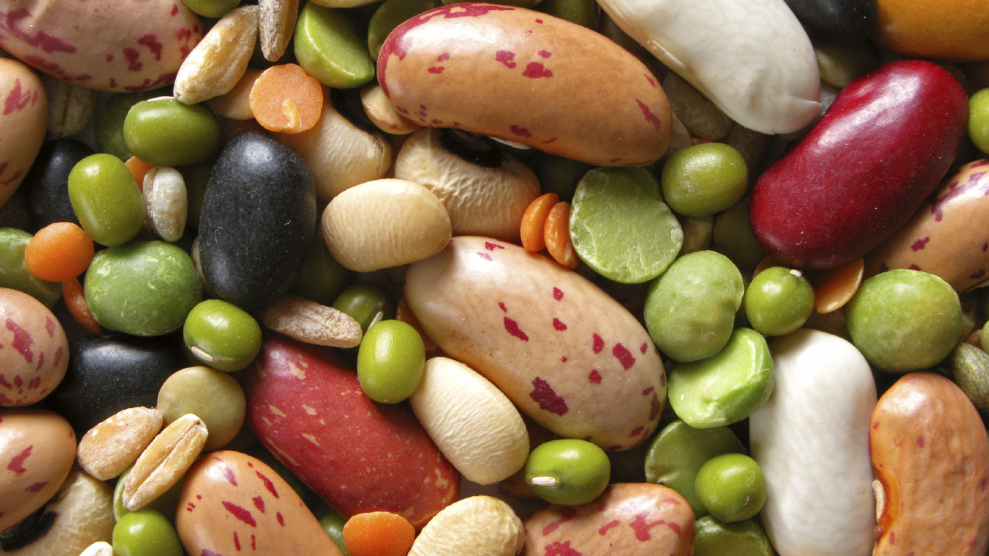
Cabbage, onions and beans come to mind.

Some may protest that the cheap-eating methods involve skills beyond the current ability of many Americans
because cooking is a lost art. Carlson says culinary cluelessness should be no barrier. Fresh fruit? Wash and
eat. Beans? Defrost, or open a can. “I know cooking skills are lacking but I think we can still use a can
opener,” she said.

Perhaps the bigger issue is what people actually like to eat. A burger and fries or a whole mess of cabbage
and beans? “My study doesn’t really cover what consumers value, but we do know from other studies that
taste is the first thing that people consider … taste and convenience,” Carlson said.

News conference participants noted that there are a variety of tools on the USDA website to help people
eat well on a shoestring.

And check out these thrifty-eating tips compiled by freelance writer Karen Ravn for a previous L.A. Times
article.

Via: http://www.latimes.com/health/boostershots/la-heb-healthy-cheap-food-usda-20120516,0,2551287.story