topnav

Home Issues & Campaigns Agency Members Community News Contact Us

Community News

Open dialogue among community members is an important part of successful advocacy. Take Action California believes that the more information and discussion we have about what's important to us, the more empowered we all are to make change.

Showing posts with label California poverty. Show all posts

Monday, December 21, 2015

California adds just 5,500 jobs in November; unemployment rate declines to 5.7%

California employers added just 5,500 jobs in November, according to federal data — a significant slowdown from more robust monthly gains earlier in the year.
But the state unemployment rate continued its five-year-long decline, dropping to 5.7% in November, the lowest in eight years. The U.S. unemployment rate is 5%.
November's tepid job increases were the lowest one-month jump in more than four years, and far less than the 40,600 job gains the state posted in October.


But economists cautioned against reading too much into monthly swings in the employment data, which often are subject to revisions. September's numbers, for example, were revised upward from 8,200 positions to 21,100 jobs.
“We're reading the economy on the fly,” said Robert Kleinhenz, chief economist for the Los Angeles County Economic Development Corp. “That's just the nature of these economic statistics.”
Despite the lackluster November, California's payroll employment grew 2.6% over last year, faster than all but six other states and better than the national rate of 1.9%.
Construction continued to be the leading growth sector, as the industry continues to rebound from the housing crash. The high-paying professional and technical services industry — including lawyers, accountants, architects and engineers — also recorded some of the fastest job growth in the state.


The only industries to post losses were mining and logging, along with manufacturing and financial services.
The state unemployment rate is down significantly from a year ago, when it stood at 7.2%. The jobless rate is often criticized as an incomplete economic indicator because it doesn't count discouraged job seekers who have dropped out of the labor force.
Some of those who stopped seeking employment may be returning to the labor force, which has expanded over the last year even as unemployment fell. That suggests newly returned job seekers may be finding success.
Economists say job growth tends to taper off as an economic expansion progresses. The U.S. is technically in the seventh year of expansion.
Although California's economic growth has outperformed the nation, there are still reasons for many people to believe their fortunes have not improved.
The gap between high and low earners is more pronounced in California because wages for middle-income earners have fallen.
Since 2006, median wages have declined 6.2% in California, compared with 1.9% for the U.S. overall, according to the California Budget & Policy Center.


And while the share of part-time workers has declined since the depths of the Great Recession, that segment of the workforce is still larger than in the mid-2000s. About 5.9% of workers in California are considered part-time for economic reasons — meaning that they are unable to find full-time work.
That's down from 9.6% of the workforce in 2010, but still higher than when the economy last peaked in 2006.
“We don't want to miss the point that we are in one of the better times, employment-wise, in the last 40 years in California,” said Michael Bernick, a former director of the California Employment Development Department. “But at the same time, these numbers don't represent a lot of the instability: the part-time, contingent nature of the evolving labor market.”
Via Chris Kirkham, Los Angeles Times
http://www.latimes.com/business/la-fi-california-jobs-20151218-story.html

Friday, December 18, 2015

Poverty Hitting One in Six Californians


The economic recovery in California has not reached a sizable percentage of the population, with more than 16% of Californians living in poverty, according to an analysis released Tuesday by the California Budget and Policy Center.
In most California counties, the poverty rate increased from 2007 to 2014. Of the 40 California counties with available data, 32 had higher poverty rates last year than they did in 2007 before the state's recession began, the study said.
The California Budget and Policy Center is a not-for-profit that conducts independent, nonpartisan budget analysis.
"Millions of Californians continue to struggle to meet their basic needs, even after several years of steady job gains," the study said. "Poverty remained widespread even though the state's unemployment rate declined from a high of 12.2% in 2010 to 7.5% in 2014."
The federal poverty line is about $19,000 for a family of three. The overall rate fell slightly between 2012 and 2014 -- by 0.6% -- but the 2014 level of 16.4% is a full 4 percentage points higher than it was in 2007.
The study highlighted the differences between counties:
  • Not only was the poverty rate higher in 32 of the 40 counties with available data from 2007 to 2014, but there was no statistically significant difference in poverty rates in the other 8 counties;
  • In Lake County, the poverty rate rose to 25.9% of the population. In Kings County, 26.6% live in poverty;
  • In Lake, Kings and San Bernardino counties, the poverty rate jumped by more than 8 percentage points from 2007 to 2014; and
  • In 15 other counties, poverty rates in 2014 were 4 to 8 percentage points higher than in 2007. Most of those counties are in the Central Valley and in the Sacramento region.
"Many factors could contribute to the uneven recovery across California's counties," fact sheet author Alissa Anderson wrote. "These include differences in the availability of well-paying jobs and/or of sufficient work hours, as well as changes in county demographics, such as whether large numbers of people who struggle to get by move into a county."

By David Gorn
Via http://www.californiahealthline.org/capitol-desk/2015/12/poverty-hitting-one-in-six-californians

Thursday, July 16, 2015

New study says a third of Californians in poverty

Nearly a third of California’s households “struggle each month to meet basic needs,” largely because of the state’s high cost of living, a new study by United Ways of California concludes.

The study relies on what the organization calls a “real cost measure” that goes well beyond the Census Bureau’s official poverty measure, which dates back to the early 1960s and pegs California’s rate at just half of what the United Ways study found.

The organization’s methodology is, however, similar in thrust to an alternative poverty measure that includes all forms of income and is adjusted for the cost of living. By that measure, nearly a quarter of California’s 39 million residents are living in poverty.

The United Ways study is centered on a household budget “composed of costs all families much address, such as food, housing, transportation, child care, out-of-pocket health expenses and taxes.”

While overall, by that method, 31 percent of California’s families “lack income adequate to meet their basic needs,” the rates vary widely by ethnic group and locale.

Over half of Latino families fall under the United Ways poverty measure, as well as 40 percent of black families. White families (20 percent) and Asian-American households 28 percent) are better off.

Geographically, poverty rates range from as high as 80 percent in inner city Los Angeles to as low as 9 percent in suburban Contra Costa County.

The study identified housing costs as the major factor in poverty, with struggling families spending over half of their incomes for shelter, with rents of two-bedroom housing units ranging from $584 a month in Modoc County to $1,905 in Marin, San Francisco and San Mateo counties.


Via: http://www.sacbee.com/news/politics-government/capitol-alert/article27256111.html

Monday, January 13, 2014

Governor Brown Heads to the Inland Empire

Media Advisory: 1/14/2014
ContactMaribel Nunez, (562) 569-4051 mnunez@communitychange.org
Spanish Speakers Available

***MEDIA ADVISORY***

3:00 PM on January 14, 2014
Location: Riverside County Office of Education 3939 13th Street, Riverside, CA 92501

RIVERSIDE SENIORS, FAMILIES, PEOPLE WITH DISABILITIES AND ADVOCATES DEMAND GOVERNOR BROWN BUILD A ROAD OUT OF POVERTY IN CALIFORNIA

Event will focus on sharing the personal stories of how residents are living in poverty and demand that Governor Brown build a road out of California’s poverty crisis.

RIVERSIDE- Over the past week anti-poverty advocates and community members have been holding events across the state in response to the 50th anniversary of the War on Poverty and Governor Brown’s release of a proposed budget for California. They have been calling on Governor Brown to build a road out of poverty in California by reinvesting in the state’s social safety net in the California budget.
This event in Riverside will coincide with Governor Brown’s Tuesday January 14th trip to the area to hold meetings with local leaders and will encourage the Governor to confront the reality of California’s poverty crisis that he is ignoring with his 2014-15 proposed budget.

What: Community members and Health and human services advocates will gather for a press event to share personal stories of how this poverty crisis is impacting their lives and call on Governor Brown to build a road out of poverty in California for the 8.7 million Californian’s.

Where: Riverside County Office of Education, 3939 13th Street, Riverside, CA 92501

When: 3:00 PM on January 14, 2014

Speakers: Community stories on the need of restorations to Medi-Cal, childcare, CalWORKs, SSI and IHSS. 
Event Contact: Maribel Nunez, mnunez@communitychange.org (562) 569-4051
# # #
About California Partnership
California Partnership is a statewide coalition of community-based groups, organizing and advocating for the policies and programs that work to reduce and end poverty. Our mission is to organize to build power and leadership among low-income communities by strengthening our voice and collective power to advocate for the policies that affect our lives the most.
For more information, please visit www.California-Partnership.org
Best Regards,

Maribel Nunez
California Partnership-Inland Empire Organizer

(562) 569-4051

Wednesday, December 25, 2013

The Republican War on Hungry Women: The Newly Invisibile and Undeserving Poor

While the rest of the world debates America's role in the Middle East or its use of drones in Pakistan and Afghanistan, the U.S. Congress is debating just how drastically it should cut food assistance to the 47 million Americans -- one out of seven people -- who suffer from "food insecurity," the popular euphemism for those who go hungry.
The U.S. Government began giving food stamps to the poor during the Great Depression. Even when I was a student in the 1960s, I received food stamps while unemployed during the summers. That concern for the hungry, however, has evaporated. The Republicans -- dominated by Tea Party policies -- are transforming the United States into a far less compassionate and more mean-spirited society.
The need is great. Since the Great Recession of 2008, the food stamp program, now called Supplemental Nutrition Assistance Program (SNAP), has doubled from $38 billion in 2008 to $78 billion in the last year. During 2012, 65 million Americans used SNAP for at least one a month, which means that one out of every five Americans became part of the swelling rolls of "needy families," most of whom are women and children.
Democrats defend the new debit card program, which can only be used to purchase food, as feeding needy Americans at a time of high unemployment and great poverty. Republicans, for their part, argue that the program is rife with fraud, that its recipients (who are mostly single mothers) are lazy and shiftless, and that we must make drastic cuts to reduce government spending. Their most Dickensian argument is that if you feed the poor, they won't want to work.
But as the New York Times economic columnist Paul Krugman has repeatedly pointed out, welfare entitlements, including the food debit card, are not only good for families; they are also good for the economy. People who receive such help spend the money immediately. Single mothers hold down multiple jobs at minimum wages to keep their family together. The debit card allows them to go shopping and to buy needed groceries. Such entitlements boost spending and the economy, rather than depleting it.
Despite these arguments, the cuts have already begun. On November 1, 2013, Congress cutnearly $5 billion from SNAP and Republicans now want to cut another $40 billion dollars. The stalemate has resulted in the failure of Congress to pass the farm bill, which provides SNAP subsidies to farms, mostly of which are large agricultural corporations.
Meanwhile, poverty grows, the stock market zooms to new heights, the wealth of the one percent increases, and corporate executives continue to get tax exemptions for business entertainment expenses, which allow corporations to deduct 50 percent of these costs from their annual taxes.
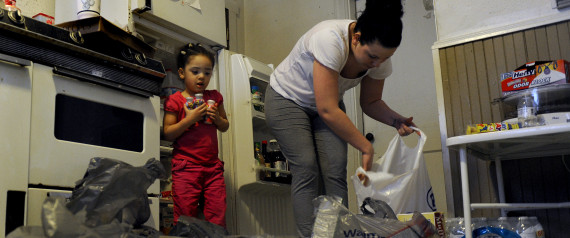
In all this discussion, the real face of poverty -- single mothers -- has strangely disappeared. Welfare policy in America has always favored mothers and children. In a country that values self-sufficiency and glorifies individualism, Americans have viewed men -- except war veterans -- as capable of caring for themselves, or part of the undeserving poor. Women, by contrast, were always viewed as mothers with dependents, people to be cared for and protected precisely because they are vulnerable and raise the next generation.
As I read dozens of think tank and government reports, and newspaper stories, however, I am surprised to notice that even strong opponents of the cuts describe SNAP's recipients as children, teenagers, seniors or the disabled. Why have single mothers disappear from such accounts about the poor? There are plenty of "needy families," "households," and "poor Americans," but the real face of poverty and the actual recipients of food assistance are single mothers, whose faces have been absorbed by the more abstract language of "poor Americans" and "needy households."
Even the strongest opponents of these cuts don't focus on women or mothers. Instead they publicize pinched-faced children -- a better poster image -- staring hungrily at food they cannot eat. Or, they discuss the public health impact these cuts may have on children. According to most reports, even from the Agriculture Department, "children and teenagers" make up almost half of the recipients of food assistance. But they don't mention the mothers who receive this assistance in order to feed those children and teenagers. From the stories about food stamps, you'd think that only children, teenagers, the elderly and the disabled have gone hungry.
The words "women" or even "mothers" rarely appear. In a powerful column against the cuts, the liberal and compassionate New York Times columnist Nicholas Kristof, for example, argued that "two-thirds of recipients are children, elderly or disabled" and warnedhis readers about the long-range impact of malnourished children. He, too, never mentioned women, who are the main adult recipients of the SNAP program and who feed those children, elderly or disabled. Nor did he point out that those who apply for such assistance are the mothers and women who seek to nourish these children. It's as though women are simply vehicles, not persons, in the reproduction process of the human race.
Yet the reality tells a different story. In 2010, for example, 42 percent of single mothersrelied on SNAP and in rural areas, the rate often rose as high as one-half of all single mothers. What's missing from this picture -- on both sides -- are the real faces of hunger, which are not "needy" families, or "poor Americans", but single mothers with "food insecurity" for themselves and their families. According to the Center for Budget Priorities, women are twice as likely to use food stamps as anyone else in the population. They are the ones who apply for the SNAP debit card, go shopping, takes buses for hours to find discounted food supplies, and try to stretch their food to last throughout the month for their children, teenagers and, less often, husbands. They are the pregnant women with older children whose infants are born malnourished, and the Americans who, at the end of the month, make hasty runs to relatives, food banks and even join other dumpster divers.
When journalists do focus on the women who are recipients of food assistance, they discover a nightmare hiding in plain sight. These women are either unemployed, under-employed or service workers who don't earn enough to feed themselves and their families. By the end of the month, they and their children frequently often skip meals or eat one meal a day until the next month's SNAP assistant arrives.
So why have women disappeared from a fierce national debate over who deserves food assistance? I'm not actually sure. Perhaps it is because so many adult women, like men, now work in the labour force and are viewed as individuals who should take care of themselves. Perhaps it is because Republicans find women's appetite, as opposed to that of children, an embarrassment, hinting at sexual desire. Perhaps it is because this is part of the Republican war on women's reproductive freedom -- a single mother with children is somehow guilty of bringing on her own poverty.
Whatever the reason, the rhetoric does not match the reality. Once in while, the media publishes or broadcasts a "human interest" story that gives poor women a face.
"It is late October," one reporter began, "so Adrianne Flowers is out of money to buy food for her family. Feeding five kids is expensive, and the roughly $600 in food stamps she gets from the federal government never lasts the whole month. 'I'm barely making it, said the 31-year-old Washington, D.C., resident and single mother."
End of story. On to weather and the sports.
For the most part, however, poor women remain invisible, even as the mothers who feed the children, teenagers, elderly and disable who live with them. They do not elicit compassion. If anything, they are ignored or regarded with contempt.
Whatever the reason, Americans are having a national debate about poor and needy Americans without addressing the very group whose poverty is the greatest. The result is that we are turning poor, single mothers, who are 85 percent of all single parents, into a newly invisible and undeserving group of recipients.
Republicans may view single mothers as sinful parasites who don't deserve food assistance. But behind every hungry child, teenager and elderly person is a hungry mother who is exhausted from trying to keep her family together. Women who receive food assistance are neither invisible nor undeserving. They are working-class heroes who work hard -- often at several minimal wage jobs -- to keep their families nourished and together.
This story originally appeared on openDemocray.net.
 

Wednesday, November 6, 2013

California still has highest poverty rate under new method

California still has - by a huge margin - the highest poverty rate of any state under an alternative Census Bureau calculation that includes the cost of living.

The Census Bureau report, issued Wednesday, says that nearly a quarter of California's 38 million residents live in poverty by the alternative method - almost 9 million - and the state's 23.8 percent rate is approached only by Washington, D.C.'s 22.7 percent.

Among other states, the second highest alternative poverty rate is found in Nevada at 19.8 percent while the lowest rates are found in Iowa (8.6 percent) and Wyoming (9.2 percent). Nationally, the alternative rate is 16 percent.while higher than the national official rate of 15.1 percent, it is surpassed by those of many other states.

The official rate is based on half-century-old criteria that have been criticized as being obsolete, leading the Census Bureau to develop the alternative method that uses broader indices, including the cost of living. The official rate assumes, in essence, that the cost of living is the same nationwide.

California scored the highest rate during the Census Bureau's first report on the alternative method and continues with that dubious title. A few weeks ago, the Public Policy Institute of California released a report using methodology similar to the Census Bureau's alternative and came up with similar results.

The official rate is used for a wide variety of federal and state programs. Were the alternative method to become the official one, there would be huge upheavals in those programs, possibly meaning a big jump in federal aid to California.

PHOTO: Kazoo Yang, 31, spent most of the day packing up her possessions as Sacramento police officers evict 150 homeless people from an illegal campground along the American River. The Sacramento Bee/Manny Crisostomo

via http://blogs.sacbee.com/capitolalertlatest/2013/11/california-still-has-highest-poverty-rate-under-new-method.html

Tuesday, October 1, 2013

L.A. County leads California in poverty rate, new analysis shows

Los Angeles has the highest poverty rate among California counties, according to a new analysis announced Monday that upends traditional views of rural and urban hardship by adding factors such as the soaring price of city housing.
The measurement, developed by researchers with the Public Policy Institute of California and the Stanford Center on Poverty and Inequality, found that 2.6 million, or 27%, of Los Angeles County residents lived in poverty in 2011. The official poverty rate for the county, based on the U.S. Census' 2011 American Community Survey, is 18%.
The new analysis set California's poverty rate at 22%, the highest in the nation, compared with the official rate of 16%. Counties such as Placer and Sacramento, with more moderate housing costs, have lower poverty rates than those of metropolitan areas, researchers said.
"We always see maps of official poverty and think of the Central Valley as the most impoverished," said economist Sarah Bohn, a research fellow at the public policy institute and one of the study's authors. "This really turns that on its head."
The new model aims to present a fuller picture of poverty by taking into account living expenses and government benefits ignored in the official formula.
Social scientists have argued for decades that the federal definition of poverty, which dates to the early 1960s, falls short on two counts: ignoring the benefits of government aid, including food stamps, Social Security, subsidized housing and tax credits, and failing to account for regional cost differences in transportation, healthcare and housing.
The report released Monday found that although many Californians find it difficult to make ends meet, things would be much worse without state, federal and local safety net programs, including food stamps, CalWORKs and the earned income tax credit. Out-of-pocket medical costs, however, increase the hardship, particularly for Californians over 65, the report said.
The U.S. Census Bureau for the last two years has released its own alternative poverty rate that attempts to recalibrate the poverty threshold. The rate is for research purposes only, but if adopted nationally, it could lead to a dramatic redistribution of federal funding in state and local jurisdictions.
The new California estimates could add to the pressure for change.
"People in Los Angeles deserve more help from the federal government than people in Mississippi," said Dowell Myers, professor of policy, planning and development at USC.
Myers said there has been tremendous resistance to adjusting the poverty rate, "even when it makes total sense."
Daniel Flaming, president of the Economic Roundtable, cautioned the rural poor often have higher transportation costs and fewer social service agencies than their city counterparts.
The rural poor are isolated "and there are very few places to turn for help," he said.

Friday, September 20, 2013

California's $2 Minimum-Wage Hike Could Make A Huge Difference

California is on track to pass a bill that would raise the state's minimum wage to $10 an hour by 2016.
That salary certainly won't make anyone rich -- as the Center for American Progress points out, it'll only bring a family of three just above the federal poverty line. But the bump is a huge step forward for the state of California, which is home to the highest total number of working-poor families in the country.
Here's a look at how a $2 wage increase would affect the lives of California's minimum-wage workers.

Tuesday, June 11, 2013

Infographic: Why you must support the Mitchell Plan

blog-image

Recently we wrote a blog post letting you know about the Mitchell Plan, an admirable proposal by Assemblymember Holly Mitchell to increase the meager CalWORKs cash grant. Currently, the maximum cash grant for a family of three—a mother and two children—is $638 per month.
Assemblymember Mitchell recommends that the CalWORKs grant be increased by 12 percent starting January 1, 2014, with subsequent annual adjustments of 4.5 percent until the total grant a family can receive is at 50 percent of the Federal Poverty Line. For a family of three, the proposed maximum grant would be $814.*

At this very moment, the Mitchell Plan is being discussed and negotiated in Sacramento and a decision will be reached by June 15, 2013. We’re nervous because the Assembly supports the Mitchell Plan, while the Senate and the Governor have yet to be convinced.
This life-saving plan is a turning point that we’ve all been working toward. The Great Recession has made life very difficult for California’s poor children and families and this plan is a decisive step in the right direction.

We must make sure that the Mitchell Plan survives the negotiations in Sacramento. We have a week to convince our senators and the Governor to reinvest into CalWORKs. Our children need us—they are the main beneficiaries of this program. And we need your help to spread the word about the Mitchell Plan and its importance.

To help you understand Assemblymember Mitchell’s plan and to help explain CalWORKs, we created an infographic that shows, plain and simple, that children are the main recipients of CalWORKs; that CalWORKs takes up only a fraction of our state’s budget (but has suffered disproportionate cuts over the last three years—more than $700 million in cuts); and that CalWORKs grants today are worth HALF of what they were worth 25 years ago. (Scroll down to see instructions for sharing the infographic.)

If you take away anything from this infographic, let it be this: Children and families on CalWORKs today receive the same cash amount as they did 25 years ago. But what about inflation? What about the rising cost of living? How are families supposed to pay rent and bills?  

In addition to the infographic, we created a very informative CalWORKs fact sheet. Please read it to learn how CalWORKs benefits children, families and our state economy: Why CalWORKs Matters: Helping Women and Children Move Out of Poverty.

Please SHARE this infographic WIDELY with your friends and networks. If your social share reaches and informs just one more person, we will have made a difference.

All sharing options are below.

Why you must support The Mitchell Plan - infographic - WFCA


FACEBOOK:
Share a link to this blog post on your personal or organization’s Facebook page. You could use or adopt the below message to accompany the link:
The Women’s Foundation of California supports the Mitchell Plan to increase the CalWORKs cash grant by 12%. Want to know why YOU need to support this plan? Check out this infographic and please LIKE it and SHARE it!

TWITTER:

DOWNLOAD AND EMBED
Download infographic (PNG)

PRINT
Download these PNG files and:
Print on legal paper (8.5×14)
Print on 11×17

* Federal Poverty Line for a family of three is $19,530, meaning that 50% is $9,765. To be at 50% of Federal Poverty Line, a family of three would need to receive $814/month.

Via www.womensfoundca.org


Tuesday, May 28, 2013

California is Richest, Poorest State

It’s fair to say that California is the richest state in the nation. We have more millionaires than any other state, and mansions dot our coastal bluffs and inland canyons.

But California is also, arguably, the poorest state in the nation. We have more people in poverty — 6.1 million — and more children in poverty than any other state.

Even more ominously, a new measure of poverty shows that California has the highest percentage of its population living below the poverty line.

By the traditional measure, California’s poverty rate is 16.6 percent, 20th in the nation. But the new, supplemental measure released last year by the Census Bureau puts California at the top of the list with a poverty rate of 23.5 percent.


Unlike the official measure, the supplemental poverty measure reflects the cost of living – including housing – in a state and also reflects transfer payments such as food and housing subsidies and tax credits.

By either measure, though, it is clear that California has a lot of poor people, far more than its glittering image would suggest.

Part of this is a reflection of our diversity, and the character of our recent population growth. We are a state of immigrants, and the wave of immigration from Latin America that peaked in the 1990s brought millions of desperately poor people to California.

These immigrants were not just penniless, but many also had little formal education. They had very little capacity to work in any job outside of agriculture and menial labor. They were, largely, stuck at the bottom rung of the economic ladder. Their lives here might have been better than the conditions they left behind, but still they formed a large and stubborn bubble in the state’s poverty numbers.

Immigration also helps explain the regional differences in poverty in California. Immigrants tended to concentrate in counties where agriculture was big and the cost of living was low. A look at the poverty numbers by county shows the contrast.

The counties with the lowest poverty rates (using the traditional measure) are generally those near the coast, places like Marin, San Mateo and Santa Clara counties. Some foothill counties are also on this list: Placer and El Dorado near Lake Tahoe, and Calaveras County in the Gold Country.

On the other extreme are, for the most part, counties in the Central Valley and other agricultural regions. In Merced County, more than one-quarter of the households have incomes below the poverty line. The situation is similar in Fresno, Kern, Tulare and Imperial counties. In fact, three of the five most impoverished metropolitan areas in the nation are in the Central Valley.

The numbers also show the connection between poverty and family structure. Families headed by a single parent are much more likely to be living in poverty. In the ten counties with the lowest poverty rates, 25 percent of families have a single parent. But in the ten counties with the highest poverty rates, 36 percent of the families are headed by one parent. And in those counties, more than half the families with a single mother are living in poverty.

Education is also correlated with poverty. The counties with the lowest high school drop out rates, like Placer, Calaveras, Marin and El Dorado, also tend to have the lowest poverty rates. And the same is true in reverse: some of the poorest counties, like Kings, San Joaquin, Yuba and Fresno, also have some of the highest rates of high school drop outs. It’s not clear whether failing to complete high school causes poverty or is caused by it, or both, but the two are definitely related.

The good news for California is that second-generation immigrants tend to be better educated than their parents, speak English better, and are less likely to be living in poverty. By the third generation, the gap between the grandchildren of immigrants and other Californians becomes shrinks even further. So with immigration having peaked in the early 1990s, time will slowly make at least a dent in these numbers.

But California still has a long way to go. As the economy improves and the wealthy and middle-income people see their situations improve, the state needs to be careful not to sustain a forgotten underclass.

Especially in the Central Valley, but in pockets of poverty throughout the state, we need a concerted, focused effort to change the things that are correlated with poverty — from high school drop-outs to single parenthood.

That won’t eliminate poverty. But if every child born here at least has an equal chance to join the economic mainstream, that would be a big start.

via Fox & Hounds: Keeping Tabs on California Business & Politics http://www.foxandhoundsdaily.com/2013/05/california-is-richest-poorest-state/