topnav

Home Issues & Campaigns Agency Members Community News Contact Us

Community News

Open dialogue among community members is an important part of successful advocacy. Take Action California believes that the more information and discussion we have about what's important to us, the more empowered we all are to make change.

Tuesday, April 16, 2013

California Ban on Gay Conversion Therapy at Center of Legal Battle


When the Legislature last year backed the nation's first ban on gay conversion therapy for minors, lawmakers had in mind the experiences of people such as James Guay.
At 16, Guay's devout Southern California Christian family placed him in therapy in an attempt to put a stop to his same-sex desires. Decades later, he calls the therapy "quackery" and psychological abuse -- and is among many gays and lesbians now defending the new state law in court.
"Parents can teach their children whatever they want," said Guay, now 41, a pastor's son who lived 20 years in San Francisco until moving recently to West Hollywood. "What they don't have a right to is knowingly or unknowingly using the guise of psychotherapy to damage their children."
On Wednesday, a federal appeals court will review whether California's attempt to ban the practice on minors trampled on the rights of families to seek such counseling -- and also whether it improperly threatens professional therapists who risk the loss of licenses and livelihoods if they violate the law.
A group of therapists and parents challenged the law in January, arguing it interferes with religious practices and violates free speech rights by barring gay conversion discussions between young patients and their counselors.
The case has produced a legal standoff between a state's power to regulate what it considers harmful conduct by licensed professionals and supporters of the therapy who insist parents have a right to follow their beliefs in arranging such therapy for their children.
Two Sacramento federal judges have split over the issue, one upholding the law and the other finding it runs afoul of the First Amendment. The 9th U.S. Circuit Court of Appeals put the law on hold while the case proceeds.
The showdown is being closely watched as other states, including New Jersey and Massachusetts, move to enact similar laws. Legal experts say the case poses tough questions because the U.S. Supreme Court has not established much precedent on a state's ability to impose such restrictions on the speech of licensed professionals.
"It hasn't really told us to what extent restrictions are constitutional," said Eugene Volokh, a UCLA law professor. "This is not clear."
Attorney General Kamala Harris' office is defending the law, saying in court papers that major mental health organizations consider the therapy harmful to minors struggling with their sexual identity. State officials also say states have the power to regulate licensed professionals, and "the First Amendment is not a shield for incompetent or harmful professional conduct."
Gay rights organizations have also intervened, arguing the practice stigmatizes gay minors by suggesting they can be converted to straight and that the therapy can eventually bring on depression and even suicide.
"We're talking about protecting young people from really serious risks," said Shannon Minter, legal director of the National Center for Lesbian Rights.
But advocates of the therapy argue the state is interfering in private family relations and therapist-patient relationships, insisting minors can be helped in dealing with "unwanted same-sex attractions." In court papers, a group challenging the law says it is so overbroad it would bar a licensed therapist from counseling a minor who had been molested by "the likes of a Jerry Sandusky," referring to the former Penn State assistant football coach and convicted serial child molester.
Another group, "Parents and Friends of Ex-Gays & Gays," submitted testimony from people who say they benefited from the counseling, warning the California ban "would coercively deny thousands of Californians ... the health care support they need and desire."
Many gays and lesbians who went through the conversion therapy in their teens strongly feel California does need to abolish it. Guay, for one, says it was a damaging event in his life.
"I thought I was literally going to hell for having these thoughts, feelings and attractions," he said. "It takes years, sometimes decades, to really, truly recover."

Wednesday, April 10, 2013

California Sells $2 Billion in Debt as Taxes Roll In


California, the most-indebted U.S. state, began a $2 billion tax-exempt general-obligation bond sale as income taxes, which account for 63 percent of revenue, outpace projections.
The state, which plans to raise $1.25 billion for capital projects and $750 million for refinancing debt, is taking orders from individual investors today. Sales to institutions such as mutual funds and final pricing will take place tomorrow, said Tom Dresslar, a spokesman for Treasurer Bill Lockyer.
California’s second general-obligation sale this year comes as individual income-tax payments have exceeded both projections and 2012 levels before the April 15 filing deadline, according to figures compiled by Controller John Chiang. 
California debt is becoming safer as the state economy rebounds and Governor Jerry Brown and lawmakers reduce long-term obligations, said John Ceffalio, municipal credit analyst for New York-based AllianceBernstein Holding LP (AB), manager of $443 billion in assets.
“For this fiscal year to date, it looks solid and is running above estimates,” Ceffalio said of California revenue. “There’s always a chance of an April surprise on one side or the other. Long-term, there’s always a chance of volatility owing to the progressive nature of California’s income tax.”

Preliminary Yields

California is offering bonds maturing in October 2023 to individual investors at a preliminary yield of 2.33 percent, according to a person with direct knowledge of the sale. That’s about 0.5 percentage point more than the interest rate on benchmark 10-year munis, similar to the spread on California’s borrowing last month, data compiled by Bloomberg show.
In the March offer, Lockyer had to raise yields on some bonds with longer maturities amid a slump in state and local debt. Yields on 20-year securities rose to 3.57 percent from 3.39 percent as a 10-day rally in the Dow Jones Industrial Average depressed the bond market.
Munis have become more attractive to investors since then, even as volume remains high as issuers take advantage of low borrowing costs to refinance, said Michael Schroeder, president and chief investment officer of Naples, Florida-based Wasmer Schroeder & Co., which manages $3.5 billion in local bonds.
“This is a better time to bring a deal,” Schroeder said by telephone. “Cal paper has performed well. There’s a higher demand for it with the higher income taxes.”

Tax Vote

California voters in November raised income-tax rates on individuals earning $250,000 or more, with levies on incomes of $1 million or more increasing 3 percentage points, to 13.3 percent.
Brown, a Democrat who backed the tax increases to fund education, said in January that California would have an $851 million budget surplus at the end of June, its first in more than a decade.
Through Feb. 28, California’s income-tax collections for the year that began July 1 exceeded projections by $4.5 billion, according to figures from Chiang’s office. As of April 5, state income-tax payments exceeded 2012 levels by almost $10 billion, or 29 percent, according to Chiang’s office.
While the trend is encouraging, investors continue to view California debt with caution, Schroeder said. The volatility of income-tax receipts in California was exacerbated by the increases on the highest earners and by one-time events such as the initial stock offering byFacebook Inc. (FB) in May, he said.
“We tend to place some significance on those numbers,” Schroeder said of the income taxes, “but you have to look at the overall picture of what is behind those numbers.”


Tuesday, April 9, 2013

Jerry Brown Seeks Chinese Funding for California High-Speed Rail


California Gov. Jerry Brown heads to China this week to seek investments in his state’s “green” projects, including an astronomically expensive high-speed rail project that is floundering despite receiving tens of billions in federal stimulus money.
Brown begins a week of meetings on Tuesday with a focus on bilateral trade and investment opportunities, as well as opening a new California foreign trade and investment office.
China’s rail system is the longest in the world, covering 5,800 miles, and is heavily financed by the government, according to the San Jose Mercury News. Brown will ride the rail system from Beijing to Shanghai accompanied by Dan Richard, the chairman of California’s high-speed rail board, Dan Richard, according to the Mercury News.
California’s rail project, which would run from Los Angeles to San Francisco, faces increasing skepticism at home, with costs soaring and not much to show for it. The project has nearly tripled in cost since it was approved by voters in 2008. Most recently, the California High-Speed Rail Authority Board upped its estimate by another $97 million, just for planning costs, according to the Mercury News, bringing planning costs alone to $878 million.
As CNN reported last month, not a single rail has been laid for the high-speed train, and a report released last fall estimates the rail system could cost as much as $118 billion. The project has so far been awarded $3.5 billion in federal stimulus funds, and California wants tens of billions more.
And that’s where China comes in. The country invested an estimated $1.3 billion in the state in 2011, according to the Asia Society, and Brown is hoping for much more.
“We’re going to facilitate billions of dollars of investments,” Brown said in a speech last week, according to the Los Angeles Times. “Not overnight, but over time.”

Monday, April 8, 2013

California Businesses Lead the Charge to Drop the Penny


According to the United States Mint, pennies have become more expensive to make than they’re worth. Literally. It costs two cents to produce a one-cent coin, the data suggests. And pennies are 97.5 percent zinc, which requires mining that damages the environment, critics are quick to add.
For these reasons and more, two California businesses have joined other local shops that have stopped accepting the coin. Perhaps energized by Canada’s recent decision to stop manufacturing pennies, Cheeseboard Pizzeria and Mike’s Bikes in Berkeley are part of a of a growing movement to ban the one-cent coin.
As Shelby Pope from the East Bay Express reports
Although Mike’s Bikes and Cheeseboard Pizzeria still accept pennies as payment, neither store hands them out in change. Instead, both stores round transactions down in the customer’s favor to the nearest nickel. Although the stores lose a little from the rounding, Adams said it’s ultimately worth it: “For us, it’s a net savings. It’s more convenient, and the time it takes to roll the pennies and deal with them makes it worth it.”
Worker/owner Ridwan Schleicher of Cheeseboard Pizzeria said the eatery stopped using pennies in August 2012 because “we just got sick of dealing with them.” (The Cheeseboard cheese shop and bakery next door still uses pennies, however.) “There’s been no negative reaction. People are pretty excited.”
But not everyone is on board with the movement to drop the penny, as Pope explains:
But according Robin Adams, policy director of Americans for Common Cents, pennies are getting a bad rap and they aren’t as expensive to make as the US Mint contends. “The actual cost of producing the penny includes overhead from the US Mint,” Adams said. “If you take the penny out of circulation, the proportion that Mint applies to overhead would end up going somewhere else — like, for example, the nickel.”
Adams also argued that if the penny were to be retired, charities that rely on penny drive donations would be hit the hardest. Furthermore, he said there’s no guarantee that businesses would round in the customer’s favor, and, if they don’t, it would harm low-income consumers. “The natural tendency is for people to round up,” he said. “You can say [rounding] doesn’t make a whole lot of difference, a couple of cents here and there, but it does for people who are on stringent personal budgets.”

Thursday, April 4, 2013

California City to Vote on Banning Drones

 City Council here is set to vote on a proposal Thursday to ban drones in residential areas, what could be the first law of its kind in California.

The proposed ordinance bans the flying of "unmanned aircraft that can fly under the control of a remote pilot or by a geographic positions system (GPS) guided autopilot mechanism" up to 400 feet above areas zoned residential. Anything flying higher is in Federal Aviation Administration jurisdiction.

A "drone permit" from the city would be required to make recordings of a single residence, along with written permission from the homeowner.

"Technically, people can use these things to tape people's homes and backyards and put it on YouTube," said Steve Quintanilla, city attorney in this Palm Springs, Calif., suburb of about 20,000.
Remote-controlled drones, capable of flying at low altitudes while equipped with cameras or even weapons, have raised fears of inescapable surveillance by law enforcement from civil liberties advocates. Some 30 states are considering laws curbing their use by authorities, generally by requiring them to first get a probable cause warrant.

In February in Charlottesville, Va., home of the University of Virginia, the council passed a resolution urging the state to limit the use of police spy drones but does not ban drones in the city's air space. St. Bonifaciuis, Minn., population 2,300, followed later in February with its version of an ordinance initiated by the Rutherford Institute civil-liberties group that also forbids operating a drone in the city except on an owner's land.

But the genesis of Rancho Mirage's proposal was a homeowner, annoyed at the buzz of his neighbor's hobby.


"It sounded like a weed-eater, or weed whacker, and I wondered, 'Who's out doing their landscaping on a Sunday afternoon?" said Steve Sonneville, who was trying to relax in his backyard about six weeks ago. "Then I heard it getting louder and louder, and I looked up and realized it was coming from overhead."

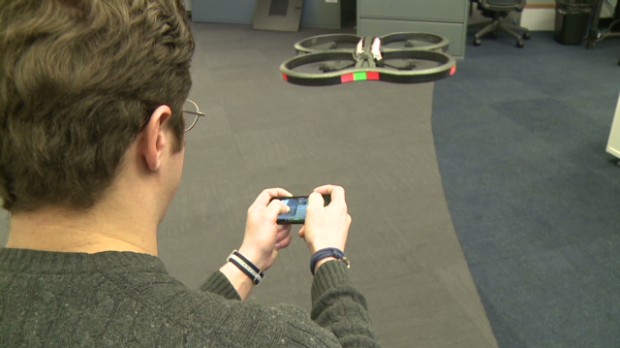
The airborne drone, held up by four rotors, was about 50 feet above him.

"It was slowly going back and forth over the backyard of my home," said the defense contractor who works out of the Marine Corps Air Ground Combat Center in Twentynine Palms, Calif. "I knew right away what it was and what was going on."

It took Sonneville a few minutes to find two men in the common area of his gated community piloting the drone remotely.

"I told them, 'I don't think you should be flying that in a subdivision, we have an expectation of privacy.' And they were very cooperative, and basically understood what I was trying to get at," Sonneville said.

The next day he emailed Rancho Mirage Mayor Scott Hines to voice his concerns.

Quintanilla said he never considered expanding the ban to cover the wider concerns. "Law enforcement is a whole different issue. This is an issue of privacy between neighbors."

Quintanilla said nothing in current law can halt bold invasions of privacy or stop a sex offender from using a drone to search for prey.

Hines, whose family gave him a drone for his birthday last year, said he has played with his iPad-controlled drone in his backyard and taken it to Joshua Tree National Park.

He believes the current language in the draft ordinance might be a little too broad.

"I think individuals should be able to use their own property and perhaps common areas of communities to enjoy the technology with their families. Where one crosses the line is by infringing on the privacy of others," he said.

Councilwoman Iris Smotrich said she's never had a personal encounter with a drone but has read up on the new technology and favors passing tougher regulations as well as the exemption for law enforcement.

"I think law enforcement should be able to use whatever technology is available to them to enforce our laws and make our citizens safe," she said.

Sonneville said he hopes the council will consider adding protections against excessive law enforcement surveillance, not in the proposal now.

Peter Bibring, a senior staff attorney for the American Civil Liberties Union of Southern California, said he's not aware of any proposed or passed laws clamping down on non-law-enforcement use of drones statewide.

A bill has been introduced in the California Senate to clarify that drones do fall under existing invasion of privacy laws, he said.

Use of commercial drones for everything from package delivery to crop dusting is expected to explode once the FAA, which now bans them, comes up with regulations allowing them in, expected to happen by 2015.

Tuesday, April 2, 2013

California Workers Face a Growing Education Gap, Study Says


A growing education gap in California could diminish workers’ chances of finding jobs in the coming years, according to a study.
Post-recession, companies increasingly look for employees with skills and education beyond a high school diploma, according to a study from Corinthian Colleges and economic consulting firm Encina Advisors. That’s a big problem in the Golden State, where demand for community colleges already outstrips available spots by 591,000.
“California has begun a transition to a new economy that requires post-secondary education and skills in healthcare, education, service industries and management,” the report says. “The new economy has created jobs which are yet to be filled, and the state lacks trained, qualified individuals to fill them.”
During the economic recovery, some companies have complained that a lack of qualified workers leads to trouble filling open positions. Recent studies have found that many firms are waiting longer to hire and demanding workers with college degrees.
The study estimates that under-educated Californians could lose out on billions of dollars of income over the next decade. During that time, an estimated 2.45 million Californians who want a community college education will be unable to find an open spot.
On average, those aged 25 to 34 with an associate’s degree make $6,432 more per year compared to a worker with just a high school diploma.
“This gap between educational and vocational training ‘demand’ versus ‘supply’ represents a significant barrier to further economic recovery and growth,” the report said.

Monday, April 1, 2013

Judge Allows California City to Enter Bankruptcy, Largest Municipality to go Bust


Stockton, Calif., became the most populous city in the nation to go broke Monday, after a judge accepted the city's application to enter bankruptcy. 

In the closely watched decision, U.S. Bankruptcy Judge Christopher Klein said the bankruptcy declaration was needed to allow the city to continue to provide basic services. He determined Stockton would not be able to perform "its obligations to its citizens on fundamental public safety as well as other basic government services without" the protections provided under bankruptcy proceedings. 

Stockton was facing a $26 million shortfall when it filed for bankruptcy last summer, the result of the housing bust and soaring pension obligations. After cutting a quarter of their police force and other city services to the bone, officials argued bankruptcy was their only option. 

The city of nearly 300,000 people has become emblematic of government excess and the financial calamity that resulted when the housing bubble burst. 

Its salaries, benefits and borrowing were based on anticipated long-term developer fees and increasing property tax revenue. But those were lost in a flurry of foreclosures beginning in the mid-2000s and a 70 percent decline in the city's tax base. 

The city's creditors wanted to keep Stockton out of bankruptcy -- a status that would likely allow the city to avoid repaying its debts in full. 

They argued the city had not cut spending enough or sought a tax increase that would have allowed it to avoid bankruptcy. 

Matthew Walsh, an attorney for the bond holders, declined to comment after Monday's ruling. 

Attorneys for the city said the city's budget and services had been cut to the bone. 
"There's nothing to celebrate about bankruptcy," said Bob Deis, Stockton's city manager. "But it is a vindication of what we've been saying for nine months." 

The Chapter 9 bankruptcy case is being closely watched nationally for potential precedent-setting implications. 

The $900 million that Stockton owes to the California Public Employees' Retirement System to cover pension promises is its biggest debt. So far Stockton has kept up with pension payments while it has reneged on other debts, maintaining that it needs a strong pension plan to retain its pared-down workforce. 

The creditors who challenged Stockton's bankruptcy petition are the bond insurers who guaranteed $165 million in loans the city secured in 2007 to pay its contributions to the CalPERS pension fund. That debt got out of hand as property tax values plummeted during the recession, and money to pay the pension obligation fell short. 

Legal observers expect the creditors to aggressively challenge Stockton's repayment plan in the next phase of the process. 

By 2009 Stockton had accumulated nearly $1 billion in debt on civic improvements, money owed to pay pension contributions, and the most generous health care benefit in the state -- coverage for life for all retirees plus a dependent, no matter how long they had worked for the city.