topnav

Home Issues & Campaigns Agency Members Community News Contact Us

Community News

Open dialogue among community members is an important part of successful advocacy. Take Action California believes that the more information and discussion we have about what's important to us, the more empowered we all are to make change.

Showing posts with label workers. Show all posts

Tuesday, December 31, 2013

California Stood Up For Immigrants, Transgender People In 2013

2013 was a big year for the rights of immigrants, workers, women and children in California. The most populous state in the nation, led by Gov. Jerry Brown (D) and a Democratic supermajority in the state Legislature, California this year passed groundbreaking laws that bucked the national trend of restricting abortion rights, rebuked the federal government's aggressive deportation program and led the country on workers' rights.
But 2014 is going to be even better -- that's when the laws start going into effect. Take a look at some of California's landmark laws from this past year below.

TRANSGENDER RIGHTS
In a nationwide first, transgender students in California will be able to choose which restrooms they want to use starting in January. They will also be able to choose between boys' and girls' sports teams.
California is the first state to enact these policies as a state law, but the groundbreaking legislation, which goes into effect Jan. 1, could be suspended within days if opposition groups gather enough signatures to test the law before voters on the November ballot.
PAPARAZZI REFORM
Paparazzi photographers who harass and intimidate celebrities and their children will face stiffer penalties under a new law passed in 2013: a fine of up to $10,000 and up to a year in county jail. Victims can also sue for damages and attorney's fees, according to the Associated Press.
Before the bill passed, celebrity moms Halle Berry and Jennifer Garner joined forces to deliver some emotional testimony about how aggressive photographers regularly frighten their children.
"My 17-month-old baby is terrified and cries," said Garner during the August hearing. "My 4-year-old says, 'Why do these men never smile? Why do they never go away? Why are they always with us?'"

ABORTION RIGHTS
California's new law authorizes nurse practitioners, certified nurse midwives and physician assistants to perform aspiration abortions during the first trimester.
California joins Oregon, Montana, Vermont and New Hampshire in allowing nurse practitioners to perform early abortions, the AP reported. In 2013, California was the only state to enact a law expanding abortion access, The New York Times noted.
Legislators also strengthened an existing law that makes it illegal to damage or block access to abortion clinics, the AP reported.
MINIMUM WAGE
California's minimum wage will go from $8 an hour to $9 in July, and it will reach $10 an hour by 2016. California joins 12 other states that are raising their minimum wage in 2014.

TEXTING LOOPHOLE CLOSED
A legislative loophole made it possible for teens to use voice commands like Apple iPhone's Siri to text while driving, and California's lawmakers closed that loophole this year. Adults will still be able to use the hands-free texting feature while driving.
Teens have been banned from using cell phones on the road since 2007, but an apparent loophole opened up in 2012 when legislators passed a bill allowing drivers to use hands-free devices to send text messages and perform other functions, according to the AP.
GUN SAFETY LAWS
California already has some of the strictest gun laws in the country, but lawmakers cracked down even further with laws that strengthen assault weapon permit requirements, require licensed psychotherapists to tell police about patients who threaten violence against others, and make it illegal to purchase gun parts that convert firearms into assault-style rifles.
The bills were written in reaction to mass shootings across the country, including the December 2012 Sandy Hook Elementary School shooting in Newtown, Conn. In contrast, the federal government hasn't been able to pass any gun safety laws since the Newtown massacre.

DOMESTIC WORKERS BILL OF RIGHTS
California joined New York and Hawaii in creating statewide protections for domestic workers in 2013. California's law allows domestic workers like nannies and personal health care aides to claim overtime wages for more than nine hours of work a day or 45 hours of work a week.
The law is expected to affect about 100,000 workers, but it's only temporary --legislators will have to vote on whether to renew the law in 2017, KPCC reported. It's also a pared-down version of the bill that was originally proposed in 2011, which included meal and rest breaks.
IMMIGRATION REFORM
The federal government is stalling on immigration reform, and Gov. Jerry Brown made it clear that California isn't going to wait around any longer. Brown signed into law a group of bills this year to protect undocumented immigrants, the most significant of which is the Trust Act.
The Trust Act limits local police's cooperation with the Department of Homeland Security's Secure Communities, a federal deportation program that asks police departments to screen arrestees for immigration status and hold them for the feds if they're found to be undocumented. So far, Secure Communities has deported 100,000 Californians, most of whom did not have a serious criminal record, the Los Angeles Times reported, but the new law will require people to be charged with or convicted of a serious offense before being held for possible deportation by the feds.
Starting in 2015, California's undocumented immigrants will also be able to apply for driver's licenses. California joins Illinois, Colorado, Nevada, Maryland, Connecticut, Oregon, and the District of Columbia in passing the driver's license legislation in 2013, MSNBC reported. New Mexico, Washington and Utah also allow undocumented immigrants to apply for driver's licenses.

Tuesday, May 14, 2013

Nearly 13,000 University Of California Healthcare Workers Threaten Strike

By Kenny Goldberg

 — Nearly 13,000 healthcare workers at University of California medical centers are threatening to go on a two-day strike next week. Workers and the UC system are at loggerheads over a new contract. The previous one expired last year.


AFSCME, the union representing healthcare workers, says UC refuses to ensure adequate staffing at its five medical centers. Union rep Todd Stenhouse said that's creating unsafe working conditions.
"Oftentimes now we're asking fewer staff to do more with less. On a balance sheet, that may look great. If it's your relative or your loved one that's in that hospital, it doesn't look so good," Stenhouse said.
Stenhouse added the union also wants management to stop contracting out healthcare jobs to temps and volunteers.
UC spokeswoman Dianne Klein said the union doesn't want to talk about the real sticking point.
"The issue is pension reform and what the union has been doing is using the issue of patient safety to scare people," Klein said.
Klein argued the union refuses to deal with the fact that UC has $24 billion in unfunded pension liability.
Stenhouse said the union would be happy to deal with pension reform, but said management isn't playing fair.
"What UC's insisting on, is that its executives take on these huge, huge golden handshakes at the expense of front line care and their lowest-paid workers," Stenhouse said.
UC is attempting to get an injunction to block the strike from taking place next week.
Among those threatening to walk off the job are respiratory therapists, nursing aids and surgical technicians.

Saturday, February 2, 2013

California farmers eager for immigration reform


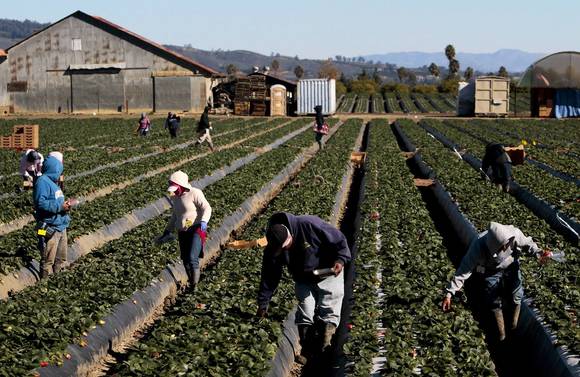
At Chandler Farms, just outside of Selma in the San Joaquin Valley, about three dozen workers are needed each season to pick acres of delicate peaches, plums, nectarines and citrus.
In recent years, however, owners Carol and Bill Chandler have struggled to find laborers as immigration from Mexicohas slowed to a near standstill.
"When the crops are ripe, we need a reliable labor force," she said. "That's what we're worried about going forward."
The Chandlers are among the state's farmers who welcomed a move this week by Congress to make immigration reform a legislative priority this year.
But the promised changes may not be enough to solve their chronic labor problems, which have been exacerbated by deportations, a stronger Mexican economy and, in good times, the lure of construction jobs.
On Monday, a group of Republican and Democratic senators unveiled a blueprint that aims to grant legal status to an estimated 11 million illegal immigrants in the country.
President Obama also joined the fray Tuesday, urging Congress to move legislation along quickly this year.
Immigration reform has been a rallying cry among farm groups in California and around the country for years.
According to data from the U.S. Department of Agriculture, roughly half of all hired crop farmworkers are in the country illegally. Of all workers, 7 of 10 are from Mexico, a country that has provided a steady supply of farm laborers to California since the middle of the last century.
With immigration reform back on the table this year, California farm groups are fiercely lobbying to make sure proposed legislation includes provisions for their workers.
There have been false starts in the past, including efforts by former President George W. Bush, who sought to create a guest worker program and overhaul immigration laws during his administration.
But the latest push to tackle the highly politicized issue is "one of the best signs we've seen in a long time," said Ken Barbic, senior director of government affairs for Western Growers in Irvine, a trade group that represents farmers in California and Arizona.
If Congress passes legislation, "the folks who are currently working here with false documents, it takes them out of the shadows," Barbic said.
Barbic added that immigration reform would remove legal liabilities for employers who hire illegal immigrants.
Diego Olagaray, 51, who grows 750 acres of wine grapes in Lodi, just north of Stockton, said that granting legal status to the state's agricultural workers ensures that both farm hands and employers would be able to breathe a little easier.
"Some of these workers go back to Mexico on a regular basis," Olagaray said. When they travel, "they're fearful of something happening to them. With amnesty, it'll make them feel more comfortable. They'll also feel that they're part of society.… And it will make it easier for employers as well."
Olagaray said that if immigration isn't resolved soon, labor shortages will become more pronounced. Last spring, he said he had trouble filling his usual crew to work on his vineyard, and other growers saw ripe crops languish in the fields.
Still, any policy effort may do little to solve the labor shortage for California farmers, said Edward Taylor, a professor of agriculture and resource economics at UC Davis.
Such shortages predate the recession. During boom times, contractors persuaded many workers in the fields to work in construction jobs, according to farmers and Taylor, who recently co-wrote a study that examined the decline in the number of farmworkers from Mexico.
A key finding in Taylor's study was that more immigrants were staying home to work on Mexico's farms. They were taking advantage of a strengthening Mexican economy and a growing middle class that ramped up agricultural production.
Now, American farmers find themselves competing for a dwindling supply of workers.
"Immigration policy stops being a solution if you can't find workers," Taylor said.
Farmers in California have already begun adapting to the drying supply of laborers.
Growers, for instance, have swapped out labor-intensive crops such as tomatoes and peaches for less labor intensive ones such as tree nuts.
Almonds, which were the second-most valuable crop in California in 2011, were ranked No. 11 in 2000. Sales of almonds have skyrocketed from $682,000 to $3.9 billion during that time period, according to the California Department of Food and Agriculture.
Technology is also playing a role. Using robots that shake loose crops from trees, farmers have been able to cut back on labor costs.
Paul Wenger, president of the California Farm Bureau Federation, said farmers are well-aware that their industry is changing.
And although he agrees that a dwindling labor supply will cause problems further down the line, he said Congress should still pass immigration reform that will allow farmers to hire legal farmworkers.
"Within the next two decades, we're going to have a problem. A domestic workforce will not want to work in the fields," he said. "It's going to be a problem. But that still doesn't mean we shouldn't fix the problems that exist today."