topnav

Home Issues & Campaigns Agency Members Community News Contact Us

Community News

Open dialogue among community members is an important part of successful advocacy. Take Action California believes that the more information and discussion we have about what's important to us, the more empowered we all are to make change.

Tuesday, January 22, 2013

California Sheds Prisoners but Grapples With Courts


Those 100-plus bunk beds are now gone. Prisoners are no longer using an open bathroom, where the smell was barely tolerable. The conditions are certainly not luxurious, but for the first time in recent memory all inmates are sleeping in cells that were designed to house them.
Nearly two years after the United States Supreme Court ruled that California’s prison system was so bad that it amounted to cruel and unusual punishment, the changes are, in some ways, readily apparent. The state is still a long way from reducing the prison population by 30,000, as the court mandated.
Nonetheless, Gov. Jerry Brown declared this month that “the prison emergency is over in California,” arguing that the federal courts should relinquish control of the state prison system and that placing more demands on correctional facilities was simply “nit-picking.”
“At some point, the job’s done,” Mr. Brown said during a fiery news conference on Jan. 8 in Sacramento, the state capital, where he defended the prison system. California has spent billions of dollars to comply with federal demands, he said: “We can’t pour more and more dollars down the rathole of incarceration.”
But a court-appointed monitor said in papers filed last week that Mr. Brown’s demand to end oversight is “not only premature, but a needless distraction” that could affect care for mentally ill inmates. The monitor cited dozens of suicides and long periods of isolation instead of treatment.
The leaky toilets have been boarded up at the prison in this suburban city east of Los Angeles. Inmates waiting to see a doctor are placed in holding pens that once doubled as cells in the hallways. Prisoners are being let out into the yard more often, as officers are less concerned that their time out of cells will inevitably lead to tensions.
Critics, including the lawyers who sued the state on behalf of prisoners, say that many of the changes are nothing more than cosmetic and that the system still does not provide adequate care to physically or mentally ill inmates.
“We’re wasting a lot of money on nonsense,” Mr. Brown said. “Everybody wants to send people to prison. Nobody wants to pay for it.”
Many advocates, had hoped that the court rulings would prompt more changes in the state’s aggressive sentencing laws, and submitted papers showing that there would be no uptick in crime rates if more prisoners were released. Officials have argued that they have already released the lowest-level offenders and that further releases would threaten public safety, even if there were no increase in overall crime.
“The state refuses to engage with the fundamental problem, which is that we incarcerate far too many people for far too long,” said Allen Hopper, a policy director with theAmerican Civil Liberties Union of Northern California. “What has gotten us into this mess in the first place is the constant ratcheting up of sentencing laws.”
California is expected to spend $8.6 billion on prisons this year, the third-largest chunk of the state’s total budget, just behind public schools and health care.
It now has roughly 130,000 prisoners, with 119,000 housed in state prisons. That is a significant drop from 162,500 in 2006, the height of the crisis. But it is still nearly 10,000 more than what the courts said they would allow by a June 2013 deadline. Nearly 8,900 inmates are in out-of-state facilities. Most of the inmates shed by the state prisons were lower-level offenders who were sent to county jails.

Tuesday, January 15, 2013

Jerry Brown Creates California Surplus Miracle, But Can It Last?

Something close to a civic miracle seems to have occurred—at least on the surface.

California has long been synonymous with budget deficits so deep that it looked like the Golden State would inevitably be our Greece—beautiful and bankrupt.
But Gov. Jerry Brown announced that his state has suddenly projected a surplus of $851 million. Two years ago, when Brown came back into office, the state had a $25.4 billion deficit, a Sisyphean problem Governor Arnold struggled with unsuccessfully all last decade.
This reversal of fortune raises a lot of questions. What caused California’s budget turnaround? Is it sustainable? And finally, could there be a national lesson here as Washington tries to confront deficits and debt?
The top-line takeaway is that a balanced deficit-reduction approach seems to have worked in the Golden State. When he entered office in 2011, Brown proposed billion-dollar-plus cuts in welfare and Medi-Cal, as well as $500 billion from the UC system.
All told, his initial proposed budget was almost $20 billion less than Governor Schwarzenegger’s 2008–09 budget, which clocked in at $103 billion. Democrats and unions howled, and Brown’s ultimate budget was less austere than originally advertised, but deep cuts were enacted.
Crucially, Brown also took on the unpopular task of raising taxes—winning a 2012 ballot fight sonorously known as Proposition 30 and 39—that raised sales taxes and closed business tax loopholes. Next year, the combined new revenues are expected to exceed $5.8 billion.
The final factor is an improving economy—always the decisive X factor in deficit-reduction efforts. California’s economy is improving slowly, but the shift from the pit of the Great Recession moved the numbers in the right direction.
The result of increased tax revenues and spending cuts is that—at least for now—a projected deficit has been turned into a surplus.
This is good news. But not everyone is happy. And the numbers do sidestep a deeper problem.
Remember, deficits and debt are different things. Projected year-to-year deficits are comparatively easy to close, especially on the back of an improving economy. But out-of-control debt is ultimately what drags you down.
The Los Angeles Times offered a front-page reality check, under the headline “Debt a Cloud Over State’s Future,” pointing out the inconvenient fact that California “has accumulated a crushing load of debt for retiree pensions and healthcare now totaling more than taxpayers spend each year on all state programs combined.” Ouch.
Brown’s budget does begin to pay down the debt, but the outstanding amount dwarfs the pay-down. Of course, that hasn’t stopped liberal activists from demanding more money be spent immediately on social services, under the banner of “investment.”
Moreover, there are real questions about whether the increased tax burden—especially on the wealthy—will end up eroding the state’s tax base in the near future.
“There’s some doubt that high income taxpayers won’t either move to Nevada—or some other low or no-income tax state—or find other ways, such as delaying realization of cap gains, to avoid hefty new surtaxes—especially since their federal taxes are also increasing,” emails the Sacramento Bee’s Dan Walters. “California’s marginal income tax rate (federal plus state) is now highest in U.S. at highest level, about 52 percent.”
But Walters acknowledges that Brown’s budget miracle is more or less legitimate, at least for now. “It’s mostly new revenue from sales and income tax hike approved by voters in November with a dash of economic recovery and a smidgen of creative bookkeeping such as slowing down some debt repayment and assuming renewal of a tax on health care providers to trigger some federal aid,” Walters’ continues. “But overall it’s mostly the new taxes.”
Other Golden State observers take an even more skeptical view. “There is a reason Gov. Brown is known as Governor Moonbeam,” says KABC’s center-right John Phillips. “Structural deficits are everywhere, the nonpartisan Legislative Analyst’s Office says there’s still a $1.9 billion budget deficit, and rich people can’t cross the state line fast enough—taking revenues down almost 11 percent since the passage of his Prop 30 tax hikes with them. On the plus side, hey, we’re not Detroit!”
The Rust Belt does have problems that make California’s cyclical deficits and deep legislative dysfunction seem comparatively easy to solve. But Jerry Brown deserves credit for pulling off at least short-term success in a state budget situation that had many experts calling impossible to solve. In the near term, the deficit turned surplus highlights the improving national economic environment.
It also provides a compelling object lesson for advocates of a “balanced approach” for reducing deficits, like President Obama & Co. Contrary to conservative talking points about how revenue is not a legitimate part of deficit-reduction solutions—instead, it’s all spending cuts all the time—California’s recent example shows that increased tax rates can help rapidly reduce deficits. Moreover, especially compared with much of Europe, the Obama administration’s decision not to simply pursue a path of deep austerity cuts seems to have been the wiser path, at least for now.
But conservatives could have the last laugh if the wealthiest Californians decide to flee the state for comparatively low-tax climes, like a sun-baked Gérard Depardieu.
Bottom line: This fight ain’t over. But at least for the moment, Jerry Brown’s balanced if painful plan to turn deep deficits into a modest surplus deserves study. It offers a rare glimpse of good news in the relentlessly bleak world of state budget. Whether it is sustainable remains to be seen.

Thursday, January 10, 2013

Statewide Day of Action, 2013 Budget Release

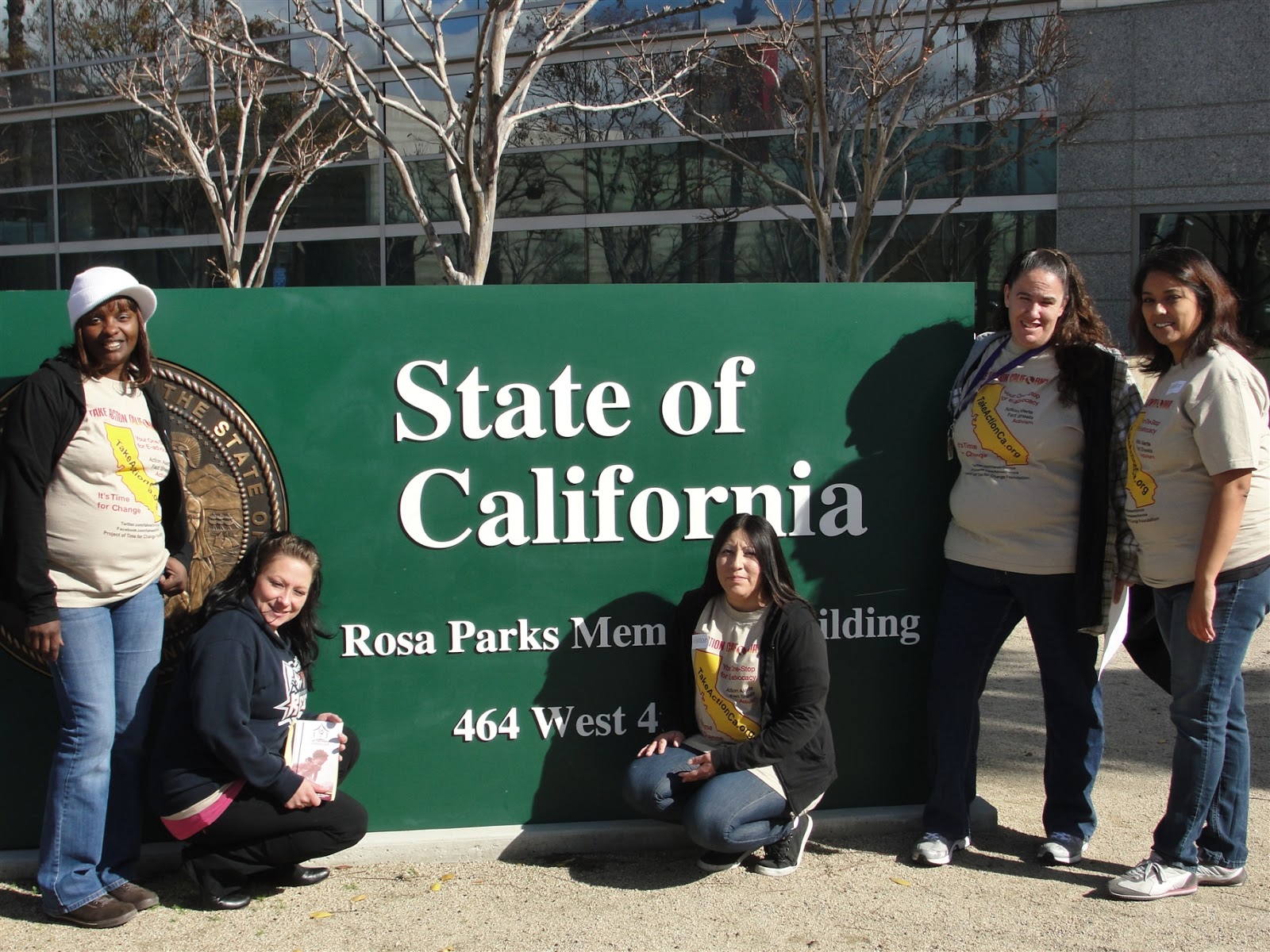
Take Action California had the privilege of participating in the Statewide Day of Action in San Bernardino, CA. The rally, "Reinvest in California Families, Seniors, and People with Disabilities," took place at the Rosa Parks State Bldg Gov't Center office. This event took place almost simultaneously in other California cities including San Francisco, San Jose, Los Angeles, Sacramento, and Fresno.

We were thrilled to see everyone who participated, including collaborative partners Time for Change Foundation and California Partnership (organizer).

Below are some pictures of the event.

To learn more about the Statewide Day of Action, visit http://www.communitychange.org/


Wednesday, January 9, 2013

Calif. budget debate turns to spending, not cuts


Gov. Jerry Brown is preparing a spending plan as California faces its most optimistic financial outlook in years, yet the Democratic governor's intention to stick with a frugal fiscal agenda could put him on a collision course with Democratic lawmakers who seek to restore state services lost during the recession.
After years of deep spending cuts to education, health and social programs, Brown and California lawmakers will be debating this year how to spend the state's money rather than battling over what to cut.
Brown will release his budget proposal Thursday for the 2013-14 fiscal year, which begins July 1. He is expected to boost education funding by at least $2 billion, as he promised during his campaign for Proposition 30. The November initiative's sales and income tax increases are expected to generate $6 billion a year.
But he also said this week that "2013 is the year of fiscal discipline and living within our means, and I'm going to make sure that happens."
The state's nonpartisan legislative analyst has pegged the 2013-14 budget deficit at $1.9 billion, a vast turnaround from the double-digit deficits of the last several years. The Legislature is required by law to approve a balanced budget by June 15, which will still force lawmakers to cut some areas of spending to close the deficit.
Brown is likely to face some of his biggest challenges this year from fellow Democrats, who now hold two-thirds majorities in the Assembly and Senate and are eager to restore spending to a host of programs after years of cuts. Brown is more fiscally conservative than many Democratic lawmakers, favoring restoring school funding and building a robust rainy day fund over expanding services.
"People want to have more child care, they want to have more people locked up, they want to have more rehab, more, more, more. More judges, more courtrooms. We have to live within reasonable limits," Brown said in a Capitol news conference this week.
The legislative analyst's office has projected that the state will spend nearly $56 billion of a $94 billion general fund budget on education in the 2013-14 fiscal year, about $2 billion more than last year. That money comes partly through a voter-approved education funding guarantee that requires the state to spend more on schools when tax revenue rises.
"You can take this to the bank: We're not going to spend money that we can't afford to spend," Brown said. "We have to do more with less; that's just the way life is."
Like Brown, the analyst's office has also cautioned that the state's rosy forecast is dependent upon maintaining the strict spending limits of the past few years.
Still, the added revenue from the voter-approved tax increases allow the governor and lawmakers to begin to tinker with school funding formulas, which Brown is expected to address in his budget.
His administration advocates scrapping a series of dedicated funds aimed at addressing specific issues. Instead, he favors freeing school districts to spend that money in areas they deem most important.
Brown's proposed school formula also is intended to target spending to the neediest students, which is likely to draw opposition from parents and teachers in more prosperous areas.
Senate President Pro Tem Darrell Steinberg, D-Sacramento, said he is open to Brown's school funding proposal. He said the goal is laudable, but there will be a lot of details to work out.
"How do you make sure, without micromanaging, that the kids that need help the most get the help that they need?" Steinberg said. "How do you make sure that the proven approaches to improving student achievement and helping kids graduate are funded?"
The legislative analyst projected last fall that the state's overall general fund spending would be about $94 billion, nearly 8 percent more than in 2012. California's general fund spending hit a high of $103 billion during the 2007-08 budget, the year the recession began, falling to a low of $87 billion in the 2011-12 fiscal year.
Still, some expenses will grow in the short term, although the analyst said they are likely to be outpaced by higher revenue in the long term. For example, more Californians are expected to sign up for Medi-Cal, the state's health insurance program for the poor, as states prepare to implement the federal health care reform law.

Read more here: http://www.fresnobee.com/2013/01/09/3127418/calif-budget-debate-turns-to-spending.html#storylink=cpy

Tuesday, January 8, 2013

Governor Brown will release state budget for Medical through the Affordable Care Act


On Thursday, January 10th, Governor Brown will release his state budget proposal and will announce how California will or will not expand Medical through the Affordable Care Act.

On January 10, 2013, health and human service advocates across the state will hold five rallies in support of a "California Budget for the 99%."

After the passage of Proposition 30, there still a 2 Billion Dollar Deficit. We need more revenue solutions so no cuts in health and human services and education are not on the chopping block.

These rallies - which will take place in Fresno, Los Angeles, Sacramento, San Bernardino, and San Francisco - will coincide with the anticipated release of the Governor's 2013 budget.

At the rallies, advocates will call for a budget that prioritizes the needs of the state's most vulnerable residents and voice their support for revenue solutions that will rebuild California's social safety net.

California schools flunk education group's ratings


California is sorely lacking when it comes to school reform, failing to adopt policies to limit teacher tenure and use student test scores in teacher evaluations, according to a rating of states issued Monday by a high-profile education advocacy group.

California received an overall grade of F, ranking 41st nationally, from StudentsFirst, a Sacramento-based group run by Michelle Rhee, the former schools chancellor in Washington, D.C., whose outspoken views have polarized those who share her focus on improving the nation's schools.
Her group's "report card" concentrates "singularly on the education policies in place in each of our states," Rhee said in a statement. "And when we look solely at policy, it's clear that we have a long way to go toward improving our education system in America."
Critics said the ratings say more about Rhee's views than about the state of the nation's schools.
Eleven states received failing grades. California received its only high mark for being the birthplace of "parent trigger" laws, which allow parents, by petition, to replace the staff of a low-performing school or turn over the campus to an independently operated charter.
California's schools would benefit from a statewide teacher and principal evaluation system that incorporates student achievement as a significant factor, the report said.
Such value-added formulas measure a teacher's effect on a student's learning through standardized test scores, taking into account a student's past performance and such factors as race or poverty. Some experts and teacher unions are skeptical of the method, and those critics have had allies in Gov. Jerry Brown and state Supt. of Public Instruction Tom Torlakson.
The California Department of Education had little use for Rhee's rating, with Deputy Supt. Richard Zeiger telling the New York Times that the F grade was a "badge of honor."
The department did not back down when the remark sparked some criticism.
"We're quite happy that California is moving in the opposite direction," said spokesman Paul Hefner. "We think that our schools are making incredible progress, given the enormous strains schools have been under in recent years."
Rhee's top-rated states are Louisiana and Florida; each earned a B-. No state earned an A.
Louisiana has been notable for converting many campuses to non-union charter schools. The state also allows lower-income students or those at poorly performing schools to receive public funds for private school. Florida requires 50% of a teacher's evaluation to be based on student performance. Parents are notified when children are placed with a teacher designated as unsatisfactory, the report said.
Rhee's system gives credit for aggressive state intervention as opposed to local control. Montana was among states receiving an F, in part for asserting "no authority to intervene when schools and districts are not meeting expectations."
The Rhee system gives no direct credit for actual student achievement or the level of spending on schools. Massachusetts, which is frequently lauded in both areas, received a D+ from Rhee's group.
Rhee rose to prominence as the head of schools in the District of Columbia, where she pressured educators to improve student achievement and fired many of them.

Monday, January 7, 2013

More than 1 in 5 California children live in poverty, study finds


As California diversifies, it will face serious economic struggles if it fails to pay attention to widespread childhood poverty, according to a report released Monday by the Center for the Next Generation. The center found that more than 1 in 5 children in the state are living in poverty.


The study, "Prosperity Threatened: Perspectives on Childhood Poverty in California," focuses on new U.S. Census Bureau figures, finding that childhood poverty is endemic among the state’s fastest-growing population -- Latinos -- with nearly 1 in 3 Latino children living at or below the poverty line.
Researchers contrasted the numbers with data on seniors, which showed fewer than 1 in 10 living in poverty.
“We can’t honestly separate our state’s economic future from current poverty rates among our kids,” said Ann O’Leary, vice president and director of the center, who co-wrote the report. “Our ability to thrive as the world’s ninth-largest economy depends on having an educated, healthy and stable next generation of workers.
"We’re headed in the opposite direction,” she added.
The study, which was funded by the center, details a trend of increased childhood poverty in California that accelerated during the recession. And while childhood poverty fell in five California counties between 2006 and 2011, 16 counties saw a reduction in senior poverty during the same period.
Los Angeles County, with more than 9.6 million people, is home to nearly 2.4 million children -- more than 17% of whom live in poverty, according to the study.
Of 51 counties studied, L.A. County ranked 22nd in terms of poverty rate.
In Orange County, slightly more than 16% of the children live at or below the poverty line, according to the study.
“We’ve taken steps to provide our seniors with some level of assurance that they’ll be cared for in their later years,” said O’Leary, adding that the study, funded by the center's general budget, began last fall. “California’s grandparents should ask why their grandkids don’t get the same treatment.” 
The report noted a correlation between education levels and childhood poverty rates; counties with the highest number of parents with college degrees also have the lowest levels of childhood poverty. The opposite also is true, the study found.
O'Leary and her coauthors suggest that state leaders make tackling childhood poverty a central goal of any economic recovery plan.
The center's mission is to influence the national debate over sustainable energy and improving opportunities for children and families.