topnav

Home Issues & Campaigns Agency Members Community News Contact Us

Community News

Open dialogue among community members is an important part of successful advocacy. Take Action California believes that the more information and discussion we have about what's important to us, the more empowered we all are to make change.

Monday, September 19, 2011

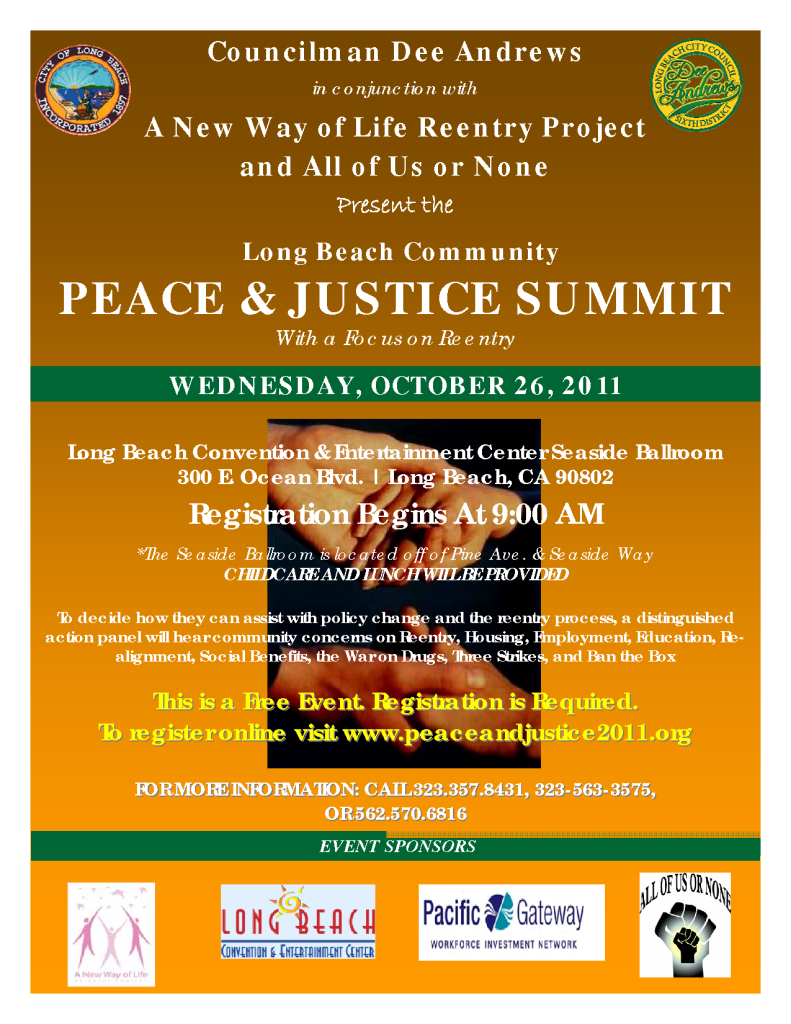
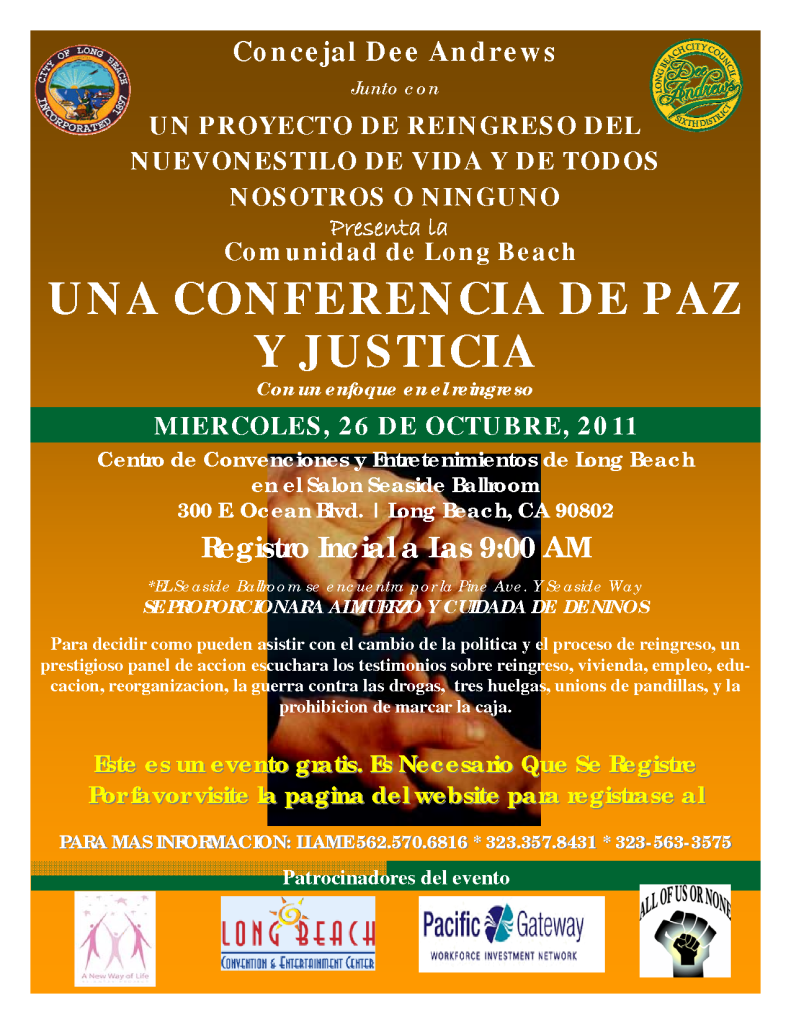
Long Beach Community Peace and Justice Summit, October 26, 2011


LONG BEACH COMMUNITY PEACE AND JUSTICE SUMMIT
We shall address the devastating effects of the failed “War on Drugs” and the many barriers to re-entry that people confront when coming out of prison.  Speakers at the Summit will talk about the damage felt by whole communities as a result of imprisoning people at alarming rates, communities who were already underserved to begin with and in need of more services and resources.  Elected officials, policy makers, administrative leaders and government personnel will hear presentations and testimony from those directly affected by our criminal justice policies and practices.  We will share specific changes and policy reform needed for us to be treated fairly and as equals in society, including declaring the end to the broken “War on Drugs”. 

The US Supreme Court has ruled that California must release tens of thousands of non-serious, non-violent, non-sexual inmates back into their communities due to overcrowding. In so doing, AB-109 was en-acted by Governor Brown. Long Beach will experience a vast majority of these individuals coming back home, as it is a concentrated city that has incarcerated many under the “non-non-non.”


The failed “War on Drugs” and the “get tough on crime” policies created barriers for us in employment, housing, social services and family reunification.  Denying us access to basic needs such as food and shelter is inhumane and traps us at the bottom of society without the possibility to live decently, fulfill our potential and leaves us vulnerable to cycling back into prison.

In a nation that prides itself on democracy, freedom and justice for all, it is crucial that we ban together to ensure that all people are treated with respect and have the opportunity to make the most of one’s life because “nobody’s free until everybody’s free.”

We urge the public to come out and join us, as we address issues that will help curtail recidivism and create a safer community with specific results stemming from voices that speak to Peace & Justice.

Contact: Fanya Baruti @ 323-357-8431 Office 562-688-0472 Cell
Long Beach Councilman Dee Andrews 562-570-6816 Office ---Attn: Tonya Martin

Wednesday, September 14, 2011

Tell Governor Brown to Sign Critical Health Bills!


Last week, California's legislature sent critical bills to Governor Brown that will advance the health of our communities. The Governor has already signed one of CPEHN's priority bills, AB 516 (V.M. Perez), which strengthens the Safe Routes to School Program. This success is just the beginning; there's still more work to be done!


Email or call the Governor TODAY at (916) 445-2841. You can also download and fax or mail in letters of support on the following bills:

Your letter can make the difference on whether these bills become law!


Thursday, September 8, 2011

The Prisons, the Universities and California


People don't usually think of prisons and universities in the same breath, but in California, they share an important distinction. This is a state which people usually stick to their home regions. But the prisons and the public universities are the only two places where Californians from different regions and backgrounds routinely come together, live together, and get to know each other better.
In this way, prisons and universities define the state, more so than almost any other institution. And over the past generation, the resources devoted to each has shifted -- thus defining Hotel California more as a prison and less as a place of learning.

As the Bay Citizen points out in this story http://www.baycitizen.org/education/interactive/education-vs-prisons-shifting-priorities/ the percentage of the state budget spent on corrections and prisons has gone from 3 percent to 11 percent since 1980. The portion spent on higher education has dropped from 10 percent to 6.6 percent.

Why? The answer is a paradox. Polls suggest that California voters want less money spent on prisons and more on universities. But more money is being spent on prisons -- and less on universities -- because of California voters.

How's that? California voters have approved sentencing guidelines and other tough-on-crime provisions that have required the expansion of prisons. They've also approved spending protection for a host of programs -- but not higher education. So the higher spending on other programs, including prisons (and debt service, a function of the failure to balance the budget), is crowing out higher education spending. The system that voters helped design is overriding the desires of Californians.

There's no better example of the California disease.

BY Joe Mathews//

Wednesday, September 7, 2011

International Drug Policy Reform Conference, November 2-5, 2011 Los Angeles, California


Brief Summary of Key Provisions in AB 109 & AB 117

2011 Public Safety Realignment
Updated July 2011


Main components
- Defines local custody for non-violent, non-serious, non-sex offenders
- Makes changes to state parole and creates local “post-release community supervision”

Local planning process
  • Expands role and purpose of the Community Corrections Partnership (CCP), which was previously established in Penal Code §1230
  • Requires CCP to develop and recommend to the board of supervisors an implementation plan for 2011 public safety realignment
  • Creates an Executive Committee from the CCP members comprised of:
    • Chief probation officer (chair)
    • Chief of police
    • Sheriff
    • District Attorney
    • Public Defender
    • Presiding judge of the superior court (or his or her designee)
    • A representative from either the County Department of Social Services, Mental Health, or Alcohol and Substance Abuse Programs, as appointed by the County Board of Supervisors
  •  The implementation plan is deemed accepted by the County Board of Supervisors unless the Board rejects the plan by a four-fifths vote.
The meetings of the CCP and its Executive Counties are subject to the Brown Act. Counties are advised to consult with counsel regarding the application of the open meeting law in this regard. 
Timeframe
All provisions are prospective and applied on October 1, 2011
  • AB 118 provides the statutory framework, allocation methodology and revenue to implement public safety realignment
No state prison inmates will be transferred to county jails.

Local custody
  • Revises the definition of felony to include specified lower-level crimes that would be punishable in jail or another local sentencing option for more than one year.
  • Maintains length of sentences.
  • Time served in jails instead of prisons:
    • Non-violent offenders
    • Non-serious offenders
    • Non-sex offenders
    • Enhanced local custody and supervision tools
      • Alternative custody tools for county jails
      • Home detention for low-level offenders
      • Local jail credits mirror current prison credits (day-for-day)
      • Broaden maximum allowable hospital costs for jail inmates and remove sunset date.
State custody
  • Convictions/priors for following offenses require state prison term:
    • Prior or current serious or violent felony as described in PC 1192.7 (c) or 667.5 (c)
    • The defendant is required to register as a sex offender pursuant to PC 290
Other specified crimes (approximately 60 additional exclusions from “low-level” definition) will still require term in state prison

Contracting back
  • Counties permitted to contract back with the state to send local offenders to state prison.
  • Authorize counties to contract with public community correctional facilities (CCFs).
  • Contracting back does not extend to parole revocations.
Post-release (county-level) community supervision
  • Prospectively, county-level supervision for offenders upon release from prison will include:
    • Current non-violent offenders (irrespective of priors)
    • Current non-serious offenders (irrespective of priors)
    • Sex offenders
  • County-level supervision will not include:
    • 3rd strikers
    • Individuals with a serious commitment offense
    • Individuals with a violent commitment offense
    • High risk sex offenders as defined by CDCR
    • Board of Supervisors designates a county agency to be responsible for Post Release Supervision and provide that information to CDCR by August 1, 2011.
  • CDCR must notify counties as to who is being released on post-release supervision at least one month prior to their release.
  • CDCR has no jurisdiction over any person who is under post-release community supervision
  • No person shall be returned to prison except for persons previously sentenced to a term of life (and only after a court order).
Post-release community supervision revocations
  • Revocations are capped at 180 days with day-for-day credit earning.
  • Authorizes discharging individuals on post-release community supervision who have no violations for six months.
Ongoing state parole
  • CDCR continues to have jurisdiction over all offenders on state parole prior to October 1, 2011 implementation
  • State parole will continue for the following:
    • The offender’s committing offense is a serious or violent felony as described in PC §§1192.7(c) or 667.5(c);
    • The offender has been convicted of a third strike;
    • The person is classified as a high risk sex offender; or
    • The person is classified as a Mentally Disordered Offender (MDO).
Parole revocations
  • Prospectively, the parole revocation process continues under Board of Parole Hearings (BPH) until July 1, 2013.
  • Parole revocations will be served in county jail and not to exceed 180 days.
  • Contracting back to the state for revocations is not an option.
  • Only persons previously sentenced to a term of life can be revoked to prison.
  • For the remaining low level offenders on parole after implementation of realignment, parole has the authority to discharge after six months if no violations have occurred.
Juvenile Justice
  • AB 109 limited the future juvenile court commitments to state juvenile detention (Division of Juvenile Justice or DJJ); this provision was removed in AB 117. Consequently, there are no changes to the state juvenile justice system in realignment.

Thursday, September 1, 2011

Gov. Brown: Please Grant Patricia Wright Clemency

Governor Jerry Brown

State Capitol
Sacramento, CA
By fax: 916.558.3160

September, 2011

Dear Governor Brown:

After reading material on Patricia Wright, I have serious concerns regarding her innocence, but this letter is a plea for mercy. Cancer has taken Ms. Wright’s vital organs including a vital part of her womanhood. My purpose in writing to you is to ask that you use the power of your office to grant her clemency. I understand from those who have been fighting for her release that your office has the right to grant her clemency without going through the Board of Parole Hearings or the Supreme Court.

Te family also understands that given her sentence, Patricia does not qualify for compassionate release, but that it is within your power to grant Ms. Wright a pardon, clemency or you can commute her sentence of life without the possibility of parole to life and then be in a position to grant a compassionate release. Cancer cells have invaded Patricia Wright’s body such that each day she loses her hold on life. THIS DOES NOT HAVE TO BE.

With so little life left in her, Patricia longs to be with her children for the few months she has left.
She must not be allowed to die in prison. Please consider Patricia Wright, her five children and her large family when making your decision. The pain they are suffering due to her advanced stage of cancer has become all the more unbearable because they are unable to be with each other at this difficult stage of her life.

Sincerely,

For more information contact
Geri Silver
FACTS Education Fund:
Families to Amend California's Three Strikes

213.746.4844