topnav

Home Issues & Campaigns Agency Members Community News Contact Us

Community News

Open dialogue among community members is an important part of successful advocacy. Take Action California believes that the more information and discussion we have about what's important to us, the more empowered we all are to make change.

Friday, January 14, 2011

Set the Alarm Clock: Don’t Sleep Through the Green Revolution

By Phaedra Ellis-Lamkins


matsalleh.net
"There is nothing more tragic than to sleep through a revolution."

The revolution Dr. King spoke of in his speech at the National Cathedral in 1968 was one of the most transformative of the 20th Century – the painful transition from a racially divided America to an America stitched together, however roughly. But the sentiment holds true for every revolution.

Today, there’s another revolution underway – a revolution that is restructuring America’s energy future. It’s changing the way we work and live. In this time of rapid change, all those caught sleeping, or even hitting the snooze button, will be left behind.

As we get ready to celebrate Dr. King’s birthday, life and legacy, it is not enough for us to reflect on the past. We must look forward and take action, we must be deliberate in shaping this revolution – because Dr. King’s work remains unfinished.


Today, there is still a great need to lift communities out of poverty and into productivity. The unemployment rate is still significantly higher in the Hispanic and African American communities. And low-income and minority communities are disproportionately more likely to breathe in polluted air, drink dirty water and suffer from asthma. As long as these disparities exist, our nation cannot fulfill its full promise as a land of opportunity and equality. And as long as these problems exist for any American, the revolution is not complete.


It is time for the nation to wake up and fight for a green economy that addresses the health and opportunity of all communities. It will take a collective effort to make this happen. Dr. King’s story teaches us that one man alone cannot achieve this kind of meaningful change. It takes a movement. He empowered others.


Following in Dr. King’s great tradition of selfless service, the rest of America should set their alarm clocks – and rouse those who are still sleeping.


Courtesy of Green for All

Wednesday, January 12, 2011

Now is the time to close California's Youth Prisons!

By Sumayyah Waheed

HUGE NEWS- Governor Jerry Brown wants to close California’s youth prisons! On Monday, Governor Brown proposed to eliminate the Division of Juvenile Justice (DJJ) and fund counties to treat the youth instead. Books Not Bars has been calling for DJJ’s closure for seven years. And finally, Sacramento is listening.

Governor Brown has called his proposed budget “painful.” With deep cuts to vital human and health services, plus nearly $1.5 billion in cuts to higher education, the next few years will be challenging. Considering the cuts to these important programs, closing DJJ makes more sense now than ever. The DJJ drains our state budget of hundreds of millions of dollars each year and fails more than 8 out of 10 youth who are released from its prisons. We cannot afford to fund a wasteful, broken system that hurts our youth and worsens the deficit.

But the fight is not over. As we write this, opponents are already contacting lawmakers to urge them to oppose this crucial plan. Please send an email to legislative leaders and stand with us in urging lawmakers to close DJJ once and for all. We’ll also collect your signatures and deliver them to lawmakers. This is our chance to show Sacramento that the majority of Californians want a juvenile justice system that invests in youth, their families, and our communities—not miserable warehouses that just add damage to damage.
 
 
Courtesy of the Ella Baker Center

Monday, January 10, 2011

Will Jerry Brown's Budget Save California?

By Ray Gustini


Photo provided by crooksandliars.com
How do you solve a problem like California's $28 billion deficit? If you're newly-elected Governor Jerry Brown, you introduce a fresh series of cuts to California's already reduced operating budget. Brown won't officially unveil his program until later today, but the Sacramento Bee already has the details on the governor's plan for "deep program cuts, a June election to extend tax increases, and a broad reordering of state and local government."


Is Brown taking the right approach? Is the state's budget crisis even solvable? A variety of opinions from around the Web:

No Sacred Cows Based on the Sacramento Bee's assessment of Brown's cuts, it's tough to argue the new governor is playing favorites. In addition to "deep cuts" to the UC and CSU systems and increased co-pays for participants in the state's MediCal health program, Brown has reduced his own office's budget by 25 percent. If approved, the revenue generated by extending 2009 increases to vehicle, sales and income taxes would raise "$8 billion to $10 billion over 18 months," which would then "flow to local governments to help finance government realignment." Brown is also pursuing a policy of realignment that offers "several plans to shift programs [away from the state level and to] local governments." These plans include "eliminating the state Division of Juvenile Justice, instead sending money to local governments to house juvenile offenders" and housing low-level prisoners in county jails.

The Trouble With Realignment Writing in The Los Angeles Times, Zev Yaroslavsky and Gloria Molina--members of the Los Angeles County Board of Supervisors--praise Brown for being "refreshingly candid and transparent about the magnitude of the [budget] problem" but express doubt about whether realignment will help in solving the problem. Yaroslavsky and Molina admit that while the policy--designed to "restore local administrative control and stabilize unpredictable revenues"--sounds appealing, it is in fact a kind of budgetary shell game. They explain:

If the state proposes to save itself money by shifting both program responsibilities and the funding for them to local governments, where will the savings be? Can it really be that local governments are so much more efficient that citizens will receive the same or higher levels of public services at substantially reduced cost?

Too Bullish On Taxes In an op-ed for The Wall Street Journal, UCLA economics professor Andrew Atkeson and 2002 California GOP gubernatorial nominee William Simon argue that raising taxes is the very thing the state shouldn't be doing. The current shortfall, they believe, exposed the California's "dangerous reliance on high income tax rates on the state's top earners" to meet its budgetary needs. Noting that the state's "top marginal personal income tax rate is one of the highest in the country, and its corporate tax rate is among the highest," Atkeson and Simon urge "extreme caution" on raising taxes even further. What's really needed, in addition to other reforms, is an effort to foster a "better business climate in California by reducing corporate taxes, regulations and red tape that are now strangling existing business enterprises and keeping new ones from starting up."

Blow To Good Government The goal of the cuts is to save money and make state government more efficient and transparent, but California Watch's Chase Davis suggests they will actually have the opposite effect. Davis cites the uncertain fate of the Brown Act, that requires the state government to reimburse local agencies for the cost of publicizing open [local government] meetings." With a $20 million annual budget, the law has been a "target of cost-cutting in recent years." Even though the passage of Proposition 59 in 2004 made it a "constitutional right [in California] to access public meetings and documents," Davis says local governments could become "lax in their disclosure without reimbursement" from the state.

 
Courtesy the Atlantic Wire

Wednesday, January 5, 2011

The consequences of repeal

By Mitch Stewart


Our progress is under attack.

Their majority is not even a day old, but House Republicans are already getting ready to pass a bill to repeal health reform.


Instead of focusing on the future, they want to put insurance companies back in charge of our health care. To go back to the days when these companies could deny coverage to children based on pre-existing conditions, cancel coverage when people would get sick, or limit the care you could receive -- even when you needed more. When seniors would be forced to choose between paying their mortgage and paying for their prescription drugs, simply because they landed in the "donut hole" in coverage.

They want to turn our progress into a partisan fight.

But you and I know that the Affordable Care Act and other reforms to protect consumers did not pass because of a partisan or ideological agenda.

They passed because millions of Americans stood up and said we were ready for commonsense solutions after years of fraud and abuse, for a new era of responsibility after unchecked power. They passed because, after 100 years of debate and negotiation, we said we would wait no longer for health reform.

These reforms passed because of you. Now, we must prepare to stand up for them again.

Organizing for America is pulling together a team of organizers and volunteers to defend reform -- and we need you on this team. Together, we'll show how our progress is already improving lives across the country -- and take on those who are pushing for repeal.

Join the fight to protect our progress and keep Congress focused on the future.


It's clear that's not where House Republicans are looking -- they're putting the car in reverse and heading straight toward the ditch that we just spent two years climbing out of.

As the President said this week, we are still emerging from a recession that took a toll on millions of families, many of whom are still trying to get their lives back on track. The Affordable Care Act and Wall Street reform were important steps forward on the road to recovery, and we can't afford to play political games with them now.


We have an obligation to ensure our progress is not rewritten by the insurance industry and big banks.


This year, we'll need to stand by the President as he works to grow our economy, make the United States more competitive, and keep moving the country forward -- but we're also going to have to work hard to defend what we have already achieved.

Join the campaign to protect our progress:

http://my.barackobama.com/ProtectOurProgress

Monday, January 3, 2011

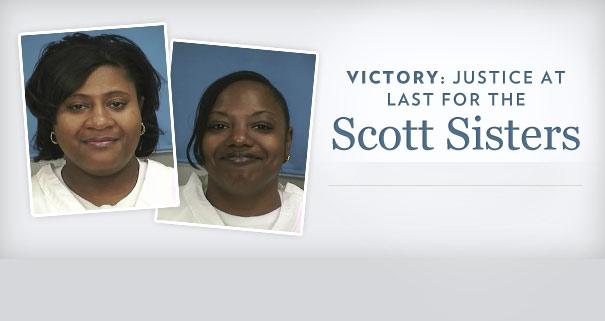
Scott Sisters return home

By Benjamin Todd Jealous


Courtesy NAACP

Gladys and Jamie Scott are returning home for the first time in 16 years.

This evening, Mississippi Governor Haley Barbour suspended their sentences -- handed down in the extreme and biased ruling of Judge Marcus Gordon that condemned each of the women to double life sentences for an $11 robbery.

The moment I landed in Jackson, Mississippi, Governor Barbour called to tell me about the suspension. And as I prepare to meet with him tomorrow, along with Derrick Johnson, President of the Mississippi State Conference of the NAACP, I want to be clear about one thing: This vindication is because of you.

The Scott sisters have read your notes and letters of support. Now please join me in welcoming them home. Sign the NAACP's welcome home card to Gladys and Jamie:

http://action.naacp.org/WelcomeHome

Jamie and Gladys always described the moment the police arrested them as a nightmare. Not just for themselves, but for their family -- for their children.

So we united together. We fought the injustice -- just as the NAACP has done for more than 100 years.

When we couldn't visit the Scott sisters, we wrote letters and notes to let them know we remembered them. When we wouldn't be heard by the political and judicial powers that be, we spoke louder. And because of that perseverance -- because of your perseverance -- the nightmare is finally over.

Celebrate this victory for Gladys and Jamie, and also for the NAACP community, by sending them a welcome home message. They would love to hear from you:

http://action.naacp.org/WelcomeHome

Last time I was in Mississippi was to file the petition for clemency with the Scott sisters' lawyer, Chokwe Lumumba, and Charles Hampton, Vice President of the Mississippi State Conference of the NAACP.

Today, thanks to you, I get to return to show the world that the NAACP will not stand idly by as our sisters and brothers are wrongfully accused.

I am humbled by how far your support has taken the Scott sisters on the road to justice and freedom. And with every step forward, we will secure a brighter future for their children, our children and our children's children.

 
Shared by the California Coalition for Women Prisoner's

Wednesday, December 29, 2010

Former women prisoners face longer odds staying out after aid programs slashed

By Mineko Brand

 
Rehabilitation taking backseat to punishment


Sunshine Schmidt photo by Mineko Brand/SF Public Press
By the time Sunshine Schmidt was 19, her rebellious streak led her to prison in Wisconsin for violating probation on a forgery charge. But it was just the beginning of her troubled young adulthood. As she tells it, the uncaring reaction from a criminal justice system on autopilot put her back in prison for minor violations, only driving her further into the life of small-time crime as she racked up drug and theft-related charges. “Every time, I was released back into homelessness or an abusive partner,” she said. “I didn’t have the resources or tools to get back on my feet.” It was only three years ago, after leaving a California prison at age 27, that Schmidt was able to pursue legitimate jobs and an education. After living in transitional housing, she became a client of Way-Pass, a City College of San Francisco-based nonprofit organization that helps female ex-prison inmates adjust to everyday life.


Sunshine Schmidt takes classes and counsels other formerly incarcerated women. "This is not an issue that a lot of people think about," Schmidt said of the rights of the incarcerated and the recently released. "The system is incarcerating people and it's not helping."

By the time Sunshine Schmidt was 19, her rebellious streak led her to prison in Wisconsin for violating probation on a forgery charge. But it was just the beginning of her troubled young adulthood. As she tells it, the uncaring reaction from a criminal justice system on autopilot put her back in prison for minor violations, only driving her further into the life of small-time crime as she racked up drug and theft-related charges.

“Every time, I was released back into homelessness or an abusive partner,” she said. “I didn’t have the resources or tools to get back on my feet.”

It was only three years ago, after leaving a California prison at age 27, that Schmidt was able to pursue legitimate jobs and an education. After living in transitional housing, she became a client of Way-Pass, a City College of San Francisco-based nonprofit organization that helps female ex-prison inmates adjust to everyday life.

But young women in Schmidt’s situation now may have a harder time getting on their feet. Leaders of re-entry programs in San Francisco say state budget cuts in 2010 drastically reduced their ability to help parolees.

Collectively, California’s prison rehabilitation programs took a nearly 45 percent cut — $250 million — in fiscal year 2009-10 as legislators and the governor grappled with the state’s budget crisis.

The 2010-11 budget, passed in October after a 100-day delay, cuts $1.1 billion from the California Department of Corrections and Rehabilitation. State officials said they expected most of this to come from staff cuts, reductions in medical care and early release of prisoners. The previous year’s cuts are not expected to be reversed anytime soon.

Way-Pass lost two of its four paid positions and no longer has funds to provide scholarships, schoolbooks or cash stipends to clients.

Karen Shain, policy adviser at Legal Services for Prisoners with Children, said life in California’s female prisons is worse than ever. The reduction in education and drug treatment programs has led to violence and unrest.

The female prison population soared eightfold nationwide between 1977 and 2007, double the rate of increase for men. Mounting evidence points to economic factors, addiction and abuse as the primary causes of criminal behavior among women. Women respond much better to rehabilitation and drug treatment programs than men do, according to a corrections department study.

Schmidt said programs such as the California Coalition for Women Prisoners and City College’s Second Chance Program, both operated by and for the formerly incarcerated, are particularly effective. “We empower each other to lift each other up,” Schmidt said.

Women in prison struggle with issues distinct from those affecting men, including reuniting with parents and children, sexual abuse and trauma, gender-specific health needs and the social stigma of a felony record, said Edith Guillén-Núñez, an adviser to the Way-Pass program. But because 90 percent of released prisoners are male, many rehabilitation programs target men only.


FRAYING NETWORK OF SERVICES


San Francisco’s Walden House — Schmidt’s first stop after prison — saw a huge reduction this year in the number of female ex-inmates it was able to serve.

“That cut happened essentially overnight,” said Vitka Eisen, the nonprofit group’s chief executive officer. They were given little more than a month to prepare for a major decrease of staff and services at the beginning of 2010.


Walden House offers rehabilitation for substance abuse, domestic violence, sexual trauma, mental health services and family reunification at locations scattered around San Francisco. The organization also offers treatment inside prisons throughout California.


Valley State Prison for Women in Chowchilla and the adjacent Central California Women’s Facility together house most of the state’s 10,000 female prisoners and are often mentioned as the world’s most populous women’s prison complex.


Walden House this year had to reduce the number of women it serves in these prisons by more than 75 percent. “There were 750 women that we saw in the Central Valley,” Eisen said. “Now we have 175.”


The last year and a half also saw the San Francisco treatment centers downsize to 427 employees from 689 last year. Of those, 125 were laid off one day in January.


FAILED REFORM EFFORTS


A state law that had made the transition out of prison easier for offenders with drug problems was undermined by another bill three years later.


Senate Bill 1453, introduced by then-state Sen. Jackie Speier in 2006, allowed prisoners to reduce their sentence by one day for every two days spent in drug treatment in prison, provided that they also completed 150 days of an “aftercare” program upon release.


When Schmidt got out of prison, this law mandated her release to Walden House, where she completed a four-month residential treatment program.


Parolees were guaranteed a spot in a treatment program and a place to stay, rather than being given a phone number, a bus ticket and a “good luck getting in.” “That was huge,” Schmidt said. “They would actually transport you to the program.” She added, “Senate Bill 1453 saved my life.”


But this year, on top of the budget cuts, another reform added to the complications for programs offering rehabilitation to women. State Sen. Denise Ducheny’s SB 18 implemented a non-revocable parole policy in January. Those who qualify are, in effect, on parole in name only. They have no parole officers and no drug tests, and can’t violate their terms of parole. Any new offenses are treated as crimes, not parole violations.


California enacted SB 18 to comply with a federal mandate to reduce the state’s prison population to 137 percent of design capacity by 2012. Prisons have nearly double the number of inmates they were built to contain. This order is being contested before the U.S. Supreme Court.


Eisen said the reform is a step forward because it spares people from returning to prison repeatedly for minor offenses. At 70 percent, California has the highest recidivism rate in the country.


But those who have not committed sexual, violent or serious felonies, and who would be aided by the support services and early release that SB 1453 provides also qualify for non-revocable parole. This “unsupervised community release” blocks access to services provided by the parole system, such as housing, education funding and job opportunities.


CUTTING TIES TO CRIME


Schmidt’s story testifies to a system designed for punishment, not necessarily rehabilitation.


When Schmidt turned 12, she took her birthday money and ran away from home in a Wisconsin suburb. She wasn’t having any real trouble at home, but her best friend had an abusive step-father, so they took an early jump at independence.


Schmidt didn’t think it amounted to much at the time. She was just rebelling. Her mother felt differently. After she was picked up by the police and returned home, she was placed in a mental institution.


“I’ve been going through the incarceration system my whole life,” Schmidt said. “I was institutionalized in one form or another from a young age.”


At age 24, having been in and out of prison in Wisconsin, she moved to San Francisco, looking for a fresh start. Her only job experience as an adult was doing make-up in a Wisconsin beauty shop. She applied for jobs at local department stores with no success.


Unable to find work, she sold drugs again to pay her rent. One offense led to another, she got evicted, went to jail a few times, then found herself homeless and pregnant on the streets of San Francisco. In 2007, she lost custody of her 2-year-old daughter the day before her release from Valley State Prison for Women.


Schmidt knows from experience and from talking to people on both sides of the walls that once you’re in the system, it can be very difficult to get out.


Upon release, Central Valley prisons’ female inmates without family to pick them up receive $200, a pair of flip-flops and a muumuu. The downtown Fresno bus station is said to be crawling with pimps and drug dealers on the lookout for those cheap, flowered dresses.


“They’re going to do what’s comfortable and what they know,” Schmidt said. “A lot of people end up right back in the system.”


For her, the turning point was access to treatment programs, and a place to stay once she was free.
 Way-Pass offered her case management, peer counseling and referral services for clothing, food vouchers, health care and housing. Schmidt is now a case manager there.


She is getting A’s in school as she counsels other formerly incarcerated women and works toward a bachelor’s degree in legal studies or public policy. She wants to work to change legislation regarding incarceration.


When she has time to talk between five classes and her jobs at the college and an environmental non-profit, she speaks somberly about her experiences and the challenges facing incarcerated women. Though talking about these things is part of her job and her studies, it never gets easy, she said.

Tuesday, December 28, 2010

It was the night before Christmas

By Youth Justice Coalition


It was the night before Christmas, when all through the block

Not a gangsta was stirring, not even a cop
Our old kicks were hung over telephone lines
In hopes that the County would come through on time


The shorties were knocked out in the back of the truck
No money for a mo-mo, we were clean outta luck
But moms had her braids done, and also her tips
Thugs said she was fly - all the Eses, Bloods and Crips


We was broke and cold, but our bellies were full
And we thought Santa might show if he could get bail
Plus we had each other - that made it all right
So we all fell asleep on a cold desert night


But the quiet ended when someone got caught slippin’
Out in the street, the cops’ sirens were straight trippin’
I was up at the windshield, but my sis pulled me to the floor
"Boy, do you wanna get shot? Don't you know where you are?"


And shining its light into our little bucket
Was it Santa? - Nah just the LAPD's ghetto bird. Ahhhh, fuck it.
Still, I stayed peeping over palm trees and trash
And saw someone running toward where moms kept her stash


I was worried they'd take the small money we had
I had to be brave, I was mom’s little man
So, I leapt from the truck in my red-footed jumper
And I covered the box hidden beneath the truck bumper

Round the corner came the two drivers, coming at me so quick
But it wasn't a angel and it wasn't St Nick
They were chasing that fool, as he flew past my neck
They were driving too crazy. They was gonna cause a wreck!


And they whistled, and shouted, and called him by name!
"Fuck ya hood!" I'll kill ya!” I heard one proclaim.
Some others I now saw were in a squad car
"Hold up or we'll shoot. You won't make it that far

Whether Eses, Bloods or Crips, I couldn't quite say
But they were looking to kill, and I was right in the way
And just as they fired, the cops fired too
Little missiles of death from AKs, ninas and 22s


I ducked, but the bullets were faster than me
I felt something warm as I fell to one knee
The concrete was cold and the lights they were glaring
I heard my moms scream and saw my sisters staring


"Oh, God save this baby," I heard someone cry
But, I saw my brothers and cousins as I looked to the sky
They had all passed before me and were lighting the way
A long road of death from the streets of L.A.


Whether it was a cop or a gangsta, I still can't be sure
All I know is that guns offer only one kind of cure
I ain't mad or bitter, I got no one to blame
It ain't the corrupt system or the homies looking for fame

It's not as simple as that, not that black and white
Not good guys and bad guys mixed up in a fight
And prisons won't solve it, this war on the streets
To silence the violence ya can't do it with heat
(I realized this as they covered my face with a sheet)

Bring love to the hood, and a legit way to make ends
Recognize that the gangstas are first sons and friends
And all the homies and shorties, we're not a disease
We're just little kids trying hard to break free


To the top of the fence on top of juvenile hall
"Break away! Break away! Break away all!"
To the top of the dome above city hall
Fly Little Homie, and never fear that you'll fall

As dry leaves that before the wild hurricane fly,
When they meet with an obstacle, mount to the sky
So up to the roof-tops of L.A. we all flew
The black and brown angels who died before they grew


Ever wonder why Christmas in the hood isn't so merry?
It’s not just the money that lacking, it's the lost kids that's so scary
Every holiday reminds people of someone they miss
Not a grandma or uncle, but some youngster's kiss


We could stop the killing and bring peace to the block
But not with a an injunction or another cell block
Not with a blue rag or red rag at the end of a glock
Or by surrounding our houses like prisons with gates and padlocks

Not with cheap drugs that fill our veins up with doubt
Not with new lofts and Starbucks forcing poor people out
You know what to do, or I hope that you do
It's not nothing mysterious or nothing new


You just have to do it - set aside all your greed
And take time to give the homies all that we need
Schools that are decent and prepare us for college
A safe place to play that will give us some knowledge


Hush to the police and the people who lead
Hush to the gangstas too angry to bleed
Listen instead to the innocents caught in the streets
And make sure to leave justice under our Christmas trees